
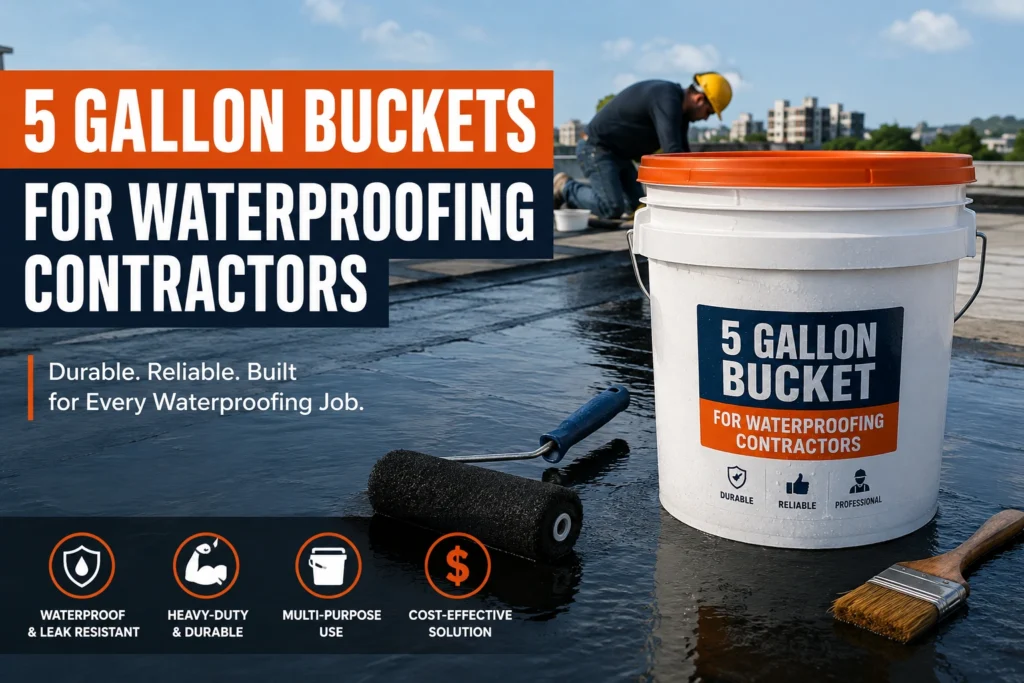
If you run a basement waterproofing crew — the kind that jackhammers concrete, digs to footings, and installs sub-floor french drain systems — you already know that 5-gallon buckets are not optional. They are a daily consumable. Mixing hydraulic cement, hauling debris, transporting drainage stone, storing sealants — your crews go through dozens per job. At $4-6 per new bucket from a big-box store, that cost compounds into thousands of dollars every quarter that most contractors never think to optimize.
There is a better way. Used food-grade 5-gallon buckets — cleaned, inspected, and delivered by the truckload — cost 40-60% less than new. And for the rough, high-volume work that waterproofing demands, they perform identically.
This guide breaks down exactly why leading waterproofing contractors across all 50 states are switching to bulk used buckets, how the economics work at scale, and how to set up a reliable supply chain that keeps your crews stocked without overpaying.
Why Waterproofing Contractors Consume So Many Buckets
Heavy excavation waterproofing is one of the most bucket-intensive trades in construction. Unlike surface-level crack repair or spray-on coatings, a proper french drain installation involves:
Concrete Removal and Debris Hauling — After jackhammering the basement floor along the perimeter, crews need containers to haul broken concrete, dirt, and debris out of the basement. Buckets are the only practical option in tight basement stairwells where wheelbarrows cannot fit.
Drainage Stone Transport — Clean washed gravel for the drain bed must be carried down in manageable loads. Five-gallon buckets of stone weigh approximately 65-70 pounds each — the maximum a worker can safely carry on stairs.
Hydraulic Cement and Mortar Mixing — Small-batch mixing of hydraulic cement for patching, channel forming, and sealing happens in 5-gallon buckets on every single job.
Waterproofing Compound Application — Products like RadonSeal, Drylok, and various crystalline waterproofing compounds ship in 5-gallon pails and are applied using additional buckets for mixing and pouring.
Sump Pit and Pump Work — Bailing water, cleaning sump pits, and testing pump discharge all require buckets on hand.
A typical french drain job on a standard residential basement (120 linear feet of interior drain) will consume 15-30 buckets in a single day. A busy crew running 4-5 jobs per week goes through 60-150 buckets weekly. That is 3,000-7,500 buckets per year for a single crew.
Multiply that across a multi-crew operation, and you understand why bucket procurement is a legitimate line item — not an afterthought.
The Real Cost Comparison: New vs. Used Buckets at Scale
Let us look at the actual numbers for a mid-size waterproofing company running three crews:
| Cost Factor | New Buckets (Big Box) | New Buckets (Wholesale) | Used Buckets (Truckload) |
|—|—|—|—|
| Price Per Bucket | $4.50 – $6.00 | $2.50 – $3.50 | $1.00 – $2.00 |
| Annual Volume (3 crews) | 12,000 | 12,000 | 12,000 |
| Annual Bucket Spend | $54,000 – $72,000 | $30,000 – $42,000 | $12,000 – $24,000 |
| Annual Savings vs. Big Box | — | $24,000 – $30,000 | $42,000 – $48,000 |
| Truckload Delivery | No (store runs) | Maybe | Yes (direct to yard) |
At the truckload level, a single full truckload of used 5-gallon buckets delivers approximately 2,000-2,400 buckets. For a three-crew operation, that is roughly two months of supply in a single delivery — no more sending guys to Home Depot on the clock.
The savings are not theoretical. Companies like Everdry Waterproofing, Sure-Dry Basement Systems, and independent french drain installers across the Midwest have figured this out: the bucket is a tool, not a showpiece. It does not need to be virgin plastic to hold 70 pounds of gravel down a flight of stairs.
What “Used” Actually Means — and Why It Works for Construction
The most common question contractors ask: “What were these buckets used for before?”
The answer: food production. The vast majority of used 5-gallon buckets come from food manufacturing plants — bakeries, sauce producers, pickle factories, dairy operations, and commercial kitchens. These buckets originally held ingredients like frosting, sauces, oils, brines, and flavorings.
After the food manufacturer empties the bucket, it has zero value to them. It becomes waste they have to pay to dispose of. That is where we come in — we pick up those buckets in bulk, clean them, sort them, and redistribute them to trades that need a durable container and do not need it to be cosmetically perfect.
For waterproofing contractors, this is ideal because:
1. HDPE Durability Is Identical — A used HDPE bucket has the same wall thickness, UV resistance, and impact strength as a new one. The polymer does not degrade from holding food products.
2. Cosmetic Imperfections Do Not Matter — Your crew is filling these with broken concrete and drainage gravel. A faded label or minor scuff has zero impact on functionality.
3. Food-Grade Origin Means Clean — These buckets started as food-safe containers. They did not hold toxic chemicals or hazardous materials. A basic rinse is all most crews need.
4. Environmental Credibility — Reusing containers instead of buying new plastic aligns with the growing green building expectations from homeowners who are already investing in sustainable home improvements like waterproofing.
How to Set Up a Truckload Bucket Supply Chain
The smartest waterproofing companies do not buy buckets one pallet at a time. They set up a recurring supply relationship that works like this:
Step 1: Estimate Your Monthly Consumption — Count how many buckets each crew uses per job, multiply by jobs per month. Most companies underestimate by 30-40% because they are not counting the buckets that get left behind, damaged, or repurposed.
Step 2: Order by the Truckload — A full truckload (2,000-2,400 buckets) is the most cost-effective unit. If your volume does not justify a full truck monthly, consider half-truck orders or coordinating with nearby contractors for combined shipments.
Step 3: Designate a Staging Area — You need a dry, covered area at your shop or yard to stack pallets of buckets. A 10×20-foot area handles a full truckload of stacked, nested buckets easily.
Step 4: Set a Reorder Trigger — When your inventory hits a two-week supply, place your next order. Transit time from our Wisconsin warehouse to most of the continental US is 3-5 business days for a full truckload.
Frequently Asked Questions
Q: Are used buckets strong enough for hauling concrete debris?
A: Yes. Used HDPE 5-gallon buckets maintain the same structural integrity as new buckets. The polymer does not weaken from food contact. Our buckets are inspected for cracks, warping, and structural damage before shipping — any bucket that does not pass inspection is recycled, not resold.
Q: Do used buckets come with lids?
A: Lids are available but sold separately. Most waterproofing contractors do not need lids for daily operations since buckets are used open for hauling and mixing. If you need sealed storage for sealants or compounds, we offer lid bundles at bulk pricing.
Q: What is the minimum order?
A: We sell by the pallet (minimum) and by the truckload (best pricing). A standard pallet holds approximately 200 nested buckets. Contact us for exact pricing based on your volume.
Q: Can you deliver to job sites directly?
A: We deliver to your shop, yard, or warehouse. Job site delivery is possible for large orders but most contractors prefer warehouse delivery for inventory management.
Q: What colors are available?
A: Used buckets come in mixed colors — primarily white, but also blue, red, yellow, green, and orange depending on the food product they originally held. If color consistency matters for your brand, we can sort by color for larger orders at a small premium.