
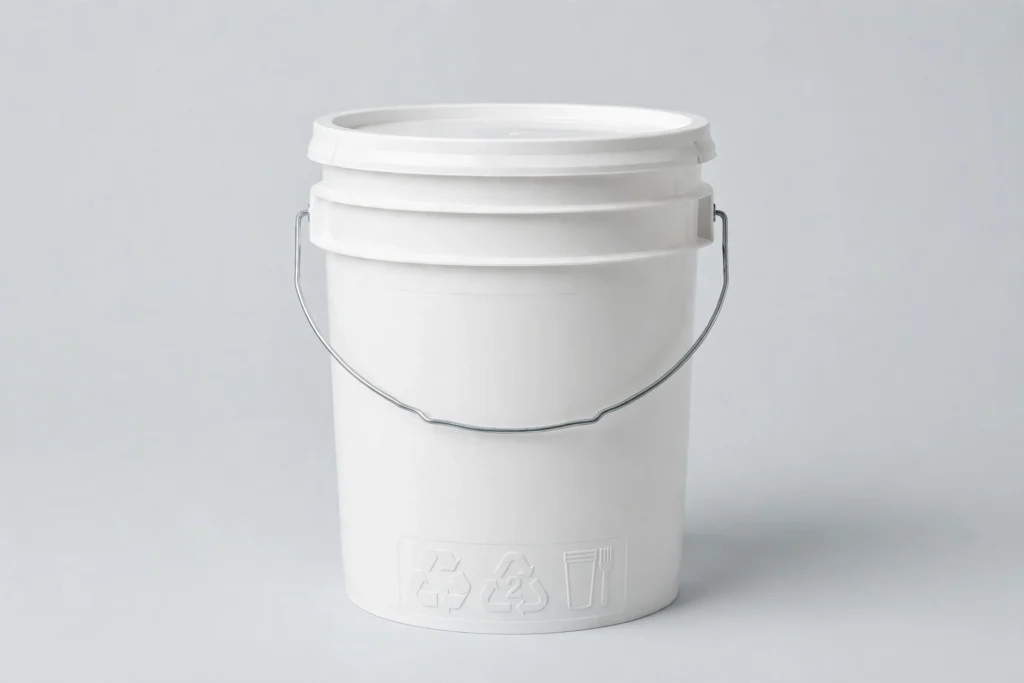
HDPE buckets food grade explained: a truly food-safe bucket is molded from virgin #2 high-density polyethylene resin formulated without BPA, made with FDA-compliant colorants and additives, produced under controlled food-contact manufacturing standards, and labeled with the cup-and-fork symbol. Buyers should verify all of these markers — the resin code alone doesn’t make a bucket food-safe.
Flip over a white 5-gallon bucket and you’ll probably find a small triangle with the number 2 inside it. Most buyers see that “HDPE” stamp and assume the bucket is food grade. Sometimes that’s right — but the stamp alone doesn’t make a bucket food-safe, and assuming it does is how restaurants, food processors, and preppers end up storing food in containers that were never meant to touch it. In this HDPE buckets food grade explained guide, you’ll learn what HDPE actually is, what truly makes a bucket food grade, how to verify one before you buy, and what commercial buyers should demand from a bulk supplier.
What HDPE Actually Is — and Why Bucket Makers Use It
HDPE stands for high-density polyethylene, one of the most widely produced plastics in the world. It’s made from petroleum-derived ethylene polymerized into long, tightly packed chains, which gives the finished plastic its signature combination of traits: high strength-to-density ratio, excellent resistance to moisture and most chemicals, and a smooth, non-porous surface that resists staining and odor absorption. That’s why it dominates food-contact packaging — milk jugs, detergent bottles, cutting boards, and food buckets are all typically HDPE. For bucket buyers, the practical properties that matter are these: HDPE stays flexible in freezers down to about -5°F, handles hot-fill applications up to roughly 160°F, and resists the cracking and denting that kills cheaper thin-wall pails. It also recycles cleanly under resin code #2, which is why food-grade HDPE buckets remain one of the most recyclable food-contact containers available.
The #2 Code: What the Resin Stamp Really Tells You
The chasing-arrows triangle with a number inside is the Resin Identification Code (RIC), and it exists to tell recyclers what plastic they’re dealing with — not to certify food safety. Here’s what the common codes mean for buckets: #2 (HDPE) is the gold standard for food-grade buckets. #5 (PP, polypropylene) is also food-safe and common in other food containers, though less common in bucket form. #1, #3, #4, #6, and #7 have no business holding your food in bucket form — avoid them for food storage. But — and this is the point most guides skip — a #2 stamp tells you the plastic family, not the bucket’s history or manufacturing. A #2 HDPE bucket that was molded with recycled content of unknown origin, made with industrial colorants, or previously filled with drywall compound is not a food-grade bucket, no matter what the stamp says. The resin code is step one of the check, not the whole check. See how to identify a food-grade bucket for the full verification routine.
Virgin Resin vs. Recycled: The Difference That Matters
Food-grade buckets are molded from virgin HDPE — brand-new resin that has never been another product. Recycled HDPE can carry traces of whatever it held in its previous life: cleaning chemicals, industrial oils, non-food additives. That’s why genuine food-grade buckets specify virgin, BPA-free resin. This is also why “used food grade” buckets are a different category: a used bucket that originally held food can be fine for gardening, workshops, or non-food storage, but food businesses should buy new for anything touching food. When a supplier’s listing just says “HDPE” without the word “virgin” or “food-grade,” ask — the omission is the answer.
FDA Compliance, BPA-Free, and the Other Markers of Food Grade
A truly food-grade bucket is defined by a stack of verifiable markers, not a single claim: FDA-compliant materials — the resin and every colorant and additive must comply with FDA food-contact requirements. (Note the wording: the FDA doesn’t “approve” buckets; compliant suppliers formulate to its food-contact rules.) BPA-free — bisphenol-A is a hardening chemical used in some plastics; food-grade buckets are formulated without it, eliminating BPA migration into contents. Cup-and-fork symbol — the internationally recognized food-safe mark, often molded into the bucket alongside the resin code. NSF listing where required — many health departments, franchises, and institutional food-service programs expect food-contact containers to carry NSF certification; check your spec before ordering. Clean manufacturing — reputable food-grade buckets are produced in facilities audited to good manufacturing practices (GMP), with smooth, clean interiors and controlled wall thickness (commercial food-grade buckets commonly run 70 to 90 mil). A supplier should be able to name its food-grade bucket standards without hesitation — if it can’t, keep shopping.
HDPE vs. PP: The Two Food-Grade Plastics Compared
Both are legitimate food-grade plastics, but they suit different jobs.
| Property | HDPE (#2) | PP (#5) |
|---|---|---|
| Typical food buckets | Yes — the standard | Less common in buckets |
| Heat tolerance | Up to ~160°F | Up to ~180°F |
| Cold tolerance | Flexible to about -5°F | Good, slightly stiffer |
| Chemical resistance | Excellent | Excellent |
| Moisture barrier | Very good | Excellent |
| Microwave safe | No | Often yes |
| Best for | Food storage buckets, brining, dry goods | Hot-fill containers, fermentation, sauces |
For most bulk bucket buyers, HDPE is the right default — it’s the material the entire 1-to-6-gallon food bucket market is built on, from 2-gallon buckets for prep stations to 5-gallon buckets for bulk dry goods.
HDPE Buckets Food Grade Explained: The 3-Step Check to Verify a Bucket
Run this HDPE buckets food grade explained checklist on every bucket before food goes in it. Step 1 — Look for the code: flip the bucket over and find the resin triangle. You want #2 (HDPE) or #5 (PP). Anything else is a no for food. Step 2 — Check for food-safe symbols: look for the cup-and-fork icon molded into the plastic, and confirm the bucket is sold and labeled as food-grade — not just “HDPE.” Step 3 — Verify the source and history: buy new from a supplier that states virgin, BPA-free, FDA-compliant resin. Never repurpose a bucket that held paint, solvents, drywall compound, or chemicals of any kind — no amount of washing makes an unknown-history bucket food-safe. If you’re buying in bulk, ask the supplier for the spec sheet: resin type, virgin vs. recycled content, wall thickness (mil), and temperature range. A real food-grade supplier answers in one email.
HDPE Buckets Food Grade Explained: Common Myths That Get Buyers in Trouble
“It’s white, so it’s food grade.” Color means nothing — white buckets hold paint too. “I washed it really well.” Washing removes residue; it can’t remove chemicals that migrated into the plastic. “All HDPE is food grade.” HDPE is a plastic family; food-grade is a manufacturing and materials standard within it. “The lid matters less than the bucket.” Lids touch food too — match food-grade lids (snap or gamma seal lids) to food-grade buckets, and retire cracked or deeply scratched containers since damaged plastic harbors bacteria.
Buying Food-Grade HDPE Buckets in Bulk: What to Ask Your Supplier
Use this HDPE buckets food grade explained checklist when you’re ordering by the pallet or skid lot, and get these answers in writing: Is the resin virgin HDPE, BPA-free, and FDA-compliant for food contact? What is the wall thickness (mil)? Thicker walls — up to 90 mil — mean better stacking strength and impact resistance for commercial use. What temperature range is it rated for? Standard food-grade HDPE covers roughly -5°F to 160°F. Are matching food-grade lids available? Order lids with the buckets — mismatched lids are the number-one bucket complaint in commercial kitchens. What sizes fit the operation? 2-gallon buckets for prep and carry work, 5-gallon buckets for bulk storage — standardize on two sizes to simplify reordering. Read our guide to 2-gallon buckets in bulk for the full sizing breakdown. Suppliers like ThoseBucketPeople sell food-grade HDPE buckets in pallet quantities with nationwide delivery — which drops the per-unit price well below retail and keeps a whole operation stocked from one order.
Frequently Asked Questions
What does HDPE stand for?
High-density polyethylene. It’s a strong, chemical-resistant plastic marked with resin code #2, and it’s the standard material for food-grade buckets.
Is every HDPE bucket food grade?
No. HDPE describes the plastic family; food-grade requires virgin resin, FDA-compliant materials, BPA-free formulation, and clean manufacturing. A #2 stamp alone is not proof — always verify the source and labeling.
What does the number 2 on the bottom of a bucket mean?
It’s the resin identification code for HDPE. It tells recyclers the plastic type; it does not by itself certify the bucket as food-safe.
Is HDPE BPA-free?
Food-grade HDPE is formulated BPA-free. But “HDPE” alone doesn’t guarantee it — confirm the bucket is sold as BPA-free and food-grade before storing food in it.
Can I put hot food in an HDPE bucket?
HDPE handles hot-fill up to about 160°F, so warm foods are fine. Don’t use HDPE buckets for boiling liquids or in dishwashers — polypropylene (#5) tolerates higher heat if that’s your use case.
How can I tell if a used bucket is safe for food?
You generally can’t verify its history, so don’t use unknown-history buckets for food. Used food-grade buckets are great for gardens, workshops, and non-food storage — buy new for anything edible.
What’s the difference between food-grade and regular buckets?
Food-grade buckets are molded from virgin, FDA-compliant, BPA-free resin in controlled conditions; regular buckets may contain recycled content or additives not cleared for food contact. The difference is in the material and manufacturing — not just the label.
Get Food-Grade HDPE Buckets in Bulk from ThoseBucketPeople
Whether you need 2-gallon buckets for prep stations or 5-gallon buckets for bulk dry goods, we supply genuine food-grade HDPE buckets — virgin resin, BPA-free, FDA-compliant — in pallet quantities with nationwide delivery. Request the HDPE buckets food grade explained spec sheet with your quote through our Get a Quote page or contact us for volume pricing.