
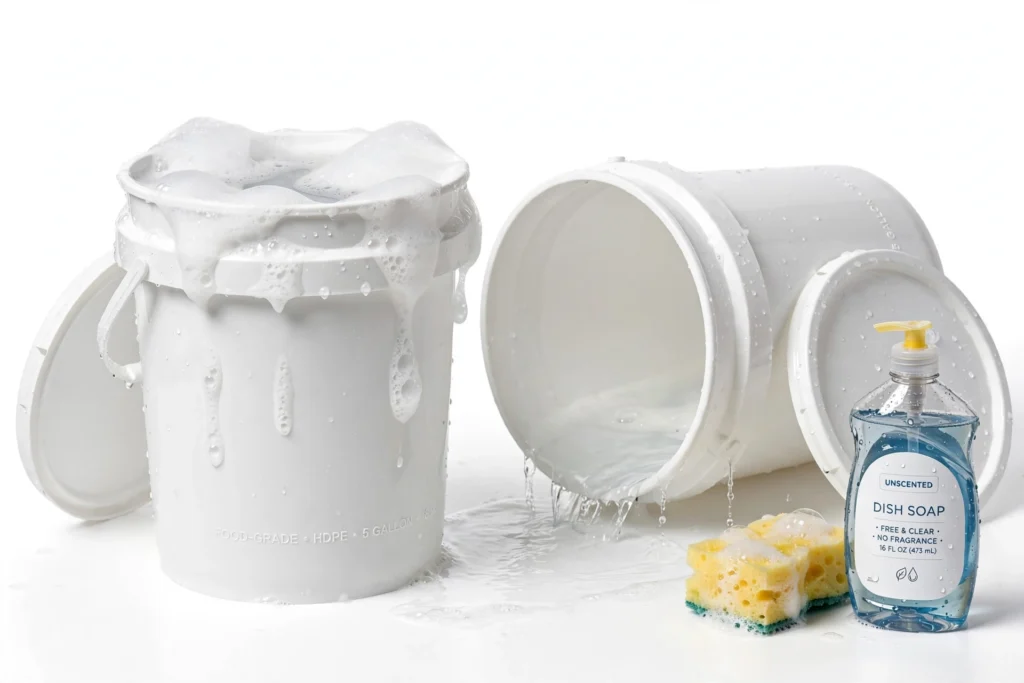
How to clean food grade buckets: follow a four-step process — pre-rinse to remove debris, wash inside and out with hot water and food-safe detergent, rinse thoroughly, then sanitize with 1 tablespoon of unscented household bleach per gallon of cool water, mixed fresh daily. Air-dry completely, lid off, before storing food. Never use scented or splashless bleach, and retire any bucket with cracks or deep scratches.
Why Cleaning Food Grade Buckets Matters More Than Buyers Expect
A brand-new food grade bucket is food-safe, but the moment it holds flour, brine, honey, or produce, it starts collecting residues, biofilm, and odors. For commercial buyers — restaurants, commissaries, food processors, beekeepers, and emergency-prep distributors — a dirty bucket is a health-inspection failure waiting to happen, and in food production it’s a contamination vector that can ruin an entire batch. Cleaning is also a cost decision: a properly washed and sanitized food grade HDPE bucket can be reused for years, while a neglected one absorbs odors and stains that never come out. And when buyers rotate stock, clean buckets hold their resale value far better than grimy ones. The good news: cleaning food grade buckets correctly is simple and cheap — the detergent and bleach for a full wash cost pennies per bucket.
Step-by-Step: How to Clean Food Grade Buckets
Step 1: Pre-rinse to remove debris
Empty the bucket completely and rinse the inside and outside with clean water to knock off loose soil, flour dust, honey residue, or produce matter. Sanitizers only work on clean surfaces — if you skip this step, you’re sanitizing the dirt, not the bucket. For stubborn residue, a stiff brush or a high-pressure rinse does the heavy lifting here.
Step 2: Wash with hot water and food-safe detergent
Fill the bucket with hot water and a food-safe dish detergent (any detergent works for the wash step on hard surfaces, per Michigan State University Extension’s harvest-container cleaning guide — antibacterial soap adds nothing, and the sanitizing step comes later). Scrub every surface — inside walls, bottom, rim, and handle mounts — with a brush or sponge. Pay attention to the lid threads and the bottom’s inner corner, where residue hides.
Step 3: Rinse thoroughly
Rinse all soap residue out with clean potable water. Leftover detergent leaves a film that both tastes bad and interferes with the sanitizer. Rinse the lid separately, including any gasket or spout parts.
Step 4: Sanitize and air-dry
Apply a sanitizing solution to all food-contact surfaces, give it the contact time the source requires (about 2 minutes for a bleach soak), then air-dry the bucket upside down with the lid off. Never towel-dry — towels reintroduce lint and bacteria. Exact solution recipes are in the table below.
Sanitizing Food Grade Buckets: Exact Bleach Solution Ratios
Sanitizing is the step most buyers get wrong. The standard sanitizer for food-contact buckets is plain, unscented household bleach (5.25% sodium hypochlorite) — no splashless, scented, or color-safe formulas, which contain additives not approved for food contact. Two authoritative recipes cover different situations:
| Use case | Recipe per gallon of cool water | Contact time | Notes |
|---|---|---|---|
| Everyday food-contact sanitizing (NDSU, reviewed June 2025) | 1 tablespoon unscented bleach | 2-minute soak, then air-dry | Make fresh daily — bleach loses potency fast in water |
| Post-disaster food-contact sanitizing (CDC) | 1 teaspoon unscented bleach | Soak or wipe, then air-dry | Lighter solution for cleaned surfaces |
| Organic operations (MSU Extension) | Hydrogen peroxide per label (≈300 ppm) | Per label | Bleach is not approved for organic production |
| Chlorine monitoring (MSU Extension) | Test strips, ≥100 ppm free chlorine | — | Required by many food-safety audits |
Always add bleach to water, never water to bleach, to reduce fumes. Never mix bleach with vinegar, ammonia, or any other cleaner — the combination produces poisonous gas. Work in a ventilated area and wear gloves. See North Dakota State University’s sanitizing guidance for the full protocol.
Should You Wash New Buckets Before First Use?
Yes — wash new food grade buckets before they touch food. New buckets carry manufacturing dust, mold-release residue, and cardboard particles from packaging, even when they arrive in plastic wrap. Run every new bucket through the same four-step clean and sanitize cycle before the first fill. While you’re at it, verify the bucket is actually food grade: flip it over and confirm resin code #2 (HDPE) or #5 (PP) and virgin-resin, BPA-free construction. If the bucket arrived without a lid, order matched lids — a bucket you can’t seal isn’t a storage container. See our gamma seal lids guide for the airtight option that pairs with standard 5-gallon buckets.
What NOT to Do When Cleaning Food Grade Buckets
A few common mistakes undo all the good work: Don’t use scented or splashless bleach — only plain unscented 5.25% sodium hypochlorite is a food-contact sanitizer. Don’t sanitize a dirty bucket — sanitizers need a clean surface; wash and rinse first, every time. Don’t mix bleach with anything — vinegar, ammonia, and acid cleaners combined with bleach release toxic gas. Don’t store buckets wet — trapped moisture grows mold and mildew, and a sealed wet bucket develops a musty odor that survives rewashing. Don’t assume one wash lasts forever — buckets in active food use should be cleaned after every use and re-sanitized before refilling after storage.
How to Clean Food Grade Buckets at Commercial Scale
Restaurants, commissaries, honey packers, and food distributors don’t clean one bucket at a time — they clean dozens. The process scales cleanly: set up a wash station with a pre-rinse hose or power washer, a hot-water detergent tank or sink, and a sanitizer bath mixed fresh at the start of the shift. Assign the ratio once and post it on the wall: 1 tablespoon unscented bleach per gallon of cool water. Keep chlorine test strips at the station and check the bath at ≥100 ppm free chlorine, the threshold food-safety auditors look for. Drying racks — buckets inverted, lids off, with airflow — prevent the mold problems of stacked wet buckets. Write the procedure down: Michigan State University Extension’s harvest-container cleaning guide includes SOP boilerplates for exactly this, and written SOPs with logged cleaning dates are what inspectors and third-party auditors ask to see. At scale, also run the math: if washing a pallet of buckets takes a crew three hours, retiring the stained and scratched ones and replacing them in bulk is often cheaper than scrubbing — order replacements by the pallet or skid lot so the per-unit cost stays low.
Clean, Sanitize, or Replace: The Bucket Triage Checklist
Not every bucket deserves to be saved. Run this checklist before a bucket goes back into food service: Clean it — the bucket is structurally sound with only normal food residue or light staining; a full wash and sanitize restores it. Deep-clean it — odor lingers but the plastic is intact; wash, then soak in the sanitizing solution a full 2 minutes and sun-dry, which breaks down many odors. Replace it — the bucket has cracks, deep scratches, crazing in the plastic, a persistent rancid smell after sanitizing, or a stain you can’t identify the source of. Damaged plastic harbors bacteria that sanitizers can’t reach, and food safety isn’t the place to save two dollars. Retired buckets don’t have to be trash — downgrade them to non-food duty: garden work, tool storage, or bait and tackle use.
Frequently Asked Questions
What is the correct bleach ratio for sanitizing food grade buckets?
For everyday food-contact sanitizing, use 1 tablespoon of plain unscented household bleach (5.25% sodium hypochlorite) per gallon of cool water, mixed fresh daily. The CDC’s post-disaster recipe uses 1 teaspoon per gallon. Always air-dry after the 2-minute contact time.
Can I use scented or splashless bleach to sanitize buckets?
No. Only plain, unscented regular bleach is a food-contact sanitizer. Scented, splashless, and color-safe bleaches contain additives that are not approved for food contact and can leave residues in your buckets.
How often should food grade buckets be cleaned?
After every use. Buckets in active food service get the full wash-rinse-sanitize cycle between fills, and any bucket coming out of storage should be re-sanitized before its first refill.
Do I need to sanitize a brand-new food grade bucket?
Yes. New buckets carry manufacturing dust, mold-release residue, and packaging debris. Wash and sanitize every new bucket before it touches food, and confirm it’s resin code #2 or #5 while you’re at it.
What’s the difference between cleaning and sanitizing a bucket?
Cleaning (soap and water) removes visible soil and residue. Sanitizing (a bleach or peroxide solution applied to the clean surface) kills the pathogens cleaning leaves behind. One without the other is only half the job.
Can I clean food grade buckets in a dishwasher?
No — buckets don’t fit, and dishwasher heat can warp HDPE. Hand-wash with hot water and food-safe detergent, sanitize with the bleach solution, and air-dry upside down.
When should a food grade bucket be retired instead of cleaned?
Retire any bucket with cracks, deep scratches, crazing, or a rancid odor that survives sanitizing — damaged plastic harbors bacteria. Downgrade retired buckets to non-food use like gardening or tool storage.
Get Food Grade Buckets in Bulk from ThoseBucketPeople
Whether you run a restaurant, commissary, honey-packing operation, or food-prep business, we supply the food-grade buckets commercial buyers actually use — 2-gallon buckets for prep and portioning, 5-gallon buckets for dry goods and bulk storage, and lids to match, in pallet quantities with nationwide delivery. Request a quote through our Get a Quote page or contact us for volume pricing. Read our guide to 2-gallon buckets in bulk for the small-size breakdown.