
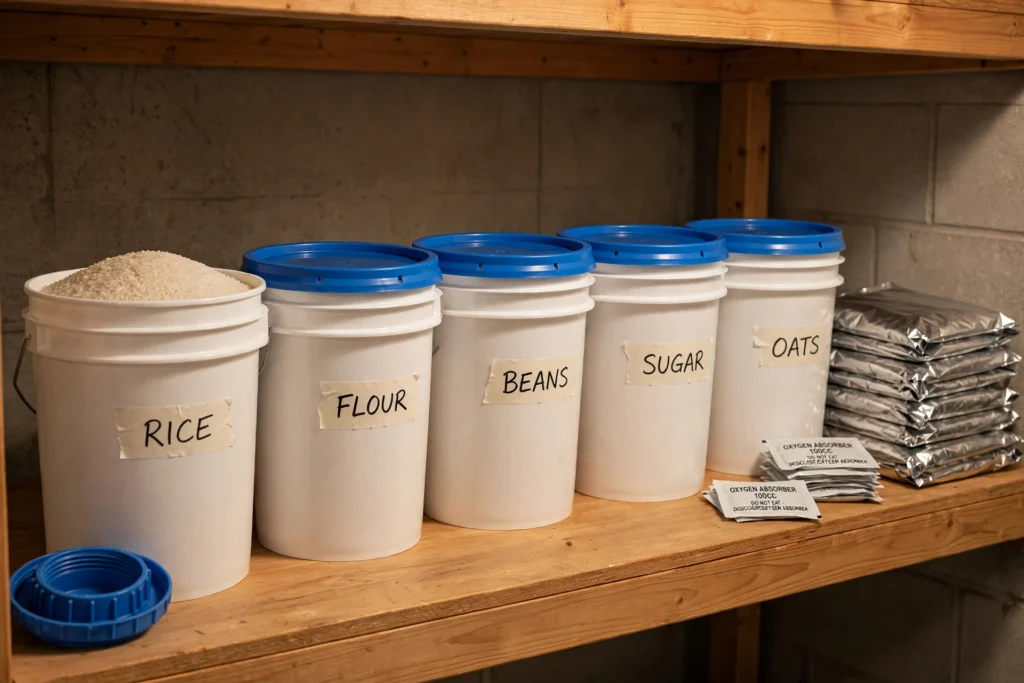
Gamma seal lids for emergency preparedness are the best way to build a pest-proof emergency food cache: store dry staples in food-grade 5-gallon buckets fitted with gamma seal lids. The screw-on lids give an airtight, double-gasketed seal that blocks moisture, insects, and rodents — and opens without tools. Paired with mylar bags and oxygen absorbers, staples like white rice and wheat stay edible for 25 years or more.
Why Standard Snap Lids Fail the Preparedness Test
A sealed 5-gallon bucket of rice is only as good as its lid, and standard snap lids are the weak link in most home food caches. They need a pail opener to remove, and every removal bends the rim a little more — after a few openings, the lid no longer seats fully, and the seal it once had is gone. That has three consequences for emergency preparedness.
First, rotation dies: if opening a bucket is a chore, nobody rotates stock, and the “first in, first out” system that keeps a cache fresh quietly collapses. Second, moisture creeps in: a lid that doesn’t seat perfectly lets humid air reach the contents, and in long-term storage, humidity is what turns rice musty and flour rancid. Third, pests get a foothold: rodents and pantry moths exploit exactly the gaps a worn snap lid leaves. Preppers who build serious caches — dozens of buckets meant to sit for years — solve all three problems with one upgrade: a screw-on lid that opens by hand, seals the same way every time, and never needs a tool. That’s what a gamma seal lid is.
How a Gamma Seal Lid Actually Works
A Gamma Seal Lid (the name is a trademark of Gamma2, a company known for pet food storage products) is a two-part lid system that converts an ordinary bucket into a resealable airtight container. Part one is an outer adapter ring that snaps permanently onto the bucket’s rim — a rubber mallet taps it on evenly around the perimeter, and it stays put. Part two is the inner lid itself, which screws into the threaded ring and twists off by hand whenever you need access.
The airtight seal comes from two gaskets: one between the adapter ring and the bucket rim, and a second O-ring around the removable screw lid — the double-gasket design is what makes the seal leak-proof and pest-resistant. The lids are molded from BPA-free, food-grade HDPE, and they fit UN-standard 3.5, 5, 6, and 7-gallon buckets with a 12-inch diameter — the standard footprint of a 5-gallon pail. See this Gamma Seal Lids features, installation, and uses guide for the full rundown, including installation tips: warm the ring in the sun if the plastic is cold and stiff, hand-tighten only (over-tightening damages the gasket), and if the threads ever feel stiff, use a food-safe silicone lube — never petroleum jelly, which degrades rubber O-rings.
Gamma Seal Lids vs. Snap Lids for Emergency Food Storage
The comparison that matters for preppers is not price per lid — it’s what the lid does to your cache over five or ten years:
| Feature | Gamma seal lid | Standard snap lid |
|---|---|---|
| Airtight seal | Yes — two gaskets, reseats identically every time | Only while new; degrades with each removal |
| Opens without tools | Yes — spin on/off by hand | No — needs a pail opener |
| Survives repeated opening | Yes — designed for constant resealing | No — rim bends and seal weakens |
| Rodent and insect resistance | High — tight double-gasket seal | Moderate — worn lids leave gaps |
| Lid colors for inventory coding | Yes — multiple colors available | Usually one color |
| Upfront cost per lid | Higher | Lower |
The rule of thumb: for buckets you will open regularly — the working pantry, the rotation shelf, anything on FIFO — gamma seal lids pay for themselves in the first year because rotation actually happens. For seal-it-and-forget-it buckets that won’t be touched for a decade, standard snap lids with mylar and oxygen absorbers inside are a defensible cheaper choice.
The Bucket Matters Too: What to Pair Gamma Seal Lids With
A gamma seal lid can only seal as well as the bucket it sits on. For emergency food storage, pair the lids with new, food-grade buckets: virgin HDPE (#2) resin, BPA-free, and FDA-compliant for food contact. Wall thickness matters for a cache that will sit stacked for years — heavy-duty 90-mil pails hold their shape under stacking far better than thin 70-mil bargain buckets, which can be seen on the 90-mil food-grade bucket and gamma seal lid combo specs (12″ wide × 15″ high, about 1.73 lbs per bucket, metal handles).
Confirm the 12-inch diameter — that is the standard gamma lids fit — and buy new buckets for anything edible; a bucket that once held paint or solvents is never a food bucket, no matter how well it is washed. Date and label every bucket on the outside (contents + pack date), because an unlabeled cache is a guessing game in five years. Read our gamma seal lids guide for the full product breakdown of lid types and sizing.
The Triple-Layer System: Mylar Bags + Oxygen Absorbers + Gamma Seal Lids
A gamma seal lid is the access layer of a food cache, not the whole preservation system. Maximum shelf life comes from three layers working together: (1) The bucket and gamma seal lid are the armor — rigid HDPE walls stop rodents and punctures, and the screw-on lid gives tool-free access with an airtight seal. (2) A 5-gallon mylar bag lines the bucket — the metallized film blocks light, moisture, and oxygen transmission far better than plastic alone. (3) Oxygen absorbers inside the sealed bag remove the oxygen mylar can’t keep out — about 2000cc of absorber capacity is the standard dose for a 5-gallon bag.
The procedure: fill the mylar bag inside the bucket, drop in the absorbers, squeeze out excess air, and heat-seal the bag shut — then screw on the gamma seal lid. The sealed mylar is what delivers the headline shelf lives (white rice and wheat hold 25–30 years stored this way, per long-standing preparedness guidance); the bucket and lid protect the bag and make the contents accessible. Two practical notes: oxygen absorbers activate on air exposure, so seal them in their own packaging immediately and work fast once opened; and for buckets you plan to open often, pack food in smaller pre-portioned mylar pouches inside the bucket, so each opening doesn’t expose the whole cache to air.
Building a Family Food Cache: How Many Buckets You Actually Need
Planning numbers preppers commonly use (approximate — densities vary): a 5-gallon bucket holds roughly 33–36 pounds of white rice, wheat berries, or dry beans; about 20–25 pounds of flour; and around 35 pounds of sugar. A widely used planning figure is roughly 300 pounds of staple grains and legumes per adult per year — which works out to about 9–10 five-gallon buckets per person for a full year. Scaled down:
| Household | ~3-month supply | ~12-month supply |
|---|---|---|
| 1 person | 3 buckets | 10 buckets |
| 2 people | 6 buckets | 20 buckets |
| 4 people | 12 buckets | 40 buckets |
A few rules make the cache actually useful instead of just impressive. Store variety, not just rice — beans, wheat, oats, sugar, and salt cover calories and nutrition better than a single staple; fats and oils stay in their original sealed containers, not buckets.
Rotate on FIFO — date every bucket and pull from the oldest first; this is where gamma seal lids earn their keep, because easy-open buckets get rotated and hard-to-open ones don’t. Store the cache cool, dry, dark, and off the floor — a basement corner or interior closet beats a hot garage, where heat halves shelf life. And build gradually: a 12-bucket cache bought all at once is a chore to fill and seal; adding two or three buckets a month gets you to the same place without the overwhelm. For the smaller carry-and-use sizes, see our guide to 2-gallon buckets in bulk.
Beyond Food: The Bug-Out Bucket
Preppers were early adopters of gamma seal lids partly because the buckets do more than hold rice. A 5-gallon bucket with a gamma seal lid is a waterproof, pest-proof, stackable module for almost anything a prepared household needs to keep ready: Water storage — the leak-proof seal keeps stored water safe from contamination; confirm your bucket is rated for liquid storage first, since some suppliers sell their bucket-and-lid combos for dry storage only. Bug-out and get-home gear — a packed 72-hour kit in a sealed bucket stays dry in a trunk or shed for years. Sanitation supplies — toilet paper, wipes, and waste bags sealed against moisture and pests.
Documents and valuables — passports, deeds, and cash in a sealed bucket survive floods that destroy filing cabinets. Tools, batteries, and first aid — one bucket per category, color-coded lids so you can tell them apart at a glance (red for first aid, blue for water, green for food). Pet food and livestock feed — the same airtight seal that keeps kibble fresh keeps bulk feed safe from rodents. Seed storage — garden seed stays viable far longer sealed dry and dark. One caution from long-term users: buckets with gamma seal lids stack, but don’t overload them — the screw lid isn’t designed to bear heavy weight, so avoid stacking full heavy buckets more than two high without a board between them to transfer the load to the bucket edges.
Buying Gamma Seal Lids for Emergency Preparedness in Bulk
When you’re buying gamma seal lids for emergency preparedness in bulk — outfitting a whole cache, or supplying a preparedness group, church cannery program, or emergency-supply business — buy lids the way you buy buckets: in quantity, as matched sets. Confirm the fit first: 12-inch diameter buckets in the 3.5 to 7-gallon range; a lid that doesn’t match your bucket stock is useless. Insist on BPA-free, food-grade HDPE lids — the lid touches your food’s air every time it seals. Check gasket condition on arrival: both the ring gasket and the screw-lid O-ring should be seated evenly with no nicks. Buy colors deliberately: color-coded lids are the cheapest inventory system you can own — one color per food type or per family member’s cache.
Order lids with the buckets: matched bucket-and-lid sets arrive ready to fill, and suppliers that sell both — like ThoseBucketPeople, which ships 5-gallon buckets and 2-gallon buckets in pallet quantities with nationwide delivery — keep your whole cache on one spec. And price the whole system, not just the lid: bucket + lid + mylar + oxygen absorbers is the real per-bucket cost of a decade-proof food cache.
Frequently Asked Questions
Answers to the most common questions about gamma seal lids for emergency preparedness.
Do gamma seal lids really make a bucket airtight?
Yes. The two-gasket design — one gasket where the adapter ring meets the bucket rim, one O-ring on the screw-on lid — creates an airtight, leak-proof, pest-resistant seal that reseats identically every time. It’s not a vacuum seal, so pair it with mylar bags and oxygen absorbers for maximum shelf life.
What size buckets do gamma seal lids fit?
UN-standard 3.5, 5, 6, and 7-gallon buckets with a 12-inch diameter — the standard 5-gallon pail footprint. Always confirm the diameter before ordering lids in bulk.
Can I store water in buckets with gamma seal lids?
The lids themselves are leak-proof, and preppers do use them on water-storage buckets — but confirm your bucket is rated for liquid storage first. Some suppliers sell their bucket-and-lid combos for dry storage only, so check the spec before filling with water.
How long will food last in a bucket with a gamma seal lid?
The lid alone protects against moisture, insects, and rodents, but the headline shelf lives — 25–30 years for white rice and wheat — come from the full triple-layer system: food-grade bucket + gamma seal lid + sealed mylar bag with oxygen absorbers, stored cool and dark.
Are gamma seal lids worth the extra cost for prepping?
For any bucket you’ll open regularly — the working pantry, rotation shelf, pet food, or bug-out gear — yes: tool-free access means rotation actually happens, and that alone justifies the premium. For buckets you plan to seal once and not touch for a decade, standard snap lids over mylar are a reasonable cheaper option.
Can mice chew through a bucket with a gamma seal lid?
Rodents struggle with rigid HDPE and a tight double-gasket seal — the lid removes the usual weak point, which is a loose or warped snap lid. No plastic is completely chew-proof, so store buckets off the floor, keep the area clean, and inspect the cache periodically.
Do I still need mylar bags if I have gamma seal lids?
For maximum shelf life, yes. Mylar plus oxygen absorbers blocks oxygen and light in a way plastic alone can’t; the bucket and gamma seal lid are the armor and the access system around that sealed core. For short-term working storage (months, not years), the bucket and lid alone are fine.
Get Gamma Seal Lid Buckets for Emergency Preparedness from ThoseBucketPeople
Whether you’re building a family food cache, stocking a preparedness group, or supplying emergency food programs, we supply the gamma seal lids for emergency preparedness and the buckets serious preppers build on — 5-gallon buckets and 2-gallon buckets in food-grade HDPE, lids to match, in pallet quantities with nationwide delivery. Request a quote through our Get a Quote page or contact us for volume pricing and delivery options.