
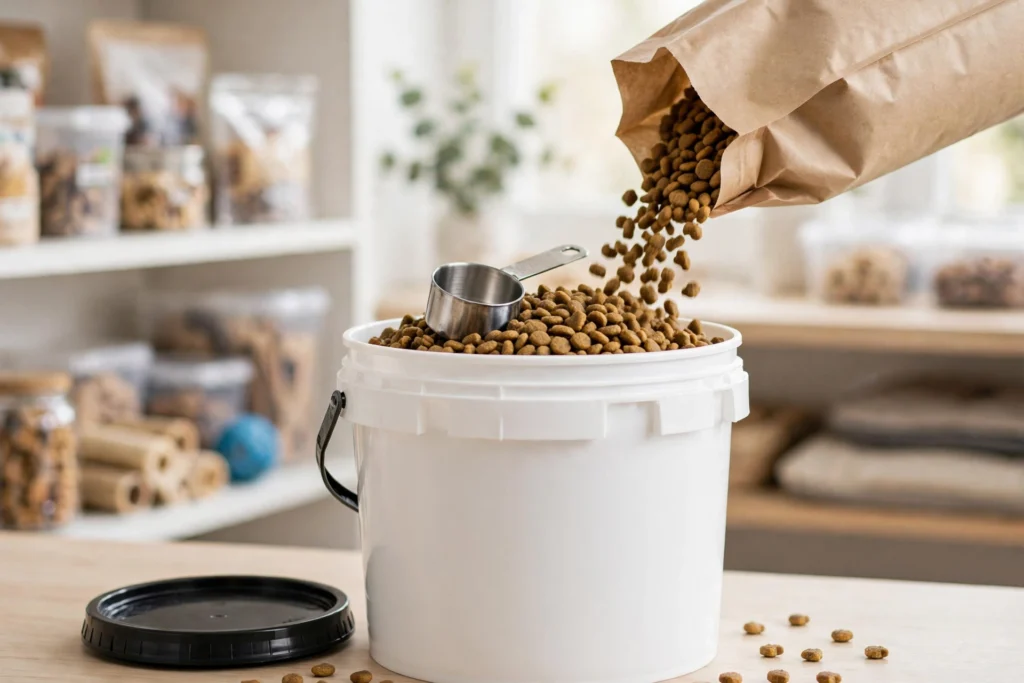
The best bucket for pet food storage is a food-grade HDPE bucket with an airtight lid — the same 5-gallon footprint used for food-grade bulk storage, sized so one bucket holds roughly 20–25 pounds of kibble. Air exposure is what kills freshness: oxygen turns the fats in kibble rancid, moisture invites mold, and open bags are an invitation to ants, roaches, and rodents. This guide covers which buckets actually keep pet food fresh, which lids seal airtight, how to size a bucket to common kibble bag weights, and how pet businesses — stores, groomers, boarding kennels, breeders, and shelters — buy buckets in bulk.
Why Kibble Needs an Airtight Bucket
Dry pet food looks shelf-stable, but it’s a fat-rich product. The kibble coating of animal fats and flavor enhancers oxidizes on contact with air, turning rancid and off-smelling within weeks of an open bag. Moisture is the second enemy: humidity softens kibble, and damp storage can grow mold that ruins a whole bag. The third enemy is pests — ants, pantry moths, weevils, and mice find open pet food fast, and once they’re in, the entire bag is lost. An airtight, food-grade bucket solves all three at once: the seal blocks oxygen and humidity, and the rigid HDPE wall is a barrier pests can’t chew through the way they can a paper or plastic bag. Keep the original kibble bag inside the bucket when you can — the bag carries the barcode, lot number, best-by date, and feeding directions you’ll need if there’s ever a recall.
What Makes a Bucket Safe for Pet Food
Pet food sits in its container for weeks, so the bucket’s material matters. Look for these markers: Food-grade HDPE (#2) or PP (#5) — virgin resin molded to FDA food-contact standards, the same grade used for human food buckets. BPA-free — commercial pet brands increasingly specify BPA-free contact materials, and it costs nothing extra at bulk quantities. Airtight lid with a gasket — the seal is the feature that keeps kibble fresh; a lid that just sits on top isn’t airtight. Smooth, cleanable interior — kibble leaves fat residue that goes rancid if it builds up, so the bucket should rinse and wipe clean easily. Opaque walls — light degrades the fats in pet food, so white or colored buckets beat clear containers. Never use a bucket that previously held paint, solvents, drywall compound, or chemicals — no amount of washing makes an unknown-history bucket pet-food safe. New food-grade buckets are the only safe default.
The Lid Is the Whole Game: Lid Types Compared
The bucket body is simple; the lid decides whether kibble stays fresh for weeks or goes stale in days. Spin-on/screw lids (Vittles Vault style) — a threaded lid that spins on and off with gaskets for an airtight seal; premium convenience, and the heavy-duty plastic plus steel handle designs are built for daily use. Retail examples run about $52 for the 10-lb size and $60 for the 20-lb size. Gamma seal lids — an adapter ring installs on a standard 5-gallon bucket and the inner lid screws on and off for an airtight seal; see our gamma seal lids guide for sizing. The bulk-buyer’s favorite: pair inexpensive food-grade 5-gallon buckets with gamma seal lids and you get Vittles-Vault-style airtightness at a fraction of the retail unit cost. Snap lids with gaskets — standard bucket lids with a rubber gasket seal well when pressed on properly, and they’re the cheapest airtight option in bulk. Downside: prying them off and reseating them several times a day is a chore, and worn gaskets must be replaced. Twist-off lids (Mighty Tuff style) — screw-off tops on 5-gallon/21-pound containers, BPA-free and food-grade, rated for indoor or outdoor use; a middle ground between retail spin-lids and bulk gamma-seal setups. Whatever the lid, the test is the same: close it, press on the center, and if it flexes with a whoosh of air, it’s not airtight.
Size-Selection Guide: Match the Bucket to the Bag
Pet food comes in standard bag weights, so buy buckets to match — too big a bucket means extra headspace of stale air; too small means you’re storing half the bag.
| Kibble bag size | Right bucket | Why |
|---|---|---|
| Up to 5 lbs | 2-gallon bucket | Holds the bag with room to scoop; the everyday pet-owner size |
| 10–15 lbs | 2-gallon or 3.5-gallon bucket | Compact footprint for cat food and small-dog bags |
| 20–25 lbs | 5-gallon bucket | The standard: one 5-gallon bucket holds roughly 20–25 lbs of kibble depending on density |
| 30–40 lbs | 5-gallon + 2-gallon pair, or 6-gallon bucket | Split large bags across two buckets so one stays sealed while the other is in daily use |
| 50 lbs+ (bulk/shelter bags) | Two 5-gallon buckets | Never overfill — a sealed, manageable bucket beats a heavy, half-closed one |
Note: kibble density varies by brand and kibble size, so these are planning numbers — size up if your brand runs dense.
Wet Food, Treats, and Bird Seed: What Changes
Not everything stores like kibble. Opened wet food (cans and pouches) belongs in the refrigerator in a covered container, used within 2–3 days — buckets are for dry goods, not refrigeration. Treats and dental chews store in small food-grade buckets or tubs the same way kibble does: airtight, cool, dark. Bird seed and small-animal feed follow the kibble rules exactly, and they’re even more pest-prone — a gasket-sealed 5-gallon bucket is the standard for feed rooms. Raw or freeze-dried food: follow the manufacturer’s storage instructions precisely; many require refrigeration after opening, and a bucket can’t substitute for cold chain.
Comparison Table: Pet Food Bucket Options at a Glance
| Bucket option | Typical capacity | Lid type | Airtight? | Best bulk buyer |
|---|---|---|---|---|
| Food-grade 5-gallon bucket + gamma seal lid | ~20–25 lb kibble | Screw-on inner lid | Yes | Pet stores, kennels, shelters, breeders |
| Food-grade 5-gallon bucket + snap lid with gasket | ~20–25 lb kibble | Press-on | Yes (with intact gasket) | Budget bulk buyers |
| Retail spin-lid container (Vittles Vault style) | 8–20 lb | Threaded spin lid | Yes | Pet stores reselling to owners |
| Twist-off 5-gallon container (Mighty Tuff style) | ~21 lb | Screw-off top | Yes | Feed rooms, barn and outdoor storage |
| Food-grade 2-gallon bucket | ~5–10 lb kibble | Snap or screw lid | Yes | Small bags, treats, single-pet households |
| Used/unknown-history bucket | — | — | — | Never for pet food |
The Bulk Buyer’s Checklist: 8 Questions Before You Order
Pet businesses burn through storage — kennels refill daily, shelters rotate donations, pet stores display inventory. Use this checklist before a bulk order: (1) Is the resin virgin, BPA-free, food-grade HDPE or PP — in writing from the supplier? (2) Does every lid include a gasket, and can you buy replacement gaskets? A bucket without a sealing lid is just a pail. (3) Which bag weights will you stock? Size the bucket order to your actual best-selling bag sizes using the table above. (4) Will staff open these buckets multiple times a day? If yes, screw-style lids (gamma seal or spin-on) beat pry-off snap lids on labor and on gasket life. (5) Do you need them to stack? Check the stack rating with weight — full 5-gallon kibble buckets are heavy, and a collapsed stack in a feed room is a safety problem. (6) Indoor or outdoor storage? Outdoor feed rooms need UV-resistant HDPE and lids that shed rain; confirm the rating. (7) What sizes do you want to standardize on? Two sizes — a 5-gallon workhorse and a 2-gallon small-bag size — cover nearly every pet business and simplify reordering. (8) Are you buying lids with the buckets? Mismatched lids are the number-one bucket complaint across every industry — order matched sets. See our guide to 2-gallon buckets in bulk for the small-size breakdown.
Keeping Kibble Fresh: The Rules That Actually Matter
The best bucket in the world can’t save kibble stored badly. These rules do the heavy lifting: Keep the original bag inside the bucket — the bag is a second barrier and it preserves the barcode, lot number, and best-by date for recalls. Store cool and dry — heat and humidity are the enemies; a climate-controlled feed room or pantry beats a hot garage. Don’t mix old and new kibble — finish one bag before opening the next, and wash the bucket between bags so rancid fat residue doesn’t taint fresh kibble. Wash buckets regularly — warm water and unscented dish soap, rinse well, and dry completely before refilling; moisture left inside grows mold. Seal the lid every time — an airtight lid left ajar is no lid at all; make it the house rule for every shift. First in, first out — date every bucket and rotate stock so nothing sits for months.
Buying Pet Food Storage Buckets in Bulk
Whether you’re a pet retailer, groomer, boarding kennel, breeder, or shelter, the math on buckets is simple: buckets crack, lids wear, gaskets dry out, and new locations and product lines keep appearing. Buying in bulk cuts the per-unit cost dramatically and keeps matched bucket-and-lid sets on the shelf. Order by the pallet or skid lot — suppliers like ThoseBucketPeople sell food-grade buckets in pallet quantities, which drops the per-unit price well below retail and stocks a whole operation (or several) from one order. Standardize on two sizes — 5-gallon buckets for the standard 20–25 lb bags and 2-gallon buckets for small bags and treats; standardization simplifies reordering and staff training. Buy the lids with the buckets — gamma seal lids for daily-access feed rooms, gasketed snap lids for sealed reserve stock. Order before peak season — holiday boarding, spring puppy season, and shelter intake surges all spike storage demand; order ahead so freight delays don’t leave the feed room short. Ask about volume pricing — if you run multiple locations or buy for a franchise group, request a quote for your actual quantities rather than paying list price.
Frequently Asked Questions
What size bucket holds a 25-pound bag of dog food?
A standard 5-gallon food-grade bucket holds roughly 20–25 pounds of kibble, depending on kibble density. If your brand runs dense, the bag may just fit — size up to a 6-gallon bucket or split across two buckets rather than forcing the lid on.
Do I need a food-grade bucket for pet food?
Yes. Kibble sits in its container for weeks, and only virgin food-grade HDPE (#2) or PP (#5) that’s BPA-free and FDA-compliant is safe for that contact. Never use a bucket with an unknown history or one that held paint or chemicals.
Should I keep the kibble bag inside the bucket?
Yes — keep the food in its original bag inside the airtight bucket. The bag adds a second freshness barrier and preserves the barcode, lot number, and best-by date, which you need if the food is ever recalled.
How long does kibble stay fresh in an airtight bucket?
With a true airtight seal, cool dry storage, and the original bag inside, kibble stays fresh through its printed best-by window — but once any bag is opened, most guidance suggests using it within about six weeks, since oxidation starts the moment air gets in. Wash the bucket between bags.
Are gamma seal lids good for pet food storage?
They’re one of the best bulk options: the screw-on inner lid gives an airtight seal that’s easy to open and close repeatedly, which is exactly what feed rooms and kennels need. Pair them with food-grade 5-gallon buckets for a commercial-grade setup.
Can I store pet food in a bucket outside?
Only with the right setup: a food-grade HDPE bucket rated for UV exposure, a gasketed airtight lid that sheds rain, and the bucket kept off bare ground in shade. Temperature swings still degrade kibble faster outdoors, so indoor storage is always better.
How often should I wash a pet food storage bucket?
Between every bag refill at minimum: warm water, unscented soap, thorough rinse, and complete drying before refilling. Fat residue from kibble turns rancid and will taint fresh food if it builds up.
Get Pet Food Storage Buckets in Bulk from ThoseBucketPeople
Whether you run a pet store, grooming salon, boarding kennel, breeding operation, or animal shelter, we supply the food-grade buckets pet businesses actually use — 5-gallon buckets for standard kibble bags, 2-gallon buckets for small bags and treats, and airtight lids to match, in pallet quantities with nationwide delivery. Request a quote through our Get a Quote page or contact us for volume pricing and delivery options.