
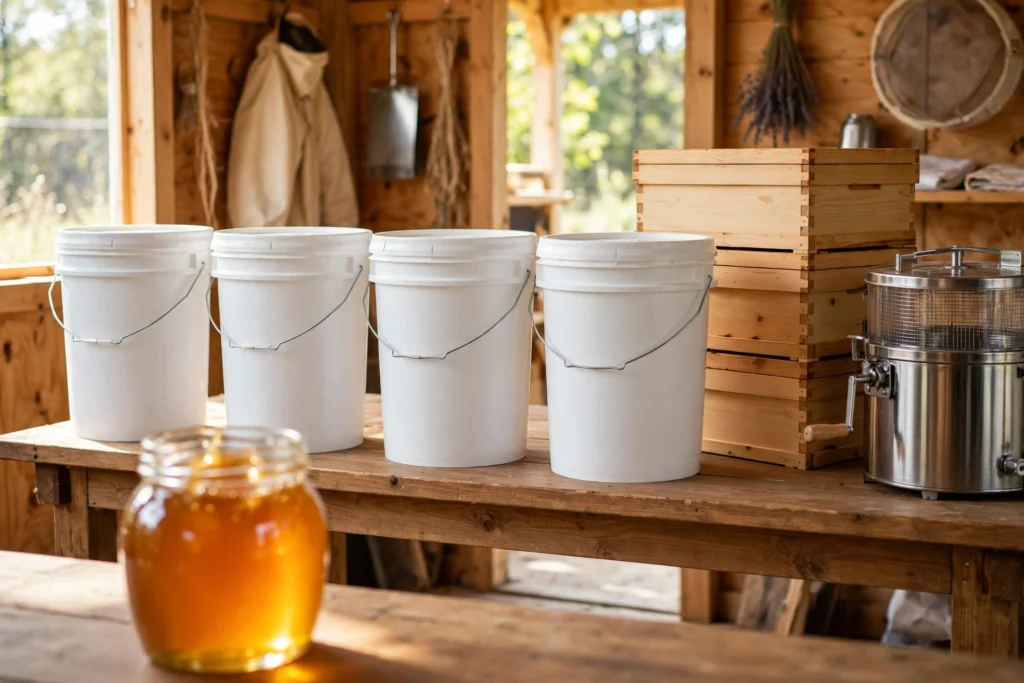
Buckets for honey storage should be food-grade HDPE 5-gallon buckets with airtight lids and honey gates — the industry standard holds about 60 pounds of honey, keeps moisture out (honey absorbs water from the air and can ferment), and pours cleanly into jars for bottling.
Beekeepers, honey packers, and farm stores buying in bulk should look for virgin #2 HDPE resin, BPA-free FDA-compliant materials, tight-sealing lids, and sturdy handles — a full 5-gallon bucket of honey weighs roughly 60 pounds, about as much as a grown person can comfortably lift.
Why Honey Storage Is Picky About Buckets
Honey is hygroscopic: it pulls moisture out of the air, and added water creates favorable conditions for mold and yeast growth — which is how stored honey ferments. Ripe, capped honey sits at roughly 17–18% moisture, and the job of the bucket is to keep it there. That means the lid matters as much as the bucket: a snap or gamma-seal lid that seals airtight is what separates a honey bucket from a paint pail.
The bucket also has to be genuinely food-grade, because honey’s acidity and long storage life will pull contaminants out of substandard plastic. New food-grade buckets are the rule — USDA loan standards for honey storage require 5-gallon containers to be new or previously used only for honey, never for chemicals or pesticides, and to meet Federal Food, Drug and Cosmetic Act requirements. See the USDA honey storage container standards for the full rulebook.
What Makes Buckets for Honey Storage Safe
Before honey goes in, verify these markers: virgin HDPE (#2) or PP (#5) resin — the two plastics cleared for food contact; virgin matters because recycled content can carry traces of prior chemicals. BPA-free and FDA-compliant — the resin, colorants, and additives must comply with FDA food-contact requirements. Airtight lid — snap lids with gaskets seal well for bulk storage; gamma seal lids give a screw-on airtight seal that’s easier to reopen repeatedly during bottling season. Sturdy handle — a full 5-gallon honey bucket weighs roughly 60 pounds; the handle must be firm and strong enough to carry it, a point the USDA standards call out explicitly.
No unknown history — a bucket that held drywall compound, paint, or industrial chemicals is never a honey bucket, no matter how well you wash it. White or light colors are standard for honey buckets; they make honey level visible and keep contents cooler in sunlight. Read our HDPE food-grade guide for the full verification routine.
Honey Weight by Bucket Size: The Table Every Beekeeper Needs
Honey weighs about 12 pounds per gallon (the basis USDA uses when estimating honey quantity), so buckets fill up with weight fast — long before they fill up with volume. This is the original spec beekeepers should plan around:
| Bucket size | Honey held (approx.) | Weight full | Best honey use |
|---|---|---|---|
| 2-gallon | ~2 gal | ~24 lb | Small harvests, farmers-market bottling days |
| 5-gallon | ~5 gal | ~58–60 lb | The industry standard — extraction, bulk storage, wholesale |
| 6-gallon | ~6 gal | ~70–72 lb | High-volume extraction days, fewer bucket changes |
Two practical consequences: never fill a 5-gallon bucket to the absolute brim if staff will carry it (leave headroom and lift with two people), and never stack full 5-gallon honey buckets more than a couple high without checking the stack rating — 60 pounds per bucket adds up fast.
The Honey Gate: The One Feature That Makes Bottling Easy
A honey gate is a small threaded valve that screws into a pre-drilled hole near the bottom of the bucket. Open it and honey flows straight into jars — no scooping, no ladles, no drips down the bucket side. Buckets for honey storage ordered with a pre-drilled honey-gate hole accept a standard gate with firm hand pressure, and the gate’s O-ring keeps it leak-free. For anyone bottling retail jars from a 5-gallon bucket, a honey gate pays for itself on the first bottling day; for pure bulk storage (buckets that will sit in a warehouse until sold wholesale), it’s optional.
Straining, Settling, and Filling: From Extractor to Bucket
Place a strainer (coarse then fine — fine mesh around 600 micron is standard) over the bucket and run extracted honey through it to catch wax bits and bee parts; fine strainers still let pollen and enzymes through. Fill buckets from the extractor or settling tank, then let the honey settle 24–48 hours so air bubbles and fine wax rise to the top, where they can be skimmed. Seal the lid while the honey is still fresh and warm from extraction — warm honey is less viscous, so trapped air escapes more easily.
Label every bucket with the harvest date, floral source, and net weight before it leaves the extracting room; if you ever pledge honey as loan collateral, USDA rules require containers to be marked with the producer’s name, loan number, and lot number.
Lids for Honey Buckets: Match the Lid to the Job
Bulk storage buckets that will sit sealed for months: snap lids with a gasket, or tamper-evident lids if the honey will be sold retail — the tamper-evident seal proves the bucket hasn’t been opened in transit. Active bottling buckets: gamma seal lids — the screw-on/screw-off access keeps the seal airtight between bottling sessions without wrestling a snap lid 60 times a season. Whatever the lid, the USDA standard is the same: the cover opening must not be damaged in any way that prevents a tight seal, and punctured-and-resealed containers are not acceptable. Order lids with the buckets — mismatched lids are the number-one bucket complaint across every industry.
Buckets for Honey Storage: Comparison Table at a Glance
| Bucket option | Typical capacity | Lid pairing | Best for |
|---|---|---|---|
| Food-grade HDPE 5-gallon with honey gate | 5 gal (~60 lb honey) | Snap or gamma seal | Beekeepers who bottle from the bucket |
| Food-grade HDPE 5-gallon, plain | 5 gal (~60 lb honey) | Snap with gasket | Bulk storage, wholesale sale in buckets |
| Food-grade 2-gallon bucket | 2 gal (~24 lb honey) | Snap lid | Small apiaries, hobby beekeepers, retail displays |
| Food-grade 6-gallon bucket | 6 gal (~72 lb honey) | Snap lid | High-volume extraction, fewer changeouts |
| Tamper-evident retail pails (1–2.5 gal) | 1–2.5 gal | Tamper-evident | Farm stores selling honey by the pail |
Storing Honey in Buckets: The Rules That Keep It Pristine
Keep buckets sealed and dry — honey’s enemy is moisture, and a sealed bucket in a dry room is the entire preservation strategy; university extension guidance says to store honey in a clean airtight container because it draws moisture from the air. Keep buckets off the floor and out of damp basements; a pallet in a climate-controlled room is ideal.
Avoid the 52–59°F zone for long-term storage — that’s where crystallization runs fastest, so room temperature (not the refrigerator, not a cold garage) is the sweet spot. See these honey storage facts for the underlying science. Protect from strong odors and sunlight — honey absorbs aromas and light darkens color over time. Never heat a sealed bucket to re-liquefy crystallized honey — warming a full bucket unevenly can damage flavor; instead, dispense what you need and warm it gently in an open container (crystals dissolve in hot, not boiling, water; crystallization is natural and harmless).
For wholesale operations: USDA rules say loan-eligible honey must be in approved storage that affords safe storage — a clean, pest-controlled building, not a leaky shed.
Buying Buckets for Honey Storage in Bulk: What to Ask Your Supplier
Beekeepers and packers order buckets for honey storage by the pallet or skid lot, and the spec questions are different from retail: Is the resin virgin, BPA-free HDPE (#2), FDA-compliant for food contact? Get it in writing — honey sits in these buckets for months or years. What is the wall thickness (mil)? Commercial food-grade buckets commonly run 70–90 mil; thicker walls stack better under 60-pound loads. Are honey-gate-drilled buckets available? Ask for pre-drilled buckets matched to standard gates.
Are matching lids (snap, gamma seal, or tamper-evident) available in the same order? Standardize on one size — most honey operations standardize on the 5-gallon bucket and use 2-gallon buckets for retail pails; two sizes simplify reordering and staff training. Order before extraction season — honey harvest concentrates in late summer and fall; order buckets in spring so freight delays don’t leave the extracting room short. Ask about volume pricing — pallet quantities drop the per-unit price well below retail. Suppliers like ThoseBucketPeople sell food-grade buckets in pallet quantities with nationwide delivery.
Frequently Asked Questions
How much honey does a 5-gallon bucket hold?
About 58–60 pounds. Honey weighs roughly 12 pounds per gallon (the figure USDA uses to estimate honey quantity), so a full 5-gallon bucket is one of the heaviest containers in a honey operation — plan for two-person lifts.
Can I store honey in any plastic bucket?
No. Buckets for honey storage must be food-grade: virgin HDPE (#2) or PP (#5), BPA-free, with FDA-compliant materials and an airtight lid. Never use a bucket with an unknown history or one that held paint, solvents, or chemicals — washing can’t undo chemical migration into plastic.
How do I keep honey from fermenting in storage buckets?
Keep moisture out: seal buckets airtight, store them dry and off the floor, and only store ripe, fully capped honey (~17–18% moisture). Honey is hygroscopic, so an unsealed or damp-stored bucket can absorb enough water to ferment.
What is a honey gate, and do I need one?
A honey gate is a threaded valve that screws into a pre-drilled hole near the bucket’s base, letting honey flow straight into jars. If you bottle retail jars from buckets, it’s essential; for sealed wholesale storage, it’s optional.
Will honey crystallize in the bucket?
Eventually, yes — it’s a natural, harmless process, fastest around 50–59°F. Store buckets at room temperature, and if you need liquid honey, warm only what you’ll use in hot (not boiling) water rather than heating a sealed full bucket.
How long can honey be stored in a bucket?
Indefinitely, if your buckets for honey storage are food-grade, sealed airtight, and stored cool and dry. Honey’s color and flavor may darken slowly over years, but properly stored honey doesn’t spoil.
Can I reuse buckets for honey?
Only if the bucket previously held honey and nothing else. USDA honey-loan rules require 5-gallon containers to be new or previously used solely for honey; any bucket that held chemicals or pesticides is permanently disqualified from honey storage.
Get Buckets for Honey Storage in Bulk from ThoseBucketPeople
Whether you run a few backyard hives or a commercial packing operation, we supply the food-grade buckets honey businesses actually use — 5-gallon buckets for extraction and bulk storage, 2-gallon buckets for retail and bottling days, and lids to match, in pallet quantities with nationwide delivery. Request a quote through our Get a Quote page or contact us for volume pricing and delivery options.