
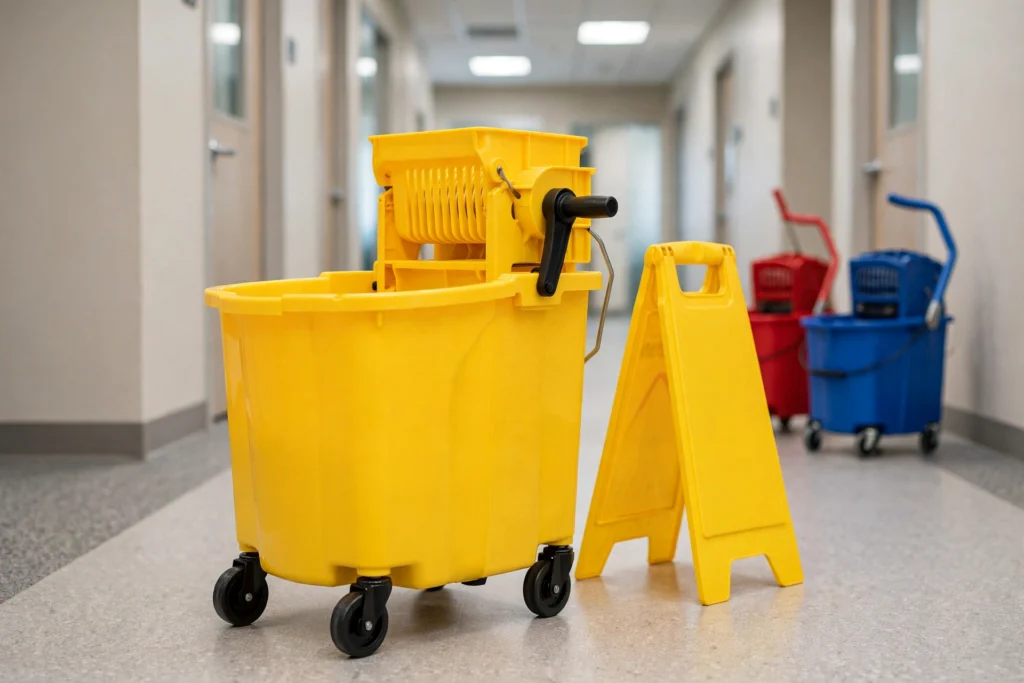
The best way to buy janitorial buckets in bulk is to standardize on a 35-quart mop bucket and wringer combo on casters — the commercial industry standard — in color-coded sets for each facility zone, ordered by the case or pallet lot. Buying in volume cuts per-unit cost, keeps spare parts on the shelf, and guarantees every location uses identical equipment that supports your cross-contamination system.
The Three Janitorial Buckets Every Facility Needs
Mop bucket and wringer combos
The workhorse: a 35-quart bucket with a mounted wringer on four casters, used for daily wet-mopping of corridors, lobbies, restrooms, and kitchens. The wringer controls mop wetness so floors dry faster and slip risk drops — which is why buying the bucket without the wringer is a false economy.
General-purpose utility pails
Plain 5-gallon buckets carry cleaning concentrates to the mop bucket, soak mop heads and cloths, haul spill-absorbent granules, and stage supplies on the janitor cart. See our guide to 2-gallon buckets in bulk for the small-size breakdown.
Color-coded zone buckets
Dedicated buckets assigned by zone or risk area under a color-coding system. These are the same mop bucket and pail shapes — the color is what separates them, and the system is what stops a restroom mop from ever touching a kitchen floor.
Mop Bucket and Wringer Combos: The Commercial Standard — If you buy one thing in bulk, make it this: a 35-quart (8.75-gallon) mop bucket and wringer combo on four swivel casters. The 35-quart size is the industry sweet spot — big enough to cover serious floor area between refills, small enough to move and empty. What separates a commercial combo from a retail bucket: non-marking casters that roll a full bucket room to room instead of carrying it; structural web-molded plastic that holds its shape under daily abuse; graduated measurement marks in 5-quart increments so crews mix cleaning solution to the correct dilution every time; a pour spout and sink ledge for controlled emptying; and a foot-pedal or handle release so nobody lifts a full bucket over a sink — because a full 35-quart bucket of water weighs roughly 73 pounds. The category leader is Rubbermaid’s WaveBrake line: the original combos were tested past 40,000–50,000 wringing cycles, and the newer WaveBrake 2.0 adds molded-in baffles that reduce splashing up to 80% compared with competitors, with wringers rated for 5 years or 200,000 cycles. See the WaveBrake 2.0 mop bucket and wringer specs for the full numbers. In 2026, a 35-quart commercial combo runs roughly $150–$220 from janitorial suppliers — and the per-unit price drops when you order in case or pallet quantities.
Side-Press vs. Down-Press Wringers: Which to Buy — Side-press wringers hold the mop beside the wringer and press water out with a side lever — the most common style in offices, schools, and retail, and operators find the side motion quick and intuitive. Down-press wringers seat the mop inside the housing and push down with a press arm; trade listings rate them roughly 30% more efficient at wringing than side-press, with capacity for larger 32-oz mop heads. The buying rule: match the wringer to the mop heads your crews already stock. If your operation runs standard 16–24 oz string mops, either wringer works; if you run heavy 32-oz mops, spec down-press. Buy one wringer type across the whole fleet so spare parts and training stay simple.
Color Coding: The System That Stops Cross-Contamination — A mop or bucket that cleaned a restroom floor should never touch a kitchen. Color coding makes that separation automatic — and it works even for crews who don’t read English, because the system is visual. The common industry pattern, documented in trade color-coding guidelines: red for restroom floors, toilets, and urinals; yellow for restroom sinks and mirrors; green for food-service settings; blue for general, low-risk areas. But be aware: there is no true universal standard — some hospitals use yellow for clinical areas, and individual contractors run their own systems. The right answer is the one your whole organization follows consistently. For bulk buyers, this means ordering buckets in color-coded sets: assign one color per zone, buy matching mops and cloths in the same colors, post the chart in every janitor closet, and train every shift. Order spares in every color — a red restroom bucket replaced with a random yellow one breaks the system. See the color-coding guidelines for cleaning tools for the full framework.
Dual-Compartment Buckets: Clean Water and Dirty Water Stay Separate — One upgrade worth pricing: dual-compartment mop buckets split the tank into two chambers (for example, two 15-liter sides), so the mop wrings dirty water into one chamber while drawing clean solution from the other. Some systems claim crews can mop up to 13 times more floor area before changing water compared with a single-tank bucket — a serious productivity win in schools, hospitals, and warehouses where mop-water quality is a compliance issue. For the fleet order, price dual-compartment units for the large-area crews and standard 35-qt combos for everyone else.
Comparison Table: Janitorial Bucket Options at a Glance
| Bucket option | Typical size | Key features | Best bulk buyer |
|---|---|---|---|
| 35-qt mop bucket + side-press wringer combo | 35 qt (8.75 gal) | Casters, 5-qt measurement marks, pour spout | Offices, schools, retail — the standard facility buy |
| 35-qt mop bucket + down-press wringer combo | 35 qt (8.75 gal) | ~30% more efficient wringing, handles up to 32-oz mops | Warehouses, hospitals with heavy mops |
| WaveBrake 2.0-style combo | 35 qt (8.75 gal) | Anti-splash baffles, wringers rated 5 yrs / 200k cycles | High-traffic facilities, contract cleaners |
| Dual-compartment mop bucket | 2×15 L | Clean/dirty water separation, integrated press wringer | Large-area crews, healthcare, schools |
| 5-gallon utility pail | 5 gal | Plain HDPE, pairs with snap or gamma seal lids | Every janitor closet — mixing, soaking, spills |
| 2-gallon cleaning pail | 2 gal | Light when full, fits on janitor carts | Restroom detail kits, small-area cleaning |
The Bulk Buyer’s Checklist: 8 Questions Before You Order — Janitorial buckets are a consumable line item for every facility — they crack, wringers wear, and casters seize. Use this checklist before a bulk order: (1) Standardize on one mop bucket and one wringer type chain-wide — identical equipment means identical training, identical spare parts, and volume pricing. (2) Order in color-coded sets per zone — red, yellow, green, blue — and buy spare buckets in every color, not just your most-used one. (3) Match the wringer to your mop heads: side-press for standard 16–24 oz mops, down-press if you run 32-oz mops. (4) Demand replacement parts: wringer springs, caster wheels, and handle assemblies — a $15 part that keeps a $200 combo in service is the cheapest line item on the order. (5) Spec the utility pails too: 5-gallon buckets for mixing and soaking, 2-gallon buckets for cart kits — and order matched lids (snap or gamma seal lids for concentrates stored on the shelf). (6) Check the casters: non-marking swivel casters protect finished floors, and buckets should nest even with casters attached to save closet space. (7) Order caution signage with the buckets: wet-floor signs are part of the same purchase — mopping without them is a slip claim waiting to happen. (8) Ask about volume pricing and lead times: case and pallet quantities drop the per-unit cost well below retail. Suppliers like ThoseBucketPeople sell buckets in pallet quantities with nationwide delivery.
Keeping Janitorial Buckets Serviceable — The best mop bucket combo dies early when crews mistreat it. These rules keep the fleet in service: rinse the wringer mechanism and bucket at the end of every shift — dried cleaning solution gums up wringers and breeds odor. Never leave dirty mop water sitting overnight — it becomes a bacteria and odor problem, and biofilm shortens the equipment’s life. Replace worn casters before they score finished floors. Check wringer springs and handles monthly — a worn wringer leaves floors too wet, which is a slip hazard. And retire cracked buckets: cracked plastic harbors bacteria and leaks solution onto floors you’re trying to keep clean.
Frequently Asked Questions
What size mop bucket is standard for commercial janitorial work?
The 35-quart (8.75-gallon) bucket and wringer combo on casters is the industry standard. It covers meaningful floor area between refills while staying maneuverable — a full one weighs roughly 73 pounds, which is exactly why commercial combos include pour spouts and no-lift emptying.
Should I buy mop buckets and wringers separately or as combos?
As combos for standardized facilities: the bucket and wringer are engineered to fit, and buying them as a matched unit in bulk keeps training, spare parts, and replacement cycles simple. Buy separate wringers only to replace worn ones on existing buckets.
What is the difference between side-press and down-press wringers?
A side-press wringer presses the mop from the side and is the most common facility style; a down-press wringer pushes down on the mop inside the housing and trade listings rate it roughly 30% more efficient, with capacity for larger 32-oz mop heads. Match the wringer to the mop heads your crews already use.
How does the color-coding system for janitorial buckets work?
Common practice assigns red to restroom floors and toilets, yellow to restroom sinks and mirrors, green to food-service areas, and blue to general low-risk areas — but there is no universal standard, so document your own system, post it in every janitor closet, and train every shift to follow it.
How many janitorial buckets does a facility need?
Map buckets to zones, not guesses: one mop bucket combo per major floor zone or wing, plus a color-coded utility pail set for each restroom and food area, with spares so a cracked bucket or worn wringer never takes a zone offline. Multi-site operators should standardize the count per location and order the whole fleet at once for volume pricing.
How long do commercial mop buckets last?
The original WaveBrake line was tested past 40,000–50,000 wringing cycles and the 2.0 generation’s wringers are rated for 5 years or 200,000 cycles — in practice, years of daily service, with wringer springs and casters as the wear parts you will replace first.
Can janitorial utility pails be used for other cleaning tasks?
Yes — plain 5-gallon utility pails double as soak buckets for mop heads and cloths, carriers for cleaning concentrates, and spill-kit containers. But keep the color-coding rule: a red restroom-zone pail never does double duty in the kitchen, no matter how well it is rinsed.