
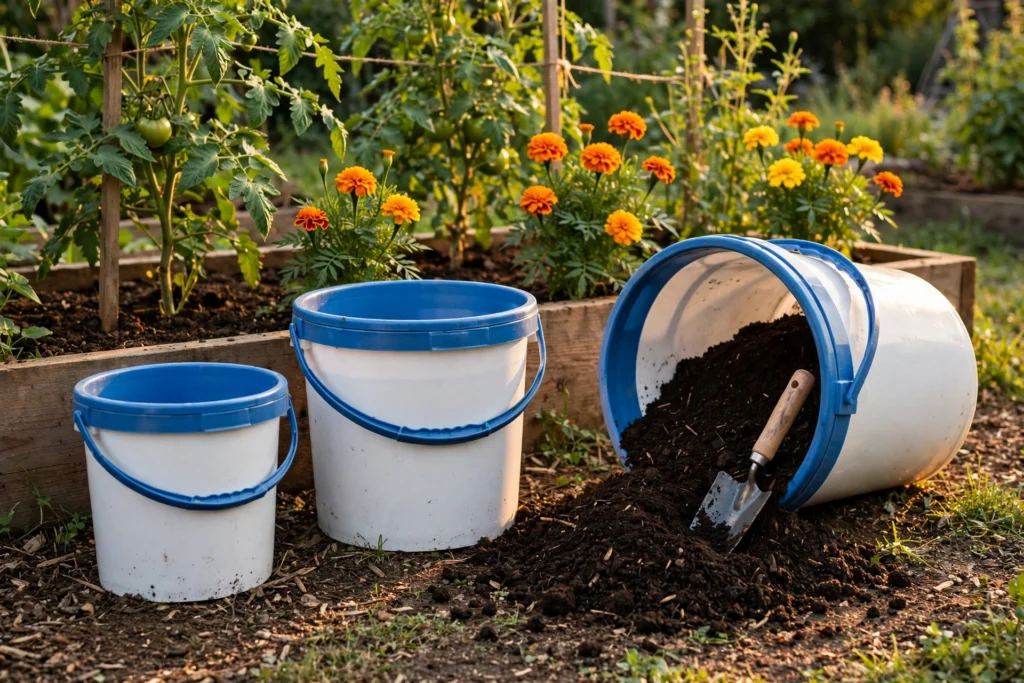
A bucket is the most versatile tool in any garden. It hauls soil, mixes amendments, collects weeds, carries harvest, waters seedlings, and stores finished compost — and it does it all for a few dollars per unit. For serious gardeners, landscapers, nurseries, and garden centers buying in bulk, the right bucket saves backs,
protects soil health, and lasts season after season. This 2026 guide to the best buckets gardening composting covers which bucket sizes and materials work best, which lids and features matter, and how to buy in bulk without paying retail markup.
How Gardeners Actually Use Buckets
Walk through a growing season and buckets show up at every stage. Planting: carrying transplants, mixing potting soil, hauling compost to amend beds — the 5-gallon bucket is the workhorse here, holding roughly 5 gallons (about 0.7 cubic feet) of soil or amendment per trip. Watering and feeding: 2-gallon buckets are easier to carry full across a garden; a full 5-gallon bucket of water weighs over 40 pounds, so the smaller size is the safer carry for daily watering and liquid feeding.
Harvest: 2-gallon buckets fit between crop rows and are light when full of tomatoes or greens. The best buckets gardening composting handle this daily rotation without cracking. Cleanup and composting: 5-gallon buckets collect kitchen scraps for the compost pile — Eco-Cycle’s compost director notes a simple 5-gallon bucket for compost collection is one of the best odor-controlling scrap collectors you can use at home. And in the nursery or garden center, buckets stage inventory, mix soil blends, and serve customers at the bulk bin.
What Makes a Bucket Garden-Worthy
Gardening is rough on buckets: UV sun, freezing winters, sharp compost, heavy soil. Cheap thin-wall pails crack within a season. The best buckets gardening composting use HDPE construction — high-density polyethylene (resin code #2) resists UV, chemicals, and cracking far better than thin generic plastic. Look for food-grade rating when soil contacts edibles — virgin HDPE or PP (#5) with FDA-compliant, BPA-free material keeps contaminants out of your food chain. Avoid unknown used buckets that held paint or chemicals; for growing media, new food-grade buckets are the safe default. Sturdy handles and thick walls survive dragging, dropping, and stacking.
Choosing the Right Size for Garden Jobs
Match the bucket to the job, not the other way around. 2-gallon buckets suit daily garden carry: watering, liquid fertilizer, harvest baskets, seedling transplanting — light when full and easy to maneuver between rows. Read our guide to 2-gallon buckets in bulk for the full breakdown. 3.5-gallon buckets hit the middle: mixing small batches of potting mix or carrying a day’s harvest. 5-gallon buckets are the garden standard for soil, compost, mulch, and scrap collection. 6- and 7-gallon buckets suit nurseries mixing larger batches. As a rule: if you carry it, keep it at 2–3.5 gallons; if you wheelbarrow-fill it, go 5 gallons.
Buckets for Composting: Collection, Curing, and Storage
Buckets serve composting at three stages. (1) Scrap collection: a 5-gallon bucket with a snap lid sits by the kitchen door, collecting vegetable scraps and coffee grounds odor-free. (2) Curing aid: for small-scale composters, a 5-gallon bucket cures small batches or holds finished compost before spreading. (3) Finished compost storage: lidded buckets keep compost dry and pest-free; pairing 5-gallon buckets with gamma seal lids creates an airtight bin for compost and amendments. Note: true hot composting needs a 3×3×3-foot pile (about 200 gallons) — far beyond any bucket. Buckets are the collection and storage layer around the pile. See this compost bin sizing guide for details.
Lids and Features That Matter Outdoors
Snap lids keep rain out of stored compost and amendments and keep pests away from scrap buckets. Gamma seal lids screw on and off for an airtight seal — ideal for storing finished compost, seed, and amendments that get opened repeatedly; they keep moisture out and stay easy to open with one hand. Drilled drainage: buckets used as planters or self-watering containers need drainage holes — food-grade 5-gallon buckets are the classic DIY planter, but drill before planting. Color: white buckets reflect heat and keep roots and compost cooler in sun; dark buckets absorb heat, which can help warm-season starts but cooks roots in summer.
Comparison Table: Bucket Sizes for Garden & Compost Use
| Bucket | Best garden use | Lid pairing | Why buyers choose it |
|---|---|---|---|
| 2-gallon bucket | Watering, feeding, harvest | Snap lid | Light when full, fits between rows. |
| 3.5-gallon bucket | Potting mix, mid-size harvests | Snap lid | Middle ground without the 5-gallon weight. |
| 5-gallon bucket | Soil, compost, mulch, scrap collection | Snap lid or gamma seal | The garden standard; one bucket ≈ 0.7 cu ft. |
| 6–7 gallon bucket | Nursery mixing, staging material | Snap lid | Bigger batches for commercial growers. |
Buying the Best Buckets Gardening Composting in Bulk
Garden centers, landscapers, and nurseries go through buckets constantly — they crack, get left at job sites, and walk off with deliveries. Buying the best buckets gardening composting in bulk cuts the per-unit cost dramatically. Order by the pallet or skid lot — suppliers like ThoseBucketPeople sell in pallet quantities, which drops the per-unit price well below retail and stocks a whole season from one order. Standardize on two sizes — one 2-gallon for carry work and one 5-gallon for hauling covers nearly every garden job; standardization simplifies reordering and staff training. Buy lids with the buckets — mismatched lids are the number-one bucket complaint; ordering matched sets avoids it.
Frequently Asked Questions
Are plastic buckets safe for vegetable gardening?
Yes, when they’re food-grade: virgin HDPE (#2) or polypropylene (#5) that is FDA-compliant for food contact and BPA-free. Never use a bucket for growing media or compost if you don’t know what it held before.
What size bucket is best for composting kitchen scraps?
A 5-gallon bucket with a tight snap lid is the standard home scrap collector: big enough to hold a week of scraps for a household, small enough to carry to the pile, and the lid controls odors.
Can I compost directly in a 5-gallon bucket?
Small-batch cold composting in a bucket works for a hobby scale, but buckets can’t reach the 3×3×3-foot mass needed for true hot composting (140–160°F), so expect slow results. Most gardeners use buckets for scrap collection and finished-compost storage, not as the composter itself.
How do I keep stored compost from getting soggy?
Use a lid, store buckets under cover or in a shed, and keep finished compost in lidded or gamma-seal buckets off bare ground. Moisture is fine during active composting but finished compost should stay damp, not waterlogged.
Do buckets work as planters?
Yes — food-grade 5-gallon buckets are one of the most popular DIY planters. Drill drainage holes in the bottom, use white buckets to keep roots cool, and remember container soil dries faster than beds.
How long do HDPE garden buckets last outdoors?
Quality HDPE buckets typically last many seasons outdoors; UV eventually degrades any plastic, so storing buckets out of direct sun when not in use extends their life. Thin bargain pails may crack within a single season.
Should garden centers sell food-grade or standard buckets?
Food-grade: it covers every use case a customer might have — soil, compost, amendments, even drinking water for livestock — while non-food-grade buckets limit safe uses. The price difference at bulk quantities is small relative to the versatility.
Get the Best Buckets Gardening Composting in Bulk from ThoseBucketPeople
Whether you run a garden center, landscaping crew, nursery, or community garden, we supply the best buckets gardening composting in bulk — 2-gallon buckets, 5-gallon buckets, and lids to match, in pallet quantities with nationwide delivery. Request a quote through our Get a Quote page or contact us for volume pricing.