
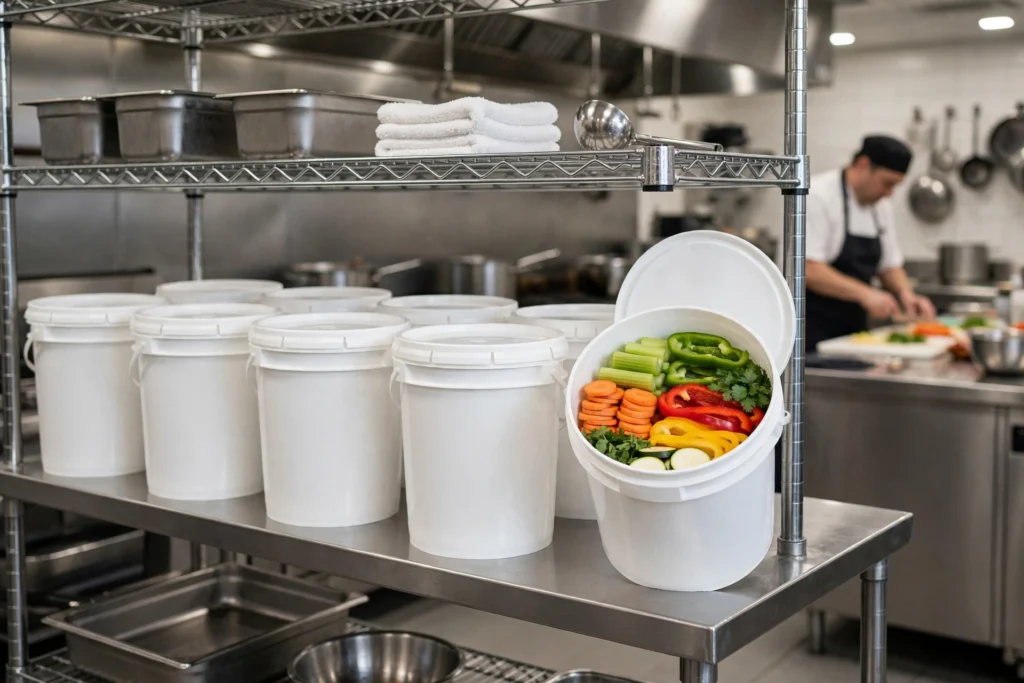
Buckets are one of the most underrated workhorses in a commercial kitchen. They hold prepped produce on the line, bulk flour and sugar in dry storage, sanitizer solution for the bar, and mop water for the closing crew. But not every bucket belongs in a restaurant: food-contact buckets need to be genuinely food-grade, sized for the station they’ll serve, and durable enough to survive daily commercial dishwashing. This guide walks buyers through commercial buckets for restaurants, what to buy, what to avoid, and how to order in bulk without overpaying.
Where Restaurants Actually Use Buckets
Before buying, map the jobs buckets do in your operation. Most restaurants use them in four places, and the spec matters differently in each:
Prep stations
Diced onions, portioned proteins, breading stations, brines and marinades. These buckets touch ready-to-eat or soon-to-be-cooked food directly, so food-grade material is non-negotiable, and 2-gallon buckets are the sweet spot: big enough for a prep batch, small enough to lift, label, and stack in a low-boy.
Dry goods and bulk ingredient storage
Flour, sugar, rice, beans, salt. Here the 5-gallon bucket shines: one standard bucket holds roughly 25–30 pounds of flour, and a tight-fitting lid keeps moisture and pests out. Pairing 5-gallon buckets with gamma seal lids turns dry storage into airtight, scoop-friendly bins that protect inventory.
Produce washing and cold holding
Washing greens, holding iced seafood, chilling beverages at events. Buckets used for cold holding should have sturdy handles (they get heavy) and lids if they sit in a walk-in where cross-contamination is a concern.
Cleaning and sanitation
Sanitizer buckets for wiping tables, mop buckets for floors, degreaser for the hood line. These must be clearly separated from food-contact buckets — ideally by color — so a mop bucket never ends up holding prep food. Many operations standardize: white for food, gray or red for cleaning.
What Makes a Bucket Food-Safe for a Commercial Kitchen
A bucket that held drywall compound last week is not a food bucket, no matter how well you rinse it. For restaurant food contact, look for these markers: HDPE or PP construction — food-grade buckets are molded from virgin high-density polyethylene (HDPE, resin code #2) or polypropylene (PP, resin code #5), both widely accepted for direct food contact. FDA-compliant materials — the plastic and any colorants must comply with FDA food-contact requirements. BPA-free — buyers of commercial buckets for restaurants increasingly specify BPA-free buckets for anything touching food. NSF listing where your operation requires it — many health departments and corporate food-service programs expect food-contact containers to meet NSF certification standards; an industry smallwares guide notes that health and safety codes commonly require NSF-certified smallwares for direct food contact.
Food-grade bucket standards typically mean virgin HDPE/PP, FDA-compliant, BPA-free, resin #2/#5. If your operation runs under a franchise or institutional food-service contract, check the spec before you buy — ordering non-listed buckets for a listed-bucket operation is an expensive mistake. And one hard rule: never put food in a used bucket unless you know exactly what it held before. For restaurants, new food-grade buckets are the safe default.
Choosing the Right Size for Your Kitchen
Bigger is not better in a kitchen — the right size is the one that matches the station. 2-gallon buckets fit prep stations, salad and sandwich lines, and portioned mise en place; they’re light when full and easy to stack in reach-in coolers. Read our guide to 2-gallon buckets in bulk for the full breakdown. 3.5-gallon buckets suit mid-volume prep — sauces, dressings, and brines for a busy service.
5-gallon buckets are the standard for bulk dry goods, produce washing, and cold holding at events or outdoor service. 6-gallon buckets work for high-volume commissaries and catering prep where fewer, larger containers mean fewer trips. Match the bucket to the lift: a full 5-gallon bucket of water weighs over 40 pounds, so if staff carry it across the kitchen, the smaller size is the safer buy.
Lids, Handles, and Features That Matter in Service
The bucket body is only half the purchase; in a restaurant, the lid and handle decide whether it survives service. Snap-on lids give a basic cover for walk-in storage and transport. Gamma seal lids screw on and off for an airtight seal — ideal for dry goods that get opened dozens of times a day, since they protect against moisture and pests while staying easy to open with one hand.
Tamper-evident lids suit commissary and delivery operations where sealed containers prove food hasn’t been opened in transit. Metal or plastic handles: metal handles carry heavy loads better, while plastic handles won’t rust in a dish pit — match the handle to the station. Color-coded lids and buckets are the cheapest cross-contamination insurance you can buy: white for food, red or gray for cleaning, and a house rule that everyone follows.
Comparison Table: Bucket Options for Restaurants
| Bucket | Best restaurant use | Lid pairing | Why buyers choose it |
|---|---|---|---|
| 2-gallon bucket | Prep stations, mise en place | Snap lid or gamma seal | Light when full, stacks in low-boys. |
| 3.5-gallon bucket | Sauces, dressings, brines | Snap lid | Mid-volume without the 5-gallon weight. |
| 5-gallon bucket | Dry goods, produce washing, cold holding | Gamma seal for dry goods | The industry standard; one bucket ≈ 25–30 lb flour. |
| 6-gallon bucket | Commissary and catering prep | Snap lid | Fewer containers for high-volume batches. |
| Cleaning/mop bucket (color-coded) | Floors, sanitizer, degreasing | — | Keeps non-food buckets out of the food line. |
Passing Health Inspections: Storage Rules That Matter
Commercial buckets for restaurants show up on health inspections more than most operators expect. Keep these rules in mind: Store food off the floor — the FDA Food Code requires food to be stored at least 6 inches above the floor; buckets stacked directly on walk-in floors are a common violation. Cover everything — open buckets of prepped food invite contamination; lids on, always, in storage.
Label and date — FIFO only works if every bucket carries the item name and prep/use-by date; tape and a marker beat memory every time. Separate allergens — flour in one bucket is fine until wheat dust settles on the bucket holding the gluten-free prep; dedicated, labeled, lidded buckets for allergen-free ingredients.
Clean and sanitize between uses — food-contact buckets go through the full wash-rinse-sanitize cycle like any food-contact surface, and cracked or deeply scratched buckets should be retired since damaged plastic harbors bacteria. Never store chemicals above food — sanitizer and cleaning buckets live on low shelves, food buckets up high.
Buying Commercial Buckets for Restaurants in Bulk
Restaurants burn through buckets: they crack, stain, get borrowed by the bar, and disappear into catering vans. Buying commercial buckets for restaurants in bulk keeps the cost per bucket down and spares on the shelf. Order by the pallet or skid lot — suppliers like ThoseBucketPeople sell in pallet quantities, which drops the per-unit price well below retail and keeps a whole location (or several) stocked from one order.
When buying commercial buckets for restaurants in bulk, standardize sizes and colors across locations — one 2-gallon white bucket for prep and one 5-gallon white bucket for dry storage, chain-wide, simplifies reordering and training. Buy lids with the buckets — mismatched lids are the number-one bucket complaint in commercial kitchens; ordering matched sets avoids it.
Plan for seasonality — patio season, catering season, and holiday volume all spike bucket demand; order ahead so freight delays don’t leave a station short. Ask about volume pricing — if you run multiple units or a commissary, request a quote for your actual quantities rather than paying list price.
Frequently Asked Questions
Are plastic buckets safe for food in restaurants?
Yes, commercial buckets for restaurants are safe when they’re made from food-grade materials: virgin HDPE (#2) or polypropylene (#5) that is FDA-compliant for food contact and BPA-free. Operations with strict procurement rules may also need NSF-listed containers — check your local health code or franchise spec.
What size bucket is best for restaurant food prep?
2-gallon buckets are the most versatile prep size: large enough for a batch, light enough to carry and stack in coolers. Use 5-gallon buckets for bulk dry goods and washing, not for lifting across the kitchen.
Can I store food in a bucket without a lid?
Not in storage. Health codes require food to be protected from contamination, which means covered containers. Open buckets are acceptable only during active prep.
How do I clean and sanitize food-grade buckets?
Wash with hot soapy water, rinse, then sanitize with an approved food-contact sanitizer and air-dry. Retire buckets that are cracked, deeply scratched, or stained in ways that won’t wash out.
What’s the difference between food-grade and regular buckets?
Food-grade buckets are molded from virgin, FDA-compliant resin with food-safe colorants; regular buckets may contain recycled content or additives not approved for food contact. The difference is in the material and manufacturing, not just the label.
How many buckets does a restaurant need?
A typical single-unit restaurant runs 20–40 buckets across prep, dry storage, and cleaning, plus spares. Commissaries and multi-unit operators often need pallet quantities — which is why bulk ordering pays off.
Can I use the same buckets for food and cleaning?
Never. Use color-coded buckets to keep food-contact and cleaning buckets permanently separate, and train every shift on the system.
Get Commercial Restaurant Buckets in Bulk from ThoseBucketPeople
Whether you run a single restaurant, a commissary kitchen, or a multi-unit group, we supply food-grade commercial buckets for restaurants — 2-gallon buckets, 5-gallon buckets, and lids to match, in pallet quantities with nationwide delivery. Request a quote through our Get a Quote page or contact us for volume pricing.