
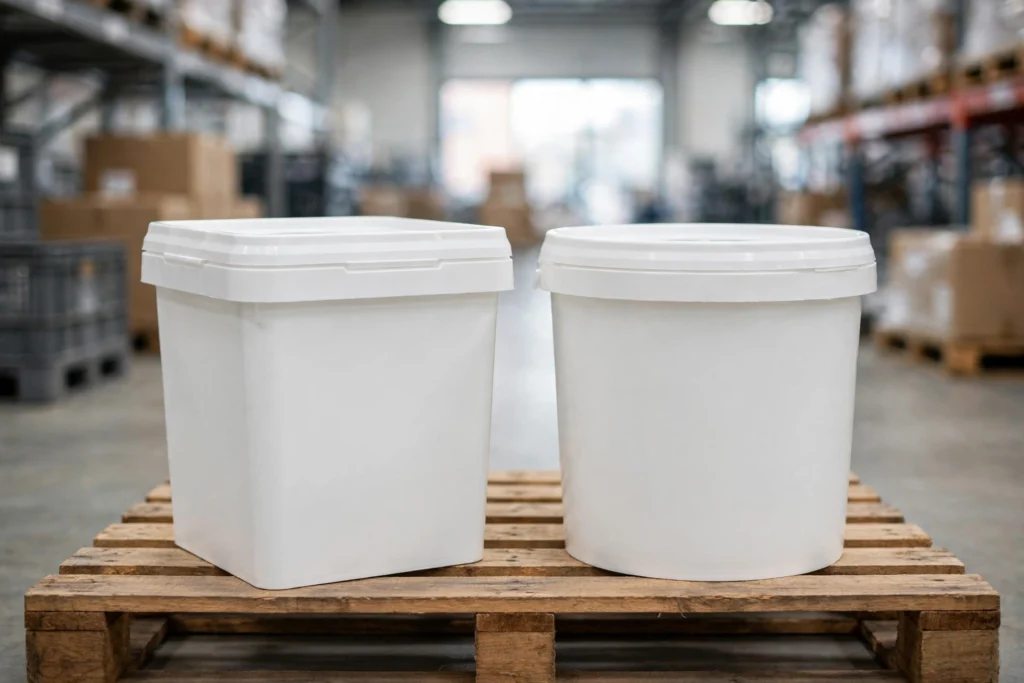
Choose square buckets when warehouse space, pallet shipping, and stack stability drive your costs — their flat sides eliminate the dead space round pails leave, adding roughly 20–25% more storage capacity per square foot. Choose round buckets for liquids, food-contact sanitation, and the lowest bulk unit cost — cylinders distribute internal pressure evenly and clean without corner residue. The right shape pays for itself over thousands of buckets; this square buckets vs round buckets guide shows how to pick it.
The One Engineering Principle That Decides the Shape
A cylinder distributes internal pressure evenly around its wall, while a square concentrates stress at its corners. That single fact explains most of the shape debate: round buckets handle liquid pressure, pouring, and frequent handling with no weak points, and their smooth interior wipes clean in one motion. Square buckets give up some of that pressure efficiency but win everywhere space is money — on pallets, on shelves, and in trucks. When you understand the tradeoff, the buying decision stops being a guess.
Where Square Buckets Win
Put square buckets in the warehouse and they earn their keep fast. The headline number comes from square-pail product engineering: on a standard 48″×40″ pallet, square pails eliminate the dead air between round containers and typically increase storage capacity by 20–25% per square foot of floor space. Over pallet-quantity orders, that is real freight savings. Beyond raw space: flat sides stack more securely and resist rolling and shifting in transit; recessed-center lids let the base of the pail above lock in, stabilizing tall stacks; flat panels give you more room for large, readable labels and branding than a curved wall; and square profiles sit well against walls and in shelving.
Where buyers standardize on them: food-service bulk ingredients (sauces, honey, dry grains), chemical products like detergents and lubricants, agricultural feed and fertilizers, and retail distribution of hardware and construction adhesives. See this 4-gallon square pails with cube-efficient design for how the pallet math works.
Where Round Buckets Win
Round is the shape liquids want. Internal pressure pushes evenly on every point of a cylinder, so round buckets carry water, brines, sanitizers, and chemicals without corner stress points. They pour more cleanly from the lip, they wipe and sanitize without scrubbing residue out of corners, and — the commercial kicker — round is the commodity standard. That means the widest accessory ecosystem: standard snap lids, tamper-evident lids, and gamma seal lids are all sized for the classic round 5-gallon pail, and bulk unit pricing is almost always the lowest because round is what every manufacturer molds at scale. For 2-gallon buckets and 5-gallon buckets, round is the default that lids, wringers, and handling equipment already fit.
The Corners Problem: Cleaning and Sanitation
This is the argument that ends most square-vs-round debates in food businesses. Square corners trap residue — dried sauce, honey, flour dust, chemical film — and require extra scrubbing in exactly the spot you can’t see well. Round interiors have no corners to miss, which is why round dominates restaurant prep stations, commercial kitchens, and sanitary food-contact uses.
If your buckets get washed and sanitized between fills (food prep, brining, ingredient storage, anything under health-department scrutiny), round saves labor and reduces sanitation risk on every single wash cycle. Square buckets can absolutely be food-grade — food-grade square pails exist in HDPE with FDA-compliant resin — but buy them for dry goods, storage, and shipping, not for jobs where the interior gets scrubbed daily.
Lids, Handles, and the Accessory Ecosystem
Gamma seal lids — the screw-on airtight lids that turn a 5-gallon pail into a scoop-friendly storage bin — are sized for standard round pails; see our gamma seal lids guide for the full breakdown. Square pails use their own lid family: snap-on lids in gasketed and non-gasketed versions, with recessed centers designed for stacking lock-in. Handles differ too: square pails commonly ship with reinforced bail handles (plastic or galvanized steel) rated for manual transport of heavy contents. The buying rule: pick the shape whose accessories already exist in your operation. If you stock gamma seal lids for your 5-gallon buckets, square pails in the same program mean a second lid inventory — price that before you switch.
Square Buckets vs Round Buckets: Comparison Table at a Glance
| Factor | Square buckets | Round buckets |
|---|---|---|
| Pallet & warehouse efficiency | Wins — ~20–25% more capacity per sq ft on a standard pallet | Loses — dead space between cylinders |
| Liquid handling | Adequate — corners concentrate stress | Wins — even pressure distribution, cleaner pouring |
| Cleaning & sanitation | Corners trap residue, harder to sanitize | Wins — smooth interior, no corners |
| Bulk unit cost | Usually higher — specialty item | Wins — commodity standard, lowest pricing |
| Lid & accessory range | Snap/gasketed lids, recessed stacking lids | Wins — gamma seal, tamper-evident, widest ecosystem |
| Labeling & branding | Wins — larger flat panels | Curved surface limits label size |
| Stack stability | Wins — flat sides, interlocking stacking lids | Good, but can shift and roll |
| Best bulk buyers | Warehouses, chemical packers, food distributors | Restaurants, janitorial, general commercial |
The Decision Matrix: Which Shape for Your Use Case
Stop asking “which is better” and ask “which is better for this job”: Restaurant prep and kitchens — round. Daily washing, sanitation rules, and gamma-seal dry storage all favor the cylinder. Dry goods storage and distribution — square. Flour, sugar, grains, and ingredients ship and stack cheaper in square pails with locking lids. Janitorial and cleaning — round for utility pails and mop buckets; square profiles work for dual-compartment mop buckets where clean/dirty water separation matters. Read our janitorial buckets guide for the fleet breakdown.
Honey and liquid food — round for pouring and cleaning; square food-grade pails for bulk ingredient shipping. Chemicals and detergents — square, where UN-rated square pails and pallet density cut hazmat freight cost. Gardening and compost — round; the 5-gallon round bucket is the garden standard for soil, scrap collection, and planters. Retail and private-label — square; flat panels take bigger, more readable labels.
If you run mixed operations, standardize square for the warehouse and round for the wash station — two shapes, each where it wins.
The Bulk Buyer’s Checklist: 7 Questions Before You Order
(1) What goes inside — liquid or dry? Liquids point to round; dry goods and granules can go either way. (2) How much warehouse and freight cost does the shape save? Run the pallet math: at ~20–25% better pallet density, square pails can cut a container load’s freight share noticeably. (3) Do these buckets get washed daily? If yes, round’s corner-free interior saves labor on every cycle.
(4) Which lids do you already stock? Gamma seal lids pair with round 5-gallon pails; square pails need their own gasketed or stacking lids. (5) What sizes do you standardize on? A 2-gallon bucket for carry work and a 5-gallon workhorse cover nearly every operation — read our 2-gallon buckets in bulk guide for the small-size math. (6) Do you need food-grade? Both shapes come in virgin HDPE food-grade versions — specify it in writing either way. (7) Are you shipping full pails? Full 5-gallon buckets of dense product weigh 40–60 pounds; square’s stack lock-in and round’s even wall strength both matter in transit — ask your supplier for the stack rating.
Frequently Asked Questions
Are square buckets better than round buckets?
Neither is universally better. Square buckets store and ship more efficiently (~20–25% more pallet capacity) and stack more stably; round buckets handle liquids better, clean faster, and cost less per unit. Pick square for warehouse economics, round for liquids and sanitation.
Do square buckets hold the same amount as round buckets?
A 4-gallon square pail and a 4-gallon round bucket both hold 4 gallons — capacity is the same. The difference is footprint: square pails pack tighter on pallets and shelves, so you store more gallons per square foot of floor space.
Which bucket shape is best for food storage?
Round for anything washed daily (prep stations, brining, kitchens), because the corner-free interior sanitizes faster. Square food-grade HDPE pails are excellent for bulk dry-ingredient storage and distribution, where pallet efficiency matters more than washability.
Can I get gamma seal lids for square buckets?
Gamma seal lids are sized for standard round 5-gallon pails. Square pails use their own lid family — snap-on lids with gasketed or non-gasketed options, including recessed stacking lids that lock stacked pails together.
Are square buckets more expensive than round buckets?
Generally yes at retail and in small quantities, because round is the commodity standard molded at the highest volumes. In pallet quantities the gap narrows — and square’s freight savings can offset the higher unit price when you are shipping full pails.
Which shape stacks better in a warehouse?
Square. Flat sides don’t roll, recessed stacking lids lock the pail above in place, and the tighter pallet footprint keeps stacks stable in transit. Round pails stack fine but leave dead space and can shift without careful wrapping.
Do square buckets come in food-grade HDPE?
Yes. Square pails are injection-molded in HDPE like round buckets and are available in virgin, BPA-free, FDA-compliant food-grade resin. Specify food-grade in writing from your supplier regardless of shape.
Get the Right-Shaped Buckets in Bulk from ThoseBucketPeople
Whether your operation needs square pails for warehouse density or round buckets for liquids and sanitation, we supply both in the sizes commercial buyers actually use — 2-gallon buckets for carry work, 5-gallon buckets for bulk storage, and matching lids — in pallet quantities with nationwide delivery. Request a quote through our Get a Quote page or contact us for volume pricing and delivery options.