
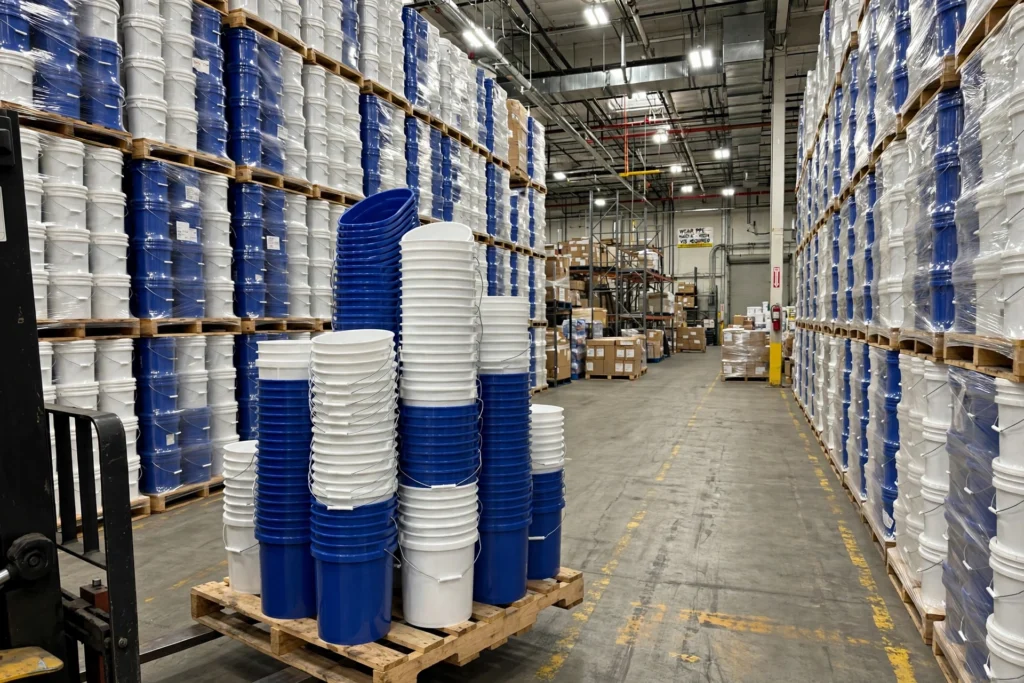
Wholesale buckets in the USA are priced in volume tiers: in 2026, a 5-gallon HDPE pail costs roughly $2.40–$3.00 at case quantities, drops to about $1.90–$2.40 at pallet volumes of 1,000+, and hits its floor at truckload or container quantities — freight almost always quoted separately. Distributors who buy at the right tier break and understand the per-unit spread keep healthy resale margins; distributors who buy by the case compete on scraps.
How Wholesale Buckets USA Pricing Actually Works
Wholesale bucket pricing in the USA isn’t a price — it’s a ladder. Every serious supplier prices 5-gallon and smaller pails in published quantity breaks, and the ladder has three or four rungs: singles and cases for the smallest buyers, pallet quantities for distributors and contractors, and truckload or container volumes for resellers and high-volume end users. The price gaps between rungs are where distributor margin lives: a pail that lists at $2.98 single drops to $1.99 at 1,800 units on the same catalog page — a $0.99 spread that becomes the reseller’s profit, minus freight. Because buckets are mostly empty air, freight is the second half of the price — most suppliers quote it separately, so the unit price on the page is never the landed cost. Smart buyers compare delivered per-unit cost, not list price.
Wholesale Buckets USA Bulk Pricing: Real 2026 Tier Benchmarks
These are live 2026 figures from US wholesale suppliers — use them as the benchmark to judge any quote against.
| Volume level | Typical quantity | 5-gallon HDPE pail per-unit (2026) | Who buys at this level |
|---|---|---|---|
| Singles and small cases | 1–100 | ~$2.41–$2.98 | Small businesses, trial orders |
| Case and quarter-pallet | 100–450 | ~$2.22–$2.74 | Contractors, mid-size operations |
| Pallet and multi-pallet | 450–1,800 | ~$1.88–$2.55 per pail; bucket + lid sets ~$4.99 at a 2-pallet minimum | Distributors, large facilities |
| Half to full truckload | 3,120–6,240+ | Negotiated, often all-in delivered | National distributors, high-volume resellers |
The pallet rung is the sweet spot for most distributors: one supplier’s 76-mil pail drops from $2.98 at quantity 1 to $1.99 at 1,800 — a 33% cut for committing to roughly one pallet lot. See these bulk bucket pricing tiers for the full ladder. Note the BayTec example at the 2-pallet rung: 240 × 90-mil 5.3-gallon buckets with spout lids at $1,197.60, or $4.99 per bucket-and-lid set — see the 2-pallet minimum bucket-and-lid pricing. The lesson: always price the set (bucket plus lid), because lids are a separate line item on most wholesale quotes.
What Moves the Price Besides Volume
Volume is the biggest lever, but five specs swing wholesale bucket pricing almost as much. Wall thickness (mil) — 50-mil utility pails price noticeably below 70–90-mil food-grade pails; heavier walls cost more resin and buy stacking strength. Food-grade spec — virgin, BPA-free, FDA-compliant resin costs more than general-purpose HDPE; demand the spec in writing. Lids — snap, spouted, tamper-evident, and gamma seal lids each add their own per-unit cost, and matched lid sets prevent the number-one distributor complaint: lids that don’t fit the bucket. Color and printing — standard white is cheapest; custom colors and heat-transfer or offset printing add setup fees and per-unit cost, usually only sensible at container quantities. UN rating — UN-rated pails for regulated materials cost more than non-UN equivalents of the same size. When comparing two wholesale quotes, check these five before comparing the price — a cheaper quote is often a thinner, non-food-grade pail.
Domestic vs. Import: The Sourcing Decision for Wholesale Buckets USA
Distributors face one strategic choice: buy domestic or import containers. Import (Alibaba and similar): 5-gallon food-grade pails list around $0.75–$1.95 at minimum orders of 500–1,000 units, and orders of 10,000+ units can cut per-unit cost 30–50% versus domestic case pricing. The catch: ocean freight, import tariffs, 30–45 day production lead times, and quality inspection are on you — plus currency risk and the working capital of a full container. Domestic (US suppliers): higher per-unit cost, but no tariffs, no container delays, short lead times, domestic freight lanes, and a supplier you can call. The US truckload model — for example, half truckloads of 3,120 buckets and full truckloads of about 6,240 moving out of Green Bay, Wisconsin with all-in delivered pricing — shows the domestic alternative to importing: volume on American highways instead of container ships. The decision rule: import when you have the cash, the warehouse, and the quality-control discipline to buy 10,000+ units at a time; buy domestic when lead time, consistency, and freight simplicity matter more than the last few cents per unit.
Freight: The Hidden Half of Wholesale Bucket Pricing
A 5-gallon bucket costs less than $2 to mold, but it takes up more than a cubic foot of trailer space — so freight is a real share of the landed cost, and most wholesale quotes treat it separately. Three freight realities for bulk bucket buyers: (1) Most suppliers quote freight separately — budget for it explicitly, and always compare quotes on delivered per-unit cost, not the unit price on the page. (2) Regional sourcing beats national when you can manage it — a distributor in the Midwest shipping from Wisconsin pays far less freight than one ordering from the opposite coast. (3) All-in delivered pricing exists — some volume suppliers quote product plus freight as a single firm number per load, which removes the second-bill surprise entirely; ask for it. And plan for seasonality: freight lanes tighten around spring construction season and holiday retail peaks, so locking truckload pricing ahead of the rush protects the margin you calculated in February.
The Distributor’s Checklist: 8 Questions Before You Order Wholesale Buckets
Buying wholesale buckets in the USA is a margin business — every question on this checklist protects a few cents per unit, and cents are what distributors live on. (1) What’s the real annual volume — not this quarter’s, but the committed twelve-month run rate? That’s what sets the tier. (2) Which size mix moves? 5-gallon buckets are the standard, but 2-gallon buckets and 3.5-gallon buckets in bulk carry better per-unit margins for the right customers. (3) Food-grade or standard? Food-grade commands the higher resale — but only order it if the resin spec is in writing. (4) Which lid with which bucket? Order matched bucket-and-lid sets; see our gamma seal lids guide for the airtight option. (5) What wall thickness? 70–90 mil for food-grade commercial pails; confirm it, because thickness is the first thing a lowball quote quietly cuts. (6) Delivered or FOB — what are the freight terms, and can you get all-in delivered pricing? (7) What’s the lead time, and does it cover your seasonal peak? Spring and summer construction demand spikes bucket sales — order before the freight lanes tighten. (8) What are the reorder terms? A distributor who reorders quarterly should be negotiating a standing-price arrangement, not re-bidding every pallet. Read our guide to 2-gallon buckets in bulk for the small-size breakdown, and see janitorial buckets in bulk for the facility-side angle.
Frequently Asked Questions
How many buckets are in a truckload?
A full truckload of 5-gallon buckets runs about 6,240 units; a half truckload is roughly 3,120. These are the standard distributor volumes for the US truckload wholesale model — if you can’t move thousands, pallet quantities (120–1,800 units) are the right rung.
What is the cheapest way to buy 5-gallon buckets in bulk?
Buy the largest volume your warehouse can hold. The price ladder is steep: single units around $2.40–$3.00 drop to about $1.90–$2.40 at pallet volumes, and 10,000+ unit container orders can cut per-unit cost 30–50%. Always compare delivered per-unit cost, freight included.
Why do wholesale suppliers quote shipping separately?
Because freight varies by lane, distance, and season — a fixed shipping number would be wrong half the time. Budget freight explicitly, and ask whether the supplier offers all-in delivered pricing per load, which rolls product and freight into one firm number.
Do wholesale buckets come with lids?
Usually not — lids are a separate line item. Price the bucket-and-lid set together: pallet-minimum combos run around $4.99 per 90-mil bucket plus spout lid. Ordering matched sets avoids the number-one distributor complaint: lids that don’t fit.
What’s the difference between 70-mil and 90-mil buckets?
Wall thickness in thousandths of an inch. 90-mil pails cost more but stack better under commercial loads and resist impact; 70-mil is the common food-grade middle ground. Commercial food-grade pails typically run 70–90 mil — thinner than that is a utility-grade pail.
Can I import buckets from China for wholesale?
Yes — 5-gallon food-grade pails list around $0.75–$1.95 at minimum orders of 500–1,000 units. But add ocean freight, tariffs, 30–45 day lead times, quality inspection, and container-level working capital. Import only when your volume and discipline justify a 10,000+ unit buy.
Should a distributor buy food-grade or standard buckets?
Food-grade, where the resale market supports it: virgin, BPA-free, FDA-compliant buckets command higher prices from food, restaurant, and prepper customers — and they’re the only pail you can sell for food contact. Keep standard utility pails as the lower-cost line, and never blur the two.
Get Wholesale Buckets in the USA from ThoseBucketPeople
Whether you’re a distributor, a contractor buying by the pallet, or a reseller scaling to truckload volumes, we supply the buckets the US wholesale market actually moves — 2-gallon buckets for carry work, 3.5-gallon pails for mid-volume jobs, 5-gallon buckets for the industry standard, and lids to match, in pallet quantities with nationwide delivery. Request a quote through our Get a Quote page or contact us for volume pricing and delivery options.