
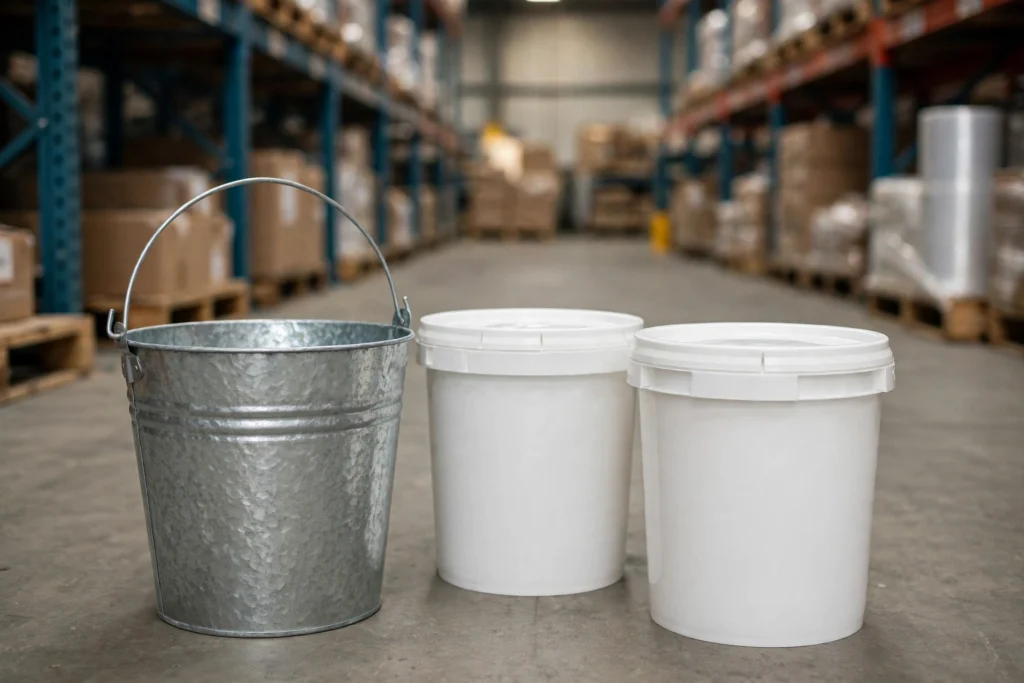
For most commercial jobs, food-grade HDPE plastic buckets win — they’re lighter, cheaper, rust-proof, chemically resistant, and easy to certify food-safe. Metal buckets — galvanized steel, stainless steel, or aluminum — win where heat, sparks, punctures, or decades of hard use are the job. This 2026 guide compares cost, durability, food safety, and bulk buying for both.
The Three Metal Buckets Commercial Buyers Actually Meet
“Metal bucket” covers three very different products, and mixing them up is the most common buying mistake in this category.
Galvanized steel buckets
Carbon steel coated in zinc for corrosion resistance. The workhorse of farms, stables, construction sites, and landscaping crews: water pails, feed buckets, mop and utility pails, well buckets, fire buckets. Strong, cheap for metal, and shrugs off weather — but the zinc coating is the catch (see the food-safety section below), and a chipped or scratched coating can rust.
Stainless steel buckets
The premium metal option, typically food-grade 304 stainless. Non-porous, corrosion-proof, and easy to sanitize with steam or harsh cleaners — which is why commercial kitchens, dairies, breweries, and laboratories use them for milk handling, brining, fermentation, and sanitary waste collection. Costs substantially more than either galvanized steel or plastic, but lasts effectively indefinitely with basic care.
Aluminum buckets
The lightweight metal: lighter than steel, naturally corrosion-resistant, but softer — dents easily and reacts with strongly acidic or alkaline contents. Common in dairy and feed handling where weight matters. Less common in bulk commercial buying than the other two metals.
Where Metal Wins
Metal earns its higher price in jobs that destroy plastic.
Heat, sparks, and fire
Steel won’t melt, and unlike plastic it doesn’t feed a fire — a real consideration near furnaces, welding stations, foundries, and anywhere hot materials or sparks are routine. A steel bucket can sit beside an open flame; an HDPE pail softens above roughly 160°F and would be ruined long before that.
Punctures, abrasion, and forklift abuse
Sharp scrap, rebar, gravel, and daily forklift handling crack and gouge plastic; steel dents and keeps working. In heavy manufacturing, buyers consistently report that plastic containers crack, warp, or break under repeated impact while steel containers absorb years of the same abuse — which is why steel wins the long-term value math in demanding environments. See this steel vs. plastic industrial containers breakdown for the numbers.
Decades of service and full recyclability
A stainless or well-kept galvanized bucket can serve for decades, then recycle completely at end of life. Food-grade HDPE is also recyclable (#2), but sun and chemical exposure shorten its working life outdoors.
Outdoor and UV immunity
Sunlight degrades many plastics over time, making them brittle and failure-prone. Steel is unaffected by UV, and galvanizing adds corrosion protection for harsh outdoor service — one reason steel dominates long-term farm and field duty.
Where Plastic (Food-Grade HDPE) Wins
For everything metal doesn’t specifically beat, plastic is usually the smarter commercial buy.
Weight crews can actually carry
A full 5-gallon bucket of water already weighs over 40 pounds; the bucket itself should add as little as possible. Plastic pails are a fraction of the weight of steel equivalents, which matters enormously for janitorial crews, painters, landscapers, and anyone carrying buckets all day. See our janitorial buckets in bulk guide for how weight drives fleet-buying decisions.
Cost — often dramatically
A food-grade HDPE pail costs a fraction of a stainless steel pail of the same size, and meaningfully less than galvanized too. When you’re ordering by the pallet, that gap multiplies into real budget: outfitting a facility with plastic buckets leaves money for lids, gamma seal upgrades, and spares.
Corrosion-proof by nature
No zinc coating to chip, no rust ever. Salt, fertilizers, cleaning chemicals, and constant washdowns that attack steel are routine duty for HDPE. For chemical handling, HDPE’s broad chemical resistance is a genuine advantage over unlined metal.
The food-grade certification path
Virgin HDPE (#2), BPA-free, FDA-compliant buckets are a standardized, widely available product with a clear verification routine. Read our HDPE food-grade explainer for the full 3-step check. Galvanized steel has a conditional food story at best (below); stainless is food-safe but expensive.
Quieter, safer handling
Steel buckets are loud when dropped, can have sharp edges at the rim or seams, and conduct electricity — a hazard near wiring. Plastic is quieter, non-conductive, and kinder to finished floors.
The Food-Safety Rules You Can’t Skip
This is where buyers get hurt, so get it exactly right.
Galvanized steel and acidic food do not mix
The FDA Food Code (Section 4-101.15) prohibits galvanized metal for food-contact surfaces used with acidic food. Acidic foods and beverages attack the zinc coating, converting it to zinc salts that the body readily absorbs — and excessive levels can cause minor sickness. Tomatoes, citrus, pickles, fruit juices, vinegar-based products, and fermented foods are all off the table in galvanized buckets. Read the American Galvanizers Association’s food-safety guidance for the full rulebook. Galvanized buckets ARE acceptable for dry, non-acidic bulk foods like grains, flour, and sugar — but never for anything acidic or wet.
Stainless steel is the food-safe metal
Food-grade 304 stainless is non-porous, doesn’t leach, and tolerates steam sanitation and harsh cleaners that would destroy plastic or strip galvanizing. If the job is food contact plus heat or sanitation chemicals, stainless is the answer — at stainless prices.
Food-grade HDPE is the default food bucket
Virgin #2 HDPE, BPA-free, FDA-compliant, with an airtight lid: the standard for dry goods, brining, fermentation, and water storage. Pair with gamma seal lids for airtight repeated access. One limit: HDPE softens above ~160°F, so no boiling liquids and no dishwasher sanitizing — stainless wins those jobs.
Comparison Table: Metal vs Plastic Buckets at a Glance
| Factor | Galvanized steel | Stainless steel (304) | Food-grade HDPE plastic |
|---|---|---|---|
| Upfront cost (5-gal) | Mid | Highest | Lowest |
| Empty weight | Heavy | Heaviest | Lightest |
| Heat tolerance | Excellent — open flame OK | Excellent — steam sanitation OK | Good to ~160°F; softens above |
| Corrosion | Good while zinc intact; rusts if chipped | Excellent — corrosion-proof | Excellent — never rusts |
| Food-safe certification | Conditional — dry non-acidic foods only | Yes — the food-safe metal | Yes — virgin #2, BPA-free, FDA-compliant |
| Chemical resistance | Moderate — acids attack zinc | Excellent | Excellent — broad HDPE resistance |
| Puncture/abuse tolerance | Excellent | Excellent | Good — can crack under sharp impact |
| UV/outdoor life | Excellent | Excellent | Good — UV stabilizers help; unprotected plastic gets brittle |
| Typical service life | Long (years–decades) | Decades | Years (shorter in harsh sun) |
| Noise/handling | Loud, can have sharp edges | Loud | Quiet, non-conductive |
Which Bucket for Your Industry: The Use-Case Breakdown
Match the material to the job, not the catalog.
Construction and masonry
Galvanized steel. Mortar, grout, sharp aggregate, and rebar ends destroy plastic fast; steel buckets take the abuse for years. Plastic still works for water and cleanup, but the mixing bucket should be steel.
Commercial kitchens and food processing
Stainless steel where heat or sanitation chemicals are involved (stock pots, sanitizer-adjacent handling); food-grade HDPE with tight lids for dry storage, brining, and prep. Never galvanized for anything acidic.
Farms, stables, and dairies
Galvanized steel for water and feed in the field (weatherproof, chew-proof, decades of service); stainless for dairy handling where sanitation is audited; food-grade HDPE for feed storage with gamma seal lids keeping rodents out.
Janitorial and facilities
Food-grade HDPE, full stop. Crews carry these all day — weight wins — and chemical resistance handles every cleaning concentrate on the cart. Read our janitorial buckets in bulk guide for the fleet spec.
Chemical and industrial handling
HDPE for most liquid chemicals (broad resistance, no corrosion); steel pails where the chemical attacks plastic or where UN-rated steel packaging is specified. Always match the container to the chemical’s SDS, never to habit.
Landscaping and nurseries
Galvanized steel for the tools-and-debris bucket that lives on the truck; HDPE for soil, water, and amendments. Steel wins the lifetime-cost math for the bucket that gets dragged across concrete daily.
Emergency preparedness and water storage
Food-grade HDPE with airtight lids (see our gamma seal lids guide). Light enough to move when full, certified food-safe, and cheap enough to build a real cache. Metal only if the cache must survive fire exposure.
The Bulk Buyer’s Checklist: 7 Questions Before You Order
(1) What will the bucket touch? Food, acids, or chemicals decide the material before anything else — get the food-safety answer in writing. (2) Hot or cold duty? Anything above ~160°F rules out HDPE; steam sanitation rules out everything but stainless. (3) Who carries it, and how far? All-day carry favors plastic; stationary duty lets steel’s durability pay off. (4) Indoor or outdoor? Years of sun favor steel or UV-stabilized HDPE — ask for the UV rating. (5) What sizes standardize your operation? A 5-gallon workhorse plus a 2-gallon carry size covers nearly every commercial job — see our guide to 2-gallon buckets in bulk. (6) Are lids included and matched? Mismatched lids are the number-one bucket complaint across every industry — order matched sets. (7) What’s the real per-year cost? Divide the pallet price by expected service life: cheap plastic replaced every two years can cost more per year than steel that lasts twenty. Price the decade, not the purchase.
Buying Metal and Plastic Buckets in Bulk
Whether your operation runs on steel or plastic, we supply the food-grade buckets commercial buyers actually use — 5-gallon buckets for bulk storage, 2-gallon buckets for carry work, and lids to match. Order by the pallet or skid lot either way — suppliers like ThoseBucketPeople sell food-grade buckets in pallet quantities with nationwide delivery, which drops the per-unit price well below retail. For metal, buy from industrial suppliers in case quantities and confirm the gauge, coating (hot-dip vs. electro-galvanized), and handle rating before committing. Standardize on one size per job, keep food-contact and non-food buckets in separate color or material families so they never get mixed up, and order lids with the buckets. And if you’re weighing round vs. square for storage density, read our square buckets vs round buckets comparison — the shape decision is independent of the material one. Request a quote through our Get a Quote page or contact us for volume pricing and delivery options.
Frequently Asked Questions
Can you store food in a metal bucket?
In stainless steel (304), yes — it’s the food-safe metal, non-porous and corrosion-proof. In galvanized steel, only dry, non-acidic foods like grains and sugar; never acidic foods, which attack the zinc coating. For most food storage, food-grade HDPE buckets are the simpler, cheaper certified option.
Are galvanized buckets food safe?
Conditionally. The FDA Food Code bars galvanized metal from food-contact surfaces used with acidic food, because acids convert the zinc coating to absorbable zinc salts. Dry, non-acidic bulk foods are acceptable; anything acidic, wet, or fermented is not.
Which lasts longer, metal or plastic buckets?
Metal, by a wide margin in hard service: stainless and well-kept galvanized buckets serve for decades, while HDPE pails last years — less in constant sun, which makes unprotected plastic brittle. In gentle indoor duty, though, a quality HDPE bucket can serve for many years at a fraction of the price.
Can plastic buckets handle hot liquids?
Food-grade HDPE handles hot-fill up to about 160°F — fine for warm foods and brines. Don’t pour boiling liquids into HDPE or run it through high-heat sanitizing; the plastic softens and can warp. For boiling water or steam sanitation, use stainless steel.
Why are metal buckets so much more expensive than plastic?
Material and manufacturing: steel costs more than HDPE resin, and forming, welding, and galvanizing add labor that injection-molded plastic skips. Stainless adds alloy cost on top. The price gap narrows over time, though — a steel bucket that lasts twenty years can beat plastic on cost per year.
Do metal buckets rust?
Galvanized steel resists rust while its zinc coating is intact, but chips, scratches, and long exposure to acids or salt will rust it. Stainless steel (304) is effectively rust-proof in normal commercial use. Plastic never rusts — one of its permanent advantages.
Can I use a metal bucket for chemicals?
It depends on the chemical: HDPE resists a broader range of chemicals than unlined steel and never corrodes, so it’s the default for most liquid chemicals. Some chemicals attack plastic but not steel, and regulated hazardous materials may require UN-rated steel pails — always match the container to the chemical’s safety data sheet.
Get Commercial Buckets in Bulk from ThoseBucketPeople
Whether your operation runs on steel, plastic, or both, we supply the food-grade buckets commercial buyers actually use — 5-gallon buckets for bulk storage, 2-gallon buckets for carry work, and lids to match, in pallet quantities with nationwide delivery. Request a quote through our Get a Quote page or contact us for volume pricing and delivery options.