
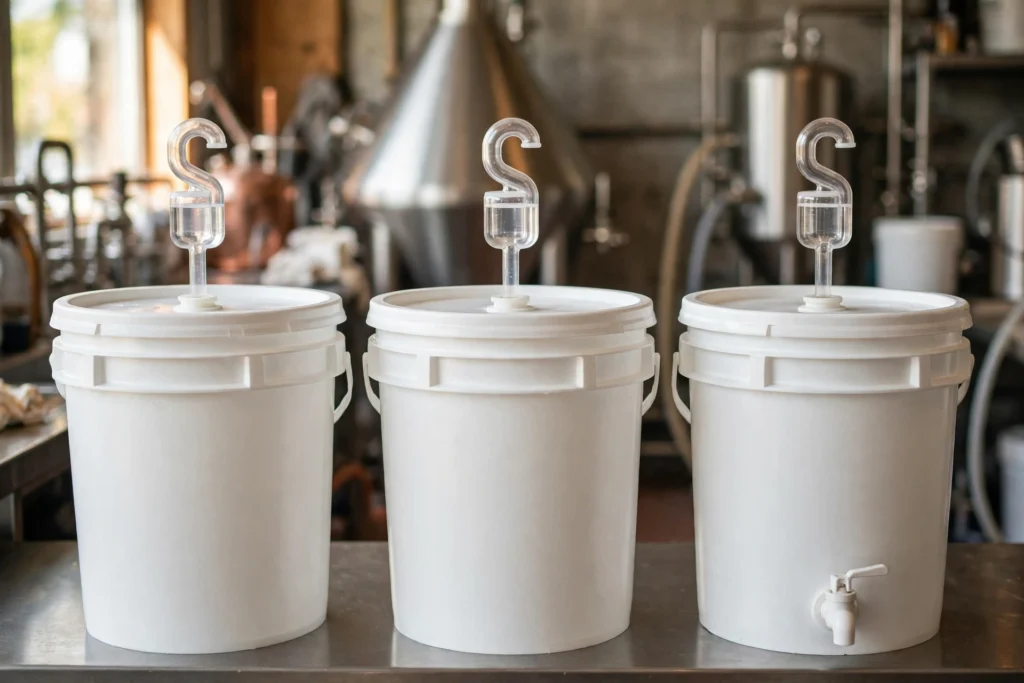
This fermentation buckets bulk guide covers which food-grade fermenting buckets homebrew shops, craft breweries, and wineries order in volume: 6.5-gallon HDPE or PP pails with airlock-ready lids for 5-gallon batches, spigot options for gravity transfers, and larger 12-gallon vessels for wine must. Buy lids matched to the buckets and sanitize everything before first use.
What Makes a Bucket a Fermentation Bucket
Fermentation is yeast converting sugars into alcohol and CO2, and the vessel has to manage both products. A fermentation bucket is a food-grade pail built around four requirements: genuinely food-grade material, a lid that vents CO2 through an airlock, a smooth sanitizable interior, and a wide mouth for adding ingredients and cleaning. Miss any one and the batch is at risk.
Food-grade comes first: fermenting buckets are molded from virgin HDPE (#2) or polypropylene (#5), BPA-free and FDA-compliant for food contact — the U.S. Solid fermenters sold to homebrewers, for example, are food-grade BPA-free polypropylene. The resin matters because wort and must sit in the vessel for weeks, and acidic young wine will pull contaminants out of substandard plastic.
The lid is the second defining feature: it carries a grommeted or drilled hole for an airlock, so CO2 escapes while outside air — and fruit flies — stay out. And one hard limit: plastic fermentation buckets are not pressure vessels. They are built for atmospheric fermentation, never for pressurized or carbonating service.
Fermenting Bucket Sizes: Match the Bucket to the Batch
Buy the bucket for the batch, plus headspace. Active fermentation produces krausen — a layer of foam that rises above the liquid — and the bucket needs room for it, or foam pushes out through the airlock. The industry sizes map to batch sizes like this:
| Batch | Right bucket | Why it works | Best bulk buyer |
|---|---|---|---|
| 1–2 gal test batches, yeast starters, kombucha | 2-gallon bucket | Small, cheap, easy to sanitize — see our guide to 2-gallon buckets in bulk | Homebrew shops selling starter kits |
| 5-gal beer, cider, or mead batches | 6.5-gallon fermenting bucket | The homebrew standard: room for krausen over a 5-gallon batch; add a blow-off tube for vigorous fermentations | Homebrew shops, brew clubs, nanobreweries |
| 10-gal or high-krausen batches | 7.9-gallon (30L) bucket | Extra headroom for big beers and wheat styles | Craft breweries, high-volume homebrew retailers |
| Wine must and fruit ferments | 12-gallon fermenting bucket | MoreBeer’s 12-gallon food-grade fermenter holds around 75 lbs of must and runs 21 inches tall — wide enough for punch-downs | Wineries, winemaking shops, cideries |
One ordering note: some suppliers sell the lid separately (MoreBeer lists its 12-gallon lid at $5.99) — confirm lids are included and matched to the bucket diameter before the pallet order, because mismatched lids are the number-one bucket complaint across every industry.
Airlocks, Spigots, and Lids: The Three Accessories That Define a Fermenter
Airlocks
An airlock is a one-way gas valve: CO2 from fermentation bubbles out through water while outside air can’t get in. The two common styles are the S-type (the S-shaped bubbler) and the three-piece (easier to clean). Keep airlocks filled and unobstructed during fermentation — and for very vigorous fermentations, swap the airlock for a blow-off tube run into a jar of sanitizer, because krausen can clog an airlock and pop the lid.
Spigots
A spigot near the base turns a fermenter into a bottling bucket: connect tubing and transfer finished beer by gravity to a keg or bottling bucket without an auto-siphon. Position the spigot above the yeast and trub layer so transfers pull clear beer. The maintenance rule: disassemble spigots between batches — internal passages, seals, and threads trap residue a rinse won’t reach — and test the seals with water before filling with wort.
Lids
Standard fermenter lids are grommeted for airlocks, and some suppliers offer screw-on lid versions for a firmer seal. Whatever the style, order lids matched to the bucket diameter in the same purchase — a lid that doesn’t seat lets fruit flies and oxygen in, and hunting down compatible lids later is a common restocking headache.
Plastic vs. Glass vs. Stainless: Fermenter Materials Compared
Homebrewers argue about fermenter materials endlessly; commercial buyers decide on cost, labor, and replacement cycles. Plastic wins the bulk order on all three — but each material has a job it’s best at:
| Material | Typical cost | Strengths | Weaknesses | Best for |
|---|---|---|---|---|
| Food-grade plastic (HDPE/PP) | Lowest — a 6.5-gal fermenter 2-pack with airlocks and spigots recently listed at $54.56 (see the U.S. Solid 6.5-gallon fermenting buckets) | Light, cheap, wide mouth for fruit additions and easy cleaning, replaceable | Scratches harbor microbes; not for pressurized service; best for primary fermentation rather than months-long aging | Homebrew shops, brew clubs, starter kits |
| Glass carboy | Mid | Impermeable, see-through | Heavy, breakable, narrow neck is hard to clean and blocks fruit additions | Individual homebrewers — not a bulk category |
| Stainless steel | Highest | Durable, clean-in-place, oxygen-tight | Expensive, heavy | Commercial breweries scaling past bucket volumes |
Fermentation Buckets Bulk: The 8-Point Buyer’s Checklist
Whether you’re stocking a homebrew shop, supplying a brew club, or kitting out a nanobrewery’s pilot system, run this fermentation buckets bulk checklist before the pallet order: (1) Food-grade in writing — virgin HDPE (#2) or PP (#5), BPA-free, FDA-compliant; get the resin spec from the supplier, not just the word “plastic.” (2) Lids matched to the buckets — grommeted or drilled for airlocks, same diameter, ordered together. (3) Airlocks and spigots bundled or sourced — confirm spigot thread size matches your tubing and that replacement grommets and airlocks are stocked. (4) Smooth interiors — ask about the interior finish; texture that looks fine dry can hide residue, and scratches are where infections start. (5) Size mix for your customers — 6.5-gallon for standard 5-gallon batches, 12-gallon for wine must, 2-gallon for starters and test batches. (6) Nesting and stacking — buckets that nest save warehouse space; check stack ratings for filled vessels. (7) Replacement parts pipeline — grommets, airlocks, and spigot washers are the wear items; stock them or your customers come back angry. (8) Kit economics — compare a bundled bucket+lid+airlock+spigot (the U.S. Solid 2-pack at $54.56 shows the retail benchmark) against à la carte pallet pricing; bundles move faster in shops, à la carte wins on margin for high-volume resellers.
Sanitizing Fermentation Buckets: The Rule That Matters Most
The best fermenter in the world can’t save a batch pitched into a dirty vessel. The routine: clean first with a soft cloth or sponge — never abrasive pads, which scratch plastic and give microorganisms places to hide — then sanitize with a no-rinse sanitizer, including the lid, grommet, airlock, and a fully disassembled spigot. Test spigot seals with water before the wort goes in.
Two rules separate serious operations from infected batches. First, retire scratched buckets: a fermenter with visible interior scoring becomes a bottling bucket or a parts donor, never a fermenter again — a new bucket costs less than a dumped 5-gallon batch. Second, dedicate vessels: keep separate buckets for clean beers versus sour, funky, or wild fermentations, so flavors and microbes don’t carry over between batches.
Mead makers get a bonus use out of the same supply chain: our buckets for honey storage guide covers the food-grade side — honey buckets for the apiary, fermenting buckets for the meadery.
Frequently Asked Questions
What size bucket do I need to ferment 5 gallons of beer?
A 6.5-gallon fermenting bucket: the extra 1.5 gallons of headspace accommodates krausen, the foam cap active fermentation produces. For very vigorous fermentations, use a blow-off tube instead of an airlock so foam can’t clog it.
Where can I buy fermentation buckets bulk?
From bucket suppliers that sell food-grade HDPE or PP pails in pallet quantities with matched airlock-ready lids — plus airlocks and spigots bundled or sourced separately. Request a quote through our Get a Quote page for volume pricing.
Are plastic fermentation buckets food safe?
Yes, when they’re molded from virgin, BPA-free HDPE (#2) or polypropylene (#5) that’s FDA-compliant for food contact — the same standard as any food-grade bucket. Never ferment in a bucket with an unknown history or one that held chemicals.
Do I need an airlock on a fermentation bucket?
Yes. The airlock lets CO2 escape while blocking outside air and contaminants. During peak fermentation the positive CO2 pressure also protects the batch; keep the airlock filled and unobstructed throughout.
Can I use a spigot bucket as a fermenter?
Yes — spigots make gravity transfers to a keg or bottling bucket easy without a siphon. Disassemble and sanitize the spigot between batches (residue hides in the threads and seals) and test it with water before filling.
How do I sanitize a plastic fermenting bucket?
Clean with a soft sponge (never abrasive pads — scratches harbor microbes), then apply a no-rinse sanitizer to the bucket, lid, grommet, airlock, and disassembled spigot. Replace any bucket with visible interior scoring.
How long can beer stay in a plastic fermenting bucket?
Through primary fermentation — typically one to four weeks depending on the style. Plastic isn’t meant for months-long aging or pressurized conditioning; transfer to kegs or bottles when fermentation is done.
Get Fermentation Buckets in Bulk from ThoseBucketPeople
For fermentation buckets bulk orders — whether you run a homebrew supply shop, a craft brewery’s pilot program, a winery, or a cidery — we supply the food-grade buckets fermentation operations actually use: 5-gallon buckets for standard batches, 2-gallon buckets for starters and test batches, and lids to match, in pallet quantities with nationwide delivery. Request a quote through our Get a Quote page or contact us for volume pricing and delivery options.