
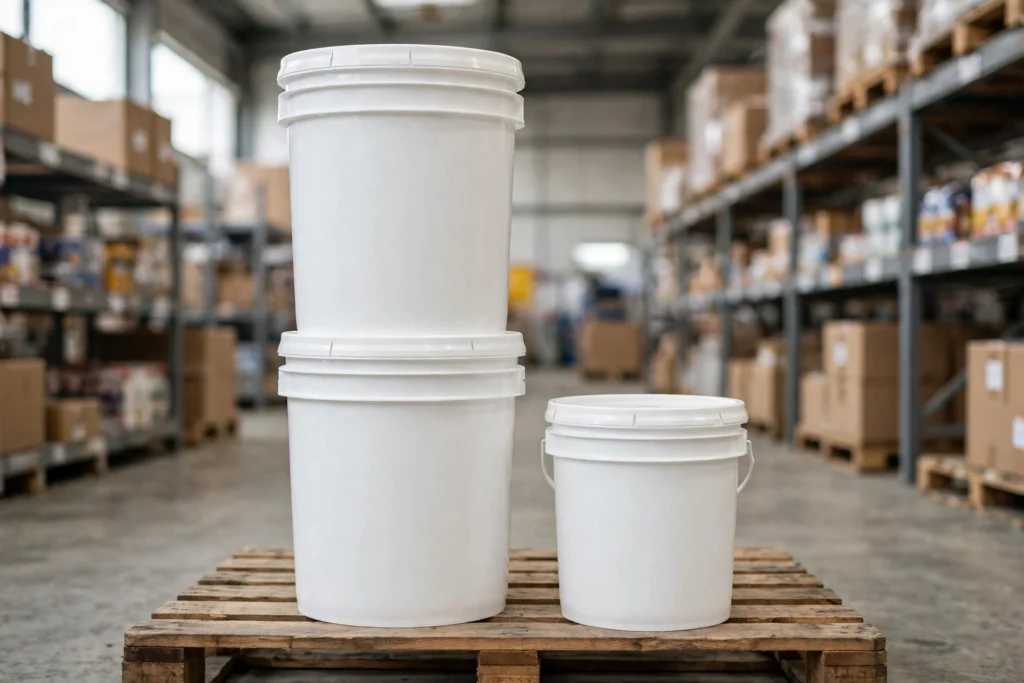
6 gallon buckets in bulk are food-grade HDPE pails on the same 12-inch diameter as 5-gallon buckets — sharing lids and gamma seals — in a taller body holding 20% more. One 6-gallon bucket stores about 40 lbs of rice or beans, 25–30 lbs of kibble, or 70 lbs of honey: the oversized standard for buyers ordering 6 gallon buckets in bulk.
Why the 6-Gallon Size Exists — and Who Actually Buys It
The 6-gallon bucket was born from two pressures. First, fermenting headroom: homebrew and winemaking supply shops sell 6.5-gallon buckets as the standard primary fermenter for 5-gallon batches, because fermentation needs space for krausen foam. Second, bulk-density economics: 20% more capacity per container means fewer buckets to buy, fill, seal, label, and ship per unit of volume — a real saving at pallet quantities. The clever part is the footprint: a 6-gallon pail keeps the same ~12-inch diameter as the 5-gallon standard, so it uses the same lids, stacks the same way, and fits the same shelf and pallet layouts. Only the height changes — roughly 2.5 to 3 extra inches. That makes the 6-gallon bucket the easiest capacity upgrade in the business: more storage per container with zero changes to your lid inventory.
6-Gallon Bucket Specs: Exact Dimensions for Commercial Buyers
When you buy 6 gallon buckets in bulk, confirm these specs with your supplier before ordering (figures from published 6-gallon pail dimensions): top diameter 11.8–12 inches, bottom diameter 10.25–10.5 inches, height 16.75–17.5 inches, empty weight 2.5–4 pounds, and a max load rating of 50–70 pounds. Compare that to the 5-gallon standard: 11.9–12 inches in diameter but only 14–15 inches tall and 2–3 pounds empty. The takeaway for buyers is the shared 12-inch diameter — it means standard 5-gallon snap lids fit 6-gallon buckets, and gamma seal lids sized for the 12-inch footprint work across 3.5, 5, 6, and 7-gallon pails. One lid inventory, multiple bucket sizes. See our gamma seal lids guide for the full lid breakdown, and our square buckets vs round buckets comparison if you’re weighing shapes.
How Much Does a 6-Gallon Bucket Hold? The Weight Table
For buyers ordering 6 gallon buckets in bulk for food, feed, or liquid storage, weight — not volume — is the planning number. This is the original reference table to size orders around:
| Product | Weight per 6-gallon bucket | Planning note |
|---|---|---|
| Water | ~50 lbs liquid (≈53 lbs full with bucket) | Two-person lift; confirm liquid-rated bucket |
| Rice or dry beans | ~40 lbs | The prepper standard; pairs with mylar + 2000cc oxygen absorbers |
| Dry kibble / pet food | ~25–30 lbs | About 20% more than a 5-gallon bucket’s 20–25 lbs |
| Honey | ~70–72 lbs | Heaviest common fill; never stack full buckets high without checking ratings |
| Flour | ~30–36 lbs | Scales from the 5-gallon bucket’s 25–30 lb figure |
| Malted grain (homebrew) | ~25–27 lbs | Two buckets per 55-lb grain sack, per homebrew-store practice |
The weight has one big consequence: a full 6-gallon bucket of water or honey is a 53–75 pound lift. Plan two-person carries and check stack ratings before warehousing full buckets more than two high.
Where 6-Gallon Buckets Beat the 5-Gallon Standard
Commercial buyers choose 6 gallon buckets in bulk when the 5-gallon standard leaves capacity — or containers — on the table.
Homebrew & wine supply shops
The 6.5-gallon food-grade fermenter buckets are the industry’s standard primary fermenter for 5-gallon beer and wine batches: the extra 1.5 gallons is headroom for fermentation foam, and external volume markers read up to 5 gallons. Retail fermenter buckets (around $17) run 17.5″ H x 12″ Ø and are food grade to 180°F — but note they ship without lids, need a drilled lid with stopper and airlock added, aren’t designed to hold pressure, and aren’t for long-term storage. Homebrew shops also stock 6-gallon buckets as bottling and sanitizer-mixing buckets.
Grain & bulk-food storage
Farm stores and homebrew shops sell to customers storing 50–55 lb grain sacks: two 6-gallon buckets swallow a sack with room to spare, sealing out moisture, pests, and odors. The taller profile means fewer buckets per ton of grain in the stockroom.
Emergency food caches
Preppers standardized on the 6-gallon bucket because it holds 40 lbs of rice or beans — a serious cache unit — and pallet pricing has run about $6 per bucket. Paired with mylar liners and 2000cc oxygen absorbers, staples store 25–30 years; the rigid buckets stack far better than bags in a storage room.
Honey & farm operations
A 6-gallon bucket holds roughly 70–72 pounds of honey, cutting bucket changes on high-volume extraction days. Same 12-inch lids as the 5-gallon stock, same food-grade HDPE rules: virgin resin, BPA-free, airtight lids.
Feed rooms & pet businesses
30–40 lb feed and kibble bags — the sizes that rattle around half-empty in a 5-gallon pail — fit a 6-gallon bucket properly, so shelters, kennels, and feed stores run fewer containers per ton of feed. See our guide to 3.5-gallon buckets in bulk for the smaller sizes.
Maple syrup & liquid handling
Food-grade 6-gallon buckets are a standard sap-collection and short-term storage size for small maple operations: tall, lidded, and easy to carry from tree to sugar shack. Confirm the bucket is rated for liquid storage before filling.
Lids for 6-Gallon Buckets: What Fits
The shared 12-inch diameter makes lid buying simple. Standard 5-gallon buckets’ snap lids fit 6-gallon buckets with the same footprint — if your operation already stocks 5-gallon lids, your 6-gallon order needs no new lid SKU. Gamma seal lids fit UN-standard 3.5, 5, 6, and 7-gallon buckets with a 12-inch diameter, so the screw-on airtight option carries straight over; see our gamma seal lids guide for sizing and installation. Fermenting buckets are the exception: they need a drilled lid with a stopper and airlock rather than a sealing lid. Whatever the job, the standing rule holds: order matched bucket-and-lid sets with the buckets — mismatched lids are the number-one bucket complaint across every industry.
6 Gallon Buckets in Bulk vs 5-Gallon: Comparison Table at a Glance
| Feature | 6-gallon bucket | 5-gallon bucket |
|---|---|---|
| Capacity | 6 gal (22.7 L) | 5 gal (18.9 L) |
| Height | 16.75–17.5″ | 14–15″ |
| Top diameter | 11.8–12″ — same lids | 11.9–12″ |
| Empty weight | 2.5–4 lbs | 2–3 lbs |
| Max load | 50–70 lbs | 40–70 lbs |
| Full of water | ~53 lbs | ~44 lbs |
| Buckets per ton of dry goods | ~20% fewer | Baseline |
| Best bulk buyer | Max density per container: preppers, grain storage, feed rooms | Carry-heavy jobs: contractors, kitchens, gardens |
The rule of thumb: if crews carry it all day, the 5-gallon is the safer lift; if it sits in storage, the 6-gallon stores more per container, per lid, and per pallet position.
Buying 6 Gallon Buckets in Bulk: 7 Questions Before You Order
Before you order 6 gallon buckets in bulk, get these answers in writing: (1) Confirm the 12-inch diameter so your existing 5-gallon lids and gamma seals interchange — the shared footprint is the size’s biggest advantage. (2) Virgin, BPA-free, food-grade HDPE — in writing from the supplier — for anything touching food, feed, or drinking water. (3) Wall thickness for stacking strength under 50–70 pound loads; commercial food-grade pails commonly run 70–90 mil. (4) Match the lid to the job: snap lids for sealed storage, gamma seal lids for repeated access, drilled lids with airlocks for fermenting. (5) Size the order to real jobs: fermenter buckets for the brew shop, tall storage pails for the feed room — don’t buy one spec for both. (6) Confirm the per-pallet count and compare freight before committing — the taller profile changes pallet math versus 5-gallon. (7) Standardize: run 5-gallon buckets for carry-heavy jobs and 6-gallon for density, and because both share the 12-inch diameter, one lid inventory serves both — two bucket sizes for nearly the complexity of one. Suppliers like ThoseBucketPeople sell buckets in pallet quantities with nationwide delivery.
Frequently Asked Questions
What are the dimensions of a 6 gallon bucket?
A standard 6-gallon pail measures about 11.8–12 inches in top diameter and 16.75–17.5 inches tall, weighing 2.5–4 pounds empty with a max load rating of 50–70 pounds. The 12-inch diameter matches a 5-gallon pail, so the two sizes share lids.
Do 5-gallon lids fit 6-gallon buckets?
Yes, when both share the standard 12-inch diameter — which most commercial pails do. Gamma seal lids likewise fit 3.5, 5, 6, and 7-gallon buckets with a 12-inch footprint. Always confirm the diameter before ordering lids in bulk, and order matched sets.
How much does a full 6-gallon bucket weigh?
Filled with water, about 53 pounds (50 lbs of water plus ~3 lbs of bucket). Dry goods are lighter: roughly 40 lbs of rice or beans, 25–30 lbs of kibble, or 70–72 lbs of honey. Plan two-person lifts for anything liquid or honey.
Why do homebrewers ferment in 6.5-gallon buckets?
A 5-gallon batch needs about 1.5 gallons of headroom for krausen foam during active fermentation. The 6.5-gallon fermenter bucket — 17.5″ H x 12″ Ø with volume markers to 5 gallons — is the industry standard primary fermenter; add a drilled lid, stopper, and airlock.
Are 6-gallon buckets food grade?
They can be: look for virgin HDPE (#2), BPA-free, FDA-compliant material — the same markers as any food-grade bucket. Retail fermenter buckets are food grade to 180°F. Never store food in a bucket that held paint or chemicals, no matter how well it’s washed.
Should I buy 6 gallon buckets in bulk or stick with 5-gallon?
If you’re buying 6 gallon buckets in bulk for storage — grain, feed, emergency food, honey — the 20% capacity bonus means fewer containers per ton. For carry-heavy jobs, the 5-gallon stays the safer lift. Most operations standardize on both, sharing one lid inventory.
Get 6 Gallon Buckets in Bulk from ThoseBucketPeople
Whether you run a homebrew supply shop, farm store, feed room, or emergency-supply operation, we supply the buckets commercial buyers actually use — 2-gallon buckets for carry work, 5-gallon buckets for the standard jobs, 6-gallon buckets for maximum density per container, and lids to match, in pallet quantities with nationwide delivery. Request a quote through our Get a Quote page or contact us for volume pricing and delivery options.