
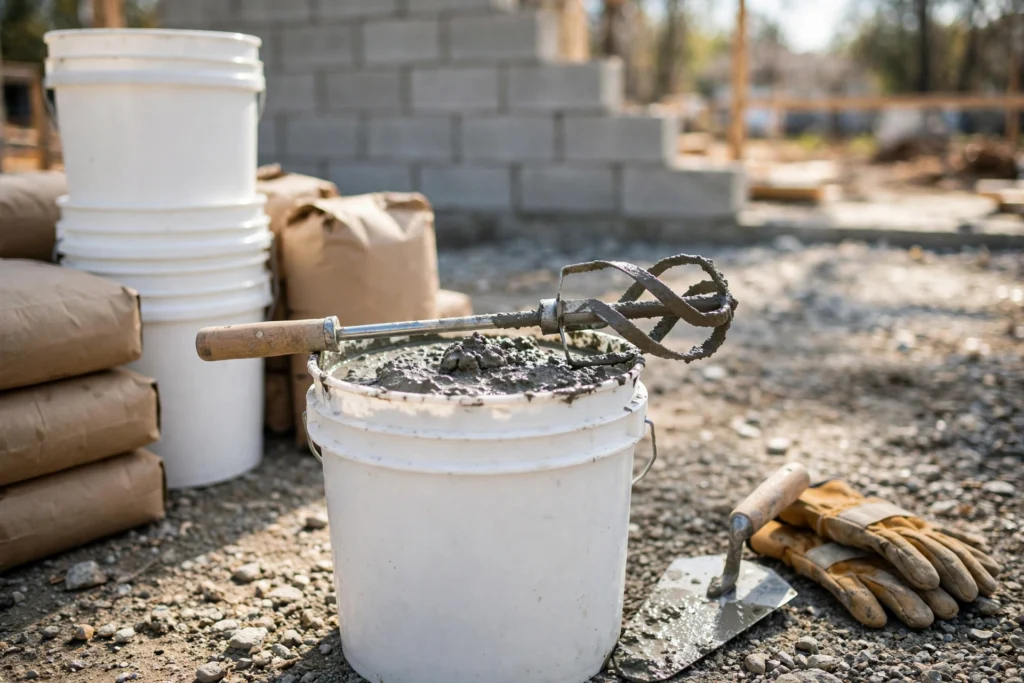
A concrete mixing bucket is an HDPE pail — usually 5 gallons — for hand-mixing bagged concrete, mortar, or grout. One 80-lb bag of Quikrete Concrete Mix yields about 0.60 cubic feet and needs about 3 quarts of water, and a 5-gallon bucket holds one 60-lb bag of mixed concrete. Contractors should buy 90-mil HDPE pails with metal handles, by the pallet.
Every concrete crew mixes in a bucket, and almost nobody thinks about the bucket until it fails. A thin pail flexes under a paddle mixer, cracks at the handle mounts, or splits when a full load of wet concrete gets carried across a slab — and a split bucket on a pour day costs far more than the bucket. The 5-gallon HDPE pail is the standard mixing vessel on American jobsites for a reason: it matches the bag sizes crews actually buy, it survives the paddle, and it costs little enough to stock by the pallet. This guide is written for contractors, masons, concrete crews, and distributors buying concrete mixing buckets wholesale. It covers which bucket and size to buy, the bag yields and water ratios that decide the size, how to mix in a bucket without weakening the pour, silica safety, and how to size a bulk order.
What Makes a Bucket a Concrete Mixing Bucket
A concrete mixing bucket is not a special product category with its own mold — it is a heavy-duty HDPE pail chosen for a hard job, and the spec is what separates it from a household bucket. Four features matter: wall thickness, handle strength, a flat stable base, and volume markings. Heavy-duty pails run around 90-mil wall thickness, which resists the flex and cracking a paddle mixer causes in thin-walled buckets. A metal handle (not plastic) carries a full bucket of wet concrete — roughly 90 to 95 pounds — without bending or snapping at the mounts. A flat base keeps the bucket from tipping while the paddle spins, and molded gallon and liter graduations on the side let a crew measure water accurately instead of guessing, which is the single most common mixing mistake.
One clarification up front, because search results mix two products: a skid-steer or excavator mixer bucket is a steel machine attachment that costs hundreds to thousands of dollars and mixes by the cubic yard. This guide is about the plastic pail a crew mixes bagged concrete in by hand or with a drill paddle — the bucket that gets bought by the pallet, used on every small pour, fence-post footing, and patch job, and replaced when it wears out. If your jobs are bagged mix and a paddle, the pail is the product; if your jobs are truckloads of ready-mix, you need the attachment, not this guide.
Bag Yields & Water Ratios: The Numbers That Decide Your Bucket Size
The bucket size follows the bag size, and the bag size is fixed by the manufacturer — so start with the yield table from the Quikrete Concrete Mix data sheet. One 80-lb bag yields about 0.60 cubic feet of mixed concrete, a 60-lb bag about 0.45, a 50-lb bag about 0.375, and a 40-lb bag about 0.30. A cubic yard is 27 cubic feet, which means 45 bags of 80-lb mix per yard — and bagged mix stops being practical above about one cubic yard, where ready-mix wins on cost and labor.
Water is where pours are won or lost. For each 80-lb bag, start with about 6 pints (3 quarts, 2.8 liters) of clean water and add more only up to a maximum of 9 pints (4.5 quarts). For a 60-lb bag, start with 4 pints and stop at 7. The rule crews learn the expensive way: one extra quart of water per 80-lb bag can reduce the concrete’s strength by up to 40 percent. Wet, soupy concrete is easier to pour and weaker when it cures — the data sheet’s 4,000 PSI 28-day strength assumes the stated water range, not a bucket topped off to make the mix flow. Graduated buckets earn their keep here: measure the water, pour two-thirds of it in first, add the dry mix, then add the rest slowly until the mix reaches a stiff, moldable consistency with no dry pockets and no standing puddles.
A 5-gallon bucket holds 0.668 cubic feet, so the arithmetic is kind to crews: one 60-lb bag (0.45 ft³) fills a 5-gallon bucket to about two-thirds — a comfortable working load with room for the paddle. One 80-lb bag (0.60 ft³) nearly fills the same bucket, leaving almost no room to mix without slopping over the rim; mix 80-lb bags in two batches in a 5-gallon pail, or step up to a larger tub. And respect the weight: mixed concrete runs about 140 pounds per cubic foot, so a full 5-gallon bucket weighs roughly 90 to 95 pounds. That is a two-person lift or a wheelbarrow load, not a one-hand carry across a slab.
Bag yield and water reference (from the Quikrete Concrete Mix No. 1101 data sheet):
| Bag size | Yield (mixed concrete) | Starting water | Maximum water |
|---|---|---|---|
| 40 lb | 0.30 cu ft | 3 pt (1.4 L) | 4.5 pt (2.1 L) |
| 50 lb | 0.375 cu ft | 3.5 pt (1.7 L) | 5.5 pt (2.6 L) |
| 60 lb | 0.45 cu ft | 4 pt (1.9 L) | 7 pt (3.3 L) |
| 80 lb | 0.60 cu ft | 6 pt (2.8 L) | 9 pt (4.3 L) |
| 90 lb | 0.675 cu ft | 7 pt (3.3 L) | 10 pt (4.7 L) |
Comparison Table: Concrete Mixing Buckets Wholesale Options at a Glance
| Bucket | Best concrete use | Mix capacity | Why wholesale buyers choose it |
|---|---|---|---|
| 5-gallon HDPE bucket, 90-mil | Standard hand-mixing, fence posts, patch work | One 60-lb bag per batch | The jobsite standard; matches bag sizes, stacks on pallets, cheapest per unit |
| 5-gallon graduated HDPE bucket | Any mix where water accuracy matters | One 60-lb bag per batch | Molded gallon/liter markings stop water-ratio mistakes |
| 2-gallon HDPE bucket | Grout, mortar touch-ups, small batches | Half a 40-lb bag or less | Light when full, precise for small mixes; see our 2-gallon buckets in bulk |
| 3.5-gallon HDPE bucket | Mid-size batches, mortar work | One 40-lb bag | The in-between size for crews that find 5 gallons too heavy |
| 6-gallon HDPE bucket | Mortar crews, larger single batches | One 80-lb bag with mixing room | Holds a full 80-lb bag and still leaves paddle room |
| Rubber mortar tub / flex tub | Large batches, wheelbarrow-free mixing | Multiple bags | Flexible walls release dried concrete; the batch-mixing option |
Size-Selection Guide: Match the Concrete Mixing Bucket to the Mix
Buy by the batch, not by the bucket. For standard concrete work — fence posts, deck piers, mailbox footings, sidewalk patches — the 5-gallon bucket is the default, because one 60-lb bag per batch is the rhythm of a small pour and the bucket is light enough to carry empty and strong enough to survive the paddle. For grout, thinset, and mortar touch-ups, step down to a 2-gallon bucket: small batches stay workable longer, the bucket is light enough to carry one-handed up a ladder or scaffold, and you waste less material when the batch is small. For mortar crews laying block or brick all day, the 6-gallon bucket earns its place: it holds a full 80-lb bag of mortar mix with room to work the paddle, so the crew mixes once per bag instead of splitting batches.
Order the mix of sizes your crews actually run, not one size for everything. A typical concrete-and-masonry contractor stocks 5-gallon buckets as the bulk buy, 2-gallon buckets for finish and grout work, and a smaller count of 6-gallon buckets for mortar days. Keep the sizes color-coded or labeled — a bucket that held mortar yesterday and concrete today is fine, but a bucket that held grout and gets used for a structural footing mix is a cross-contamination risk only if residue is left inside, which is why cleaning matters (see below). For the full breakdown of the smaller size, see our guide to 2-gallon buckets in bulk, and for the standard size, see our 5-gallon buckets.
HDPE Specs That Matter on a Jobsite
Not every 5-gallon pail survives concrete work, and the difference is in the resin and the wall. Specify virgin HDPE (resin code #2): it is the tough, chemical-resistant plastic that handles wet concrete’s alkalinity without degrading, and it stays flexible enough in cold weather to avoid brittle cracking — heavy-duty pails are rated from about −5°F to 160°F. Recycled-content pails of unknown origin are a false economy for mixing: inconsistent walls, unknown additives, and a higher crack rate under a paddle. Ask your supplier for the wall thickness in mils — 90-mil is the heavy-duty benchmark — and for a metal handle with reinforced mounts, because the handle is the failure point on a full bucket.
Graduated markings are worth specifying on at least part of the order. A bucket with molded liter and gallon lines turns water measurement from a guess into a reading, and the water ratio is the variable that decides whether the pour hits its rated strength. Lids matter less for mixing than for storage: a snap lid keeps dry bagged mix portions and tools dry in the truck, and gamma seal lids turn a bucket into a sealed container for leftover dry mix between jobs — see our gamma seal lids guide. For wash buckets and cleanup pails that ride along with the mixing crew, see our guide to janitorial buckets in bulk.
Mixing in a Bucket: The 5-Step Method
Mixing concrete in a bucket is simple, but the order of operations decides the result. First, measure the water — about 3 quarts for an 80-lb bag, about 2 quarts for a 60-lb bag — and pour two-thirds of it into the bucket. Second, add the dry mix slowly, about half the bag at a time, so the water wets the powder instead of the powder sitting dry on top. Third, mix with a paddle mixer on a drill or a hoe, working from the bottom up until there are no dry pockets; a drill paddle is faster and more consistent than hand mixing, and it is the reason the bucket wall needs to be 90-mil. Fourth, add the remaining water a little at a time until the mix reaches a stiff, moldable consistency — it should hold its shape on a trowel, not slump off it. Fifth, pour and place within the working time: standard concrete mix stays workable for about an hour, while fast-setting mixes set in 20 to 40 minutes and must be placed immediately. Never retemper a stiffening mix by adding water — it weakens the pour. If the batch starts to set in the bucket, discard it and mix fresh.
Safety First: Silica Dust and Wet Concrete
Concrete work carries two health risks that a bucket buyer should plan for, and both are cheap to control. The first is silica dust: dry concrete and mortar mixes contain crystalline silica, and OSHA’s crystalline silica overview notes that about 2.3 million US workers are exposed to silica on the job, with inhaled respirable particles raising the risk of silicosis — an incurable lung disease — plus lung cancer, COPD, and kidney disease. Mix outdoors or with ventilation, keep the dry mix downwind, wear a NIOSH-approved respirator when pouring dry bags, and dampen dusty work rather than sweeping it dry. The second risk is wet concrete itself: fresh concrete is highly alkaline and the Quikrete data sheet warns it causes severe skin burns and serious eye damage, so crews should wear impervious gloves such as nitrile, eye protection, and boots, and wash skin contact off promptly. Keep a wash bucket and clean water on the truck — it is the cheapest safety equipment on the job.
Buying Concrete Mixing Buckets Wholesale: What to Ask Your Supplier
Concrete mixing buckets are a consumable on a busy crew: they crack, they get left on jobs, and dried concrete eventually claims them. Buying concrete mixing buckets wholesale keeps the per-unit cost down and spares on the truck. Before placing a bulk order, confirm these details: Minimum order quantities and pallet counts — suppliers like ThoseBucketPeople sell in pallet quantities, which drops the per-unit price well below retail and keeps a whole crew stocked from one order. Wall thickness and resin — specify virgin HDPE and 90-mil walls in writing, not just “heavy-duty,” so the delivered pails match the sample. Handle type — metal handles with reinforced mounts for full-bucket lifts; plastic handles are fine for wash and carry buckets but not for 90-pound loads. Graduations — order at least part of the run with molded measurement markings for water accuracy. Lids with the buckets — snap lids for dry-mix storage and transport, gamma seal lids for sealed leftover mix; mismatched lids are the number-one bucket complaint on any crew. See our guide to buckets with lids in bulk for the full lid breakdown. Color-coding — one color for mixing, one for wash water, one for tools, so a wash bucket never becomes a mixing bucket mid-pour. Delivery and freight — pallets stack and ship efficiently, but confirm freight to the yard or jobsite before ordering, and ask about volume pricing for your actual quantities rather than paying list price.
Cleaning & Reuse: Don’t Let Concrete Cure in the Bucket
A mixing bucket’s service life is decided in the ten minutes after the pour. Rinse the bucket with clean water immediately after emptying it, scrub the inside with a stiff brush, and let it dry fully before stacking — wet concrete that cures inside a bucket is far harder to remove than wet concrete that gets rinsed out. If concrete does set inside, flex the bucket walls to crack the residue loose and chip out the remainder; rubber tubs release dried concrete more easily than rigid HDPE, which is why some crews keep one flex tub for the messiest batches. Retire buckets that are cracked, deeply gouged, or warped: a cracked bucket can split under a full load, and a warped base tips during mixing. Never dump concrete wash water into a storm drain or onto soil — it is highly alkaline. Let wash water settle in a dedicated bucket or tub, pour off the clear water, and dispose of the settled solids with construction waste under local rules.
Frequently Asked Questions
How many bags of concrete can I mix in a 5-gallon bucket?
One 60-lb bag per batch is the comfortable limit: it yields about 0.45 cubic feet and fills the bucket to roughly two-thirds, leaving room for the paddle. An 80-lb bag (0.60 ft³) nearly fills the bucket, so mix it in two batches or step up to a 6-gallon bucket or a mortar tub.
How much water do I need for an 80-lb bag of concrete?
Start with about 3 quarts (6 pints) of clean water and add more only up to a maximum of 4.5 quarts (9 pints), per the Quikrete Concrete Mix data sheet. Adding one extra quart beyond the maximum can cut the cured strength by up to 40 percent.
Can I mix concrete in any 5-gallon bucket?
No. Use a heavy-duty HDPE bucket with about 90-mil walls and a metal handle. Thin-walled household or food-service pails flex under a paddle mixer, crack at the handle mounts, and can split when carried full of wet concrete.
How heavy is a full 5-gallon bucket of mixed concrete?
Roughly 90 to 95 pounds. Mixed concrete weighs about 140 pounds per cubic foot and a 5-gallon bucket holds 0.668 cubic feet, so treat a full bucket as a two-person lift or a wheelbarrow load.
How long does mixed concrete stay workable in the bucket?
Standard concrete mix stays workable for about an hour; fast-setting mixes set in 20 to 40 minutes. Never add water to a stiffening batch to extend it — that weakens the pour. Mix only what the crew can place in time.
Do I need a lid on a concrete mixing bucket?
Not for mixing, but lids earn their keep around the job: snap lids keep dry mix portions and tools dry in the truck, and gamma seal lids seal leftover dry mix between jobs so it stays usable.
How do I clean dried concrete out of a bucket?
Clean it wet and it is easy: rinse immediately after the pour and scrub. Once concrete cures inside, flex the walls to crack the residue and chip it out. Retire buckets that are cracked or warped, and never dump wash water into a storm drain.
Get Concrete Mixing Buckets in Bulk from ThoseBucketPeople
Whether you run a concrete crew, a masonry outfit, or a supply house serving both, we supply the heavy-duty buckets contractors actually mix in — 5-gallon buckets for standard batches, 2-gallon buckets for grout and finish work, and lids to match, in pallet quantities with nationwide delivery. Request a quote through our Get a Quote page or contact us for volume pricing and delivery options.