
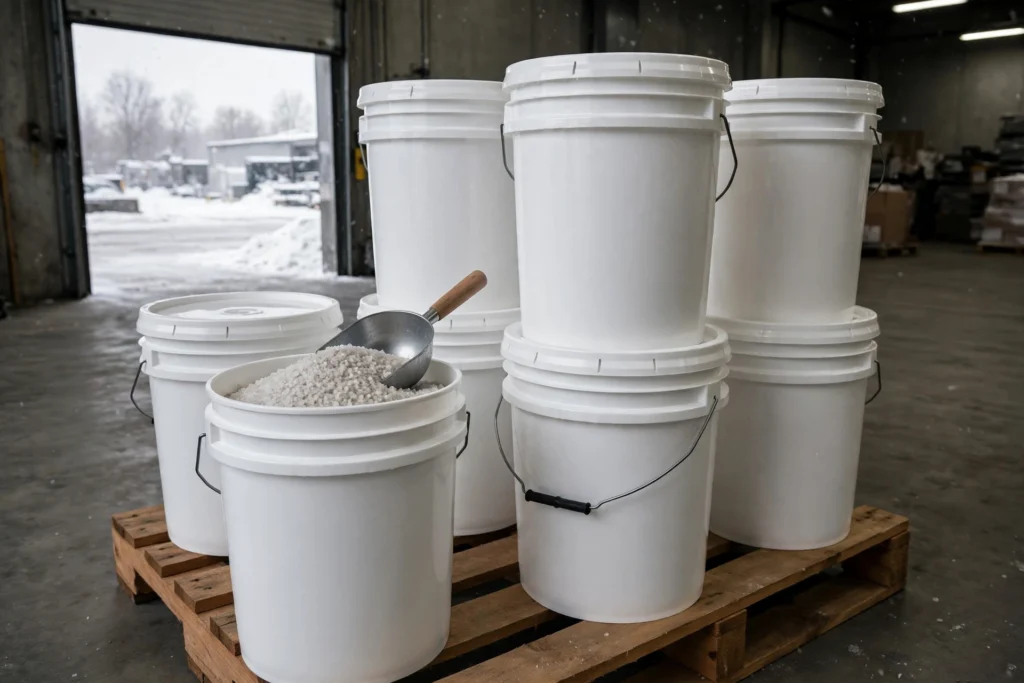
For deicing salt buckets wholesale, buy heavy-duty HDPE 5-gallon buckets with tight-fitting lids for bulk salt storage and spreading, and 2-gallon buckets for stairs, entrances, and spot treatment, with gamma seal lids on every bucket that gets opened daily. Salt is hygroscopic, so the lid and the bucket material matter more than the salt brand.
November is the month winter-maintenance buyers should already be stocked. The first freeze rarely announces itself with a convenient delivery window, and the crews that scramble for salt in January pay retail, wait on freight, and spread from torn bags. Buying deicing salt buckets wholesale before the season solves the container problem once: sealed, stackable, labeled buckets staged at every entrance, on every truck, and in every storage room, ready before the forecast turns. This guide is written for snow contractors, property managers, facilities teams, schools, and distributors buying deicing salt buckets in bulk. It covers which bucket and lid to buy, which deicer goes in which bucket, how to store salt so it stays free-flowing, and how to size a bulk order.
Deicing Salt Buckets Wholesale: Why the Bucket Matters as Much as the Salt
Salt fails in storage long before it fails on pavement. Deicing salts are hygroscopic: they actively draw moisture from the air, and once humidity climbs past roughly 75 percent, that absorption starts dissolving the granules inside the container. The result is caking — absorbed moisture forms brine, the brine recrystallizes, and a bucket of free-flowing salt becomes a solid block that has to be smashed apart before a single walkway can be treated. A torn bag in a damp garage does this in weeks. A sealed HDPE bucket with a gamma seal lid stops it, because the bucket blocks liquid water and the screw-on lid blocks humid air every time it is closed.
Material is the second decision, and it is not close. HDPE (high-density polyethylene, resin code #2) resists chloride corrosion, survives freezing temperatures without going brittle in normal winter use, and is the material storage guides recommend for salt containers. Metal buckets are the wrong buy for salt: chloride salts react with and corrode metal over time, so a metal pail that looks fine in November can be rusting through by February. For deicing salt buckets wholesale, specify HDPE, a tight-fitting or gamma seal lid, and a sturdy handle — salt is dense, and a full bucket is a heavy lift.
Comparison Table: Deicing Salt Buckets Wholesale Options at a Glance
| Bucket | Best winter use | Lid pairing | Why wholesale buyers choose it |
|---|---|---|---|
| 5-gallon HDPE bucket | Bulk salt storage, truck stock, large entrances | Gamma seal lid for daily access; snap lid for sealed reserve stock | The standard: holds a full working supply, stacks on pallets, fits a scoop |
| 2-gallon HDPE bucket | Stairs, doorways, spot treatment, small crews | Snap lid or gamma seal lid | Light enough to carry one-handed on icy steps; the entrance-station size |
| 5-gallon bucket with scoop | Entrance stations and sidewalk crews | Gamma seal lid | Scoop stays with the bucket, so crews spread evenly instead of dumping piles |
| Sealed reserve 5-gallon bucket | Off-season and backup stock | Snap lid, unopened until needed | Dry granular salt kept sealed has an indefinite shelf life, so reserve stock is not wasted |
Size-Selection Guide: Match the Deicing Salt Bucket to the Job
Buy by the crew and the site, not by a single size. A 5-gallon bucket is the workhorse for deicing salt buckets wholesale: it holds enough salt for a sidewalk run or an entrance station without constant refills, stacks neatly on a pallet or a truck bed, and pairs with a scoop for controlled spreading. It is also heavy when full — salt is denser than water, so a full 5-gallon bucket of rock salt weighs well over 40 pounds — which makes it a two-hand lift and a poor choice for carrying up icy stairs.
That is where the 2-gallon bucket earns its place. For stairs, narrow walkways, and doorway stations, a 2-gallon bucket is light enough to carry safely with one hand free for a rail, and small enough to stage at every door without blocking egress. Order both sizes together: 5-gallon buckets for storage, trucks, and large areas, and 2-gallon buckets for the spots where a heavy bucket is a slip hazard in itself. For a full breakdown of the smaller size, see our guide to 2-gallon buckets in bulk, and for the standard size, see our 5-gallon buckets.
Which Deicer Goes in the Bucket: Temperature Limits That Decide the Buy
Not every salt in a bucket works in every storm, and stocking one product for all temperatures is the most expensive mistake in winter maintenance. The Minnesota Stormwater Manual’s deicing chemicals overview gives lowest practical melting pavement temperatures — the temperatures that matter in the field, not laboratory eutectic values printed on a bag. Judge pavement temperature, not air temperature, before choosing a bucket to open.
Sodium chloride (rock salt) is the cheapest and most widely used deicer, but its lowest practical melting pavement temperature is 15°F. Below that it gets too slow to be useful, and dry salt on cold pavement can blow away before it melts anything. At 30°F pavement, one pound of rock salt melts 46.3 pounds of ice in about 5 minutes; at 15°F, that same pound melts only 6.3 pounds of ice and takes about an hour. Magnesium chloride works down to −10°F pavement, and calcium chloride down to −20°F, which is why blends and calcium products are the cold-snap stock. Calcium magnesium acetate (CMA) works only down to about 20°F but is far less corrosive, so it suits sensitive concrete and landscaped areas. Label every bucket with its contents and its temperature limit — a crew grabbing rock salt at 5°F is wasting product and leaving ice behind.
Storing Deicing Salt Buckets Wholesale So Salt Stays Free-Flowing
Storage is where wholesale orders are won or lost. Keep deicing salt buckets wholesale stock cool, dry, and off the floor. Concrete wicks moisture upward, so elevate buckets on pallets, shelving, or plastic blocks rather than setting them directly on a garage or warehouse floor. Store away from floor drains, water heaters, and windows that get left open, and keep the storage temperature as steady as possible, since temperature swings cause condensation inside containers.
Seal discipline matters as much as location. An opened bag transferred into a bucket must be closed after every use — a gamma seal lid makes this easy, because it screws on and off in seconds, while a snap lid that is left ajar is barely better than an open bag. If salt must stay in its original bag, roll the top down tightly, tape it, and put the whole bag inside a lidded bucket as a second barrier. Label the outside with the product type and the date stored, so older stock rotates first. When salt is stored dry and sealed, it does not expire: dry granular ice melt kept sealed has an indefinite shelf life, so November’s reserve stock is still good next winter. If light caking does appear, breaking the sealed bucket’s contents apart usually restores it; salt that has turned sludgy or liquid has lost effectiveness and should be handled under local waste guidance, not spread hopefully.
Spreading From a Bucket: Rates, Technique, and What Not to Do
A bucket makes spreading controllable, which is where most sites overspend. Minnesota guidance for parking lots and sidewalks targets under 4 pounds of salt per 1,000 square feet, with about a 3-inch space between granules — one pound of salt is roughly a heaping 12-ounce coffee mug. More salt does not mean more melting: excess salt stays on dry pavement after the storm, washes into drains and landscaping with the melt, and buys nothing. Plow or shovel first, then spread a light, even layer from the bucket with a scoop, and let the salt brine and break the ice bond before re-treating.
Never use a salt bucket for food, drinking water, or pet food afterward, and never store food-grade buckets and salt buckets together without labels — salt residue and chloride dust contaminate anything stored in the same container. Keep a dedicated scoop in each salt bucket so crews are not borrowing a food scoop or a bare hand, and rinse buckets at season’s end before stacking them for summer. For facilities that also buy cleaning supplies in bulk, our janitorial buckets in bulk guide covers the same HDPE sizing logic for mop and cleaning use — but keep the two fleets separate and color-coded.
Buying Checklist for Deicing Salt Buckets Wholesale
Use this checklist before placing a bulk order, and keep it with the quote request:
- Sizes confirmed per site: 5-gallon buckets for storage, trucks, and large areas; 2-gallon buckets for stairs and entrances.
- Material confirmed HDPE (#2) with sturdy handles; no metal buckets for long-term salt storage.
- Lids matched to use: gamma seal lids on daily-access buckets, snap lids on sealed reserve stock.
- Contents labeled per bucket: product type, temperature limit (rock salt 15°F, magnesium chloride −10°F, calcium chloride −20°F), and storage date.
- Storage planned before delivery: pallets or shelving, a cool dry room, and entrance stations staged before the first freeze.
- Scoops ordered with the buckets, one per daily-access bucket, so spreading stays even.
- Reserve stock sized for at least five snow or ice events, per winter-maintenance best practice, with sealed buckets held for the next season if unused.
- Supplier asked about matched sets (buckets plus lids plus scoops), pallet quantities, and delivery timing before winter.
Frequently Asked Questions
What size bucket is best for deicing salt?
A 5-gallon HDPE bucket is the standard for storage and large areas, while a 2-gallon bucket suits stairs and entrances where a full 5-gallon bucket is too heavy to carry safely. Most commercial buyers order both sizes together.
Why does deicing salt cake in storage?
Deicing salts are hygroscopic and draw moisture from humid air; above roughly 75 percent relative humidity, absorbed moisture dissolves granules, then recrystallizes into hard clumps. Sealed HDPE buckets with gamma seal lids block that moisture.
Can I store rock salt in a metal bucket?
Not for long-term storage. Chloride salts corrode metal over time, so metal pails can rust through during a single season. HDPE buckets resist chloride corrosion and are the recommended container for salt.
How cold is too cold for rock salt?
Rock salt’s lowest practical melting pavement temperature is 15°F; below that it works too slowly to be useful. For colder pavement, switch to magnesium chloride (down to −10°F) or calcium chloride (down to −20°F).
How much salt should I spread per 1,000 square feet?
Minnesota guidance targets under 4 pounds per 1,000 square feet, with about 3 inches between granules. One pound is roughly a heaping 12-ounce coffee mug; spreading more wastes product without melting more ice.
Does stored deicing salt expire?
Dry granular salt kept sealed in a bucket has an indefinite shelf life, so properly stored reserve stock carries into the next winter. Salt that has turned sludgy or liquid has lost effectiveness and should not be spread hopefully.
Should I buy deicing salt buckets wholesale before winter?
Yes. Ordering in November secures pallet pricing, matched lids and scoops, and staged entrance stations before the first freeze, instead of paying retail and waiting on freight during a storm week.
Get Deicing Salt Buckets Wholesale from ThoseBucketPeople
Whether you run a snow crew, manage a property portfolio, or stock a facilities department, we supply the buckets winter buyers actually use — 5-gallon buckets for storage and trucks, 2-gallon buckets for stairs and entrances, and lids to match, in bulk quantities with nationwide delivery. Request a quote through our Get a Quote page or contact us for volume pricing and delivery options. For the smaller size in detail, see our guide to 2-gallon buckets in bulk, and for sealed storage that stays airtight through daily use, see our gamma seal lids guide.