
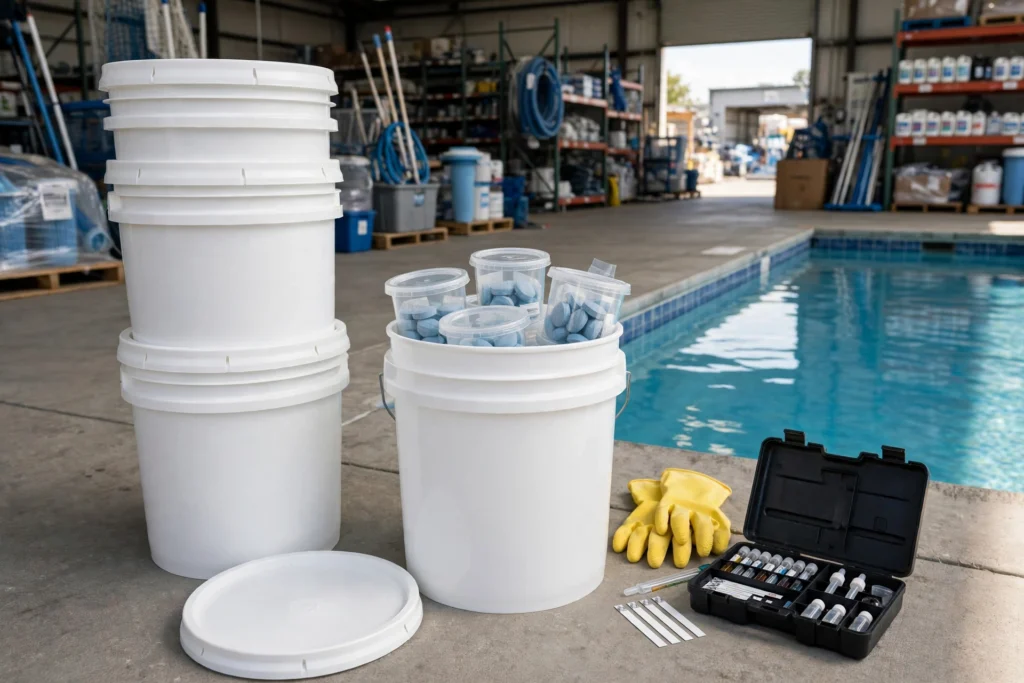
A bucket for pool chemicals is a chemical-rated HDPE pail — usually 5 gallons, UN-rated, with a gasket or locking lid — used to store, transport, and dispense chlorine tablets, shock, and other pool chemicals. Pool service companies and commercial pool operators buy buckets for pool chemicals wholesale by the pallet, because every route truck and pump room needs dedicated, labeled pails for each chemical. One rule governs everything below: the CDC says to keep pool chemicals in their original manufacturer-labeled containers, stored below 95°F, with each chemical in its own dedicated location.
Pool chemicals are the one bucket purchase where the wrong pail is not just a waste of money — it is a safety incident waiting to happen. Chlorine tablets, granular shock, and muriatic acid are all oxidizers or corrosives, and they react violently with each other, with water, and with the wrong plastic. A food-service pail or a thin household bucket has no place in a pump room. This guide is written for pool service companies, hotel and resort maintenance teams, HOAs, municipal pool operators, and distributors buying buckets for pool chemicals wholesale. It covers which bucket and lid to buy for each chemical, the UN ratings and HDPE specs that matter, the CDC storage rules your crew must follow, and how to size a bulk order.
What “Buckets for Pool Chemicals” Actually Means
Search results for buckets for pool chemicals wholesale mostly sell the chemicals, not the buckets — so the first job is to separate the three different buckets a pool operation actually buys. First, the chemical’s own shipping pail: bulk chlorine tablets arrive in 5-gallon HDPE pails — 10, 25, 50, or 100 pounds of 3-inch tablets — with a child-resistant locking lid. That pail IS the storage container, and the CDC’s rule is to keep the chemical in it, in its original manufacturer-labeled container, until it is used up. Second, the secondary containment pail: a clean, labeled HDPE bucket that a leaking or damaged chemical pail sits inside, so a spill cannot reach another chemical or the floor — the CDC’s pool chemical safety guidance specifically calls for spill containment features in chemical storage areas. Third, the dedicated dosing and handling bucket: a labeled pail used to carry measured tablets or granular shock from the storage room to the pool, and to pre-dissolve chemicals exactly when the product label directs it. Never transfer pool chemicals into an unmarked bucket, a food bucket, or a drink container — the original label carries the chemical name, hazard warnings, and instructions, and an unmarked bucket is how accidents happen.
The Pool Chemicals That Come in Buckets — and Why Each Needs Its Own Pail
Pool chemistry runs on a small set of products, and every one of them needs its own dedicated, labeled bucket — never a shared one. Trichlor tablets (trichloroisocyanuric acid) are the workhorse sanitizer: 3-inch tablets weighing about 8 ounces each, 99% trichlor with 90% available chlorine, slow-dissolving and stabilized with cyanuric acid. They are sold in 10, 25, 50, and 100-pound buckets, and a 50-pound bucket holds roughly 100 tablets at about $80–$130 online. Dosing runs 1–2 tablets per 10,000 gallons per week, targeting 1–3 ppm free chlorine. Calcium hypochlorite (cal hypo) shock is a granular oxidizer used to shock the pool after heavy use or algae — it is a different chlorine compound from trichlor, and the CDC is explicit: never mix different chlorine products together. Dichlor is a fast-dissolving granular chlorine used for spas and shock dosing. Muriatic acid lowers pH and alkalinity and is a liquid, sold in 1-gallon jugs — it must never be stored above or beside dry chlorine, because chlorine plus acid can release toxic chlorine gas. Alkalinity increaser (sodium bicarbonate) and stabilizer (cyanuric acid) are granular and comparatively mild, but they still get their own labeled pails. The buying rule is simple: one chemical, one labeled bucket, one storage location — and if a bucket held trichlor yesterday, it does not hold cal hypo today.
Comparison Table: Buckets for Pool Chemicals Wholesale Options at a Glance
| Bucket | Best pool-chemical use | Capacity | Why wholesale buyers choose it |
|---|---|---|---|
| 5-gallon HDPE pail, UN-rated, locking lid | Bulk trichlor tablets (25–50 lb) | 25–50 lb of tablets | The industry standard; chemicals ship in it, child-resistant lid, stacks on pallets |
| 5-gallon HDPE pail, gasket lid | Granular shock, dichlor, stabilizer | 25–50 lb of granules | Gasket seal keeps moisture out — wet chlorine reacts and off-gasses |
| 2-gallon HDPE bucket, snap lid | Dosing, carrying measured tablets to the pool | A day’s tablets per route stop | Light when full, easy to label per chemical; see our 2-gallon buckets in bulk |
| 5-gallon HDPE bucket, open-head | Secondary containment for a leaking chemical pail | Holds a full 5-gal pail | Cheap insurance: a spill stays inside the outer bucket, not on the floor |
| 6-gallon HDPE bucket | Larger granular orders, high-volume routes | 50+ lb of granules | Holds a full 50-lb bag of shock with room to scoop |
| Tight-head HDPE pail with bung | Liquid chemicals (liquid chlorine, acid) | 5 gal of liquid | Fixed top with bung openings; pours without removing the lid |
HDPE Specs and UN Ratings: What Makes a Pail Chemical-Rated
Not every 5-gallon pail survives pool chemicals, and the difference is in the resin, the wall, and the certification. Specify virgin HDPE (resin code #2): it is chemically resistant to chlorine compounds and acids, stays tough from about −5°F to 160°F, and is the resin behind nearly every chemical pail on the market. Recycled-content pails of unknown origin are a false economy for chemicals — inconsistent walls, unknown additives, and a higher crack and permeation rate. Ask for the wall thickness in mils — 90-mil is the heavy-duty benchmark — and for a metal handle with reinforced mounts, because a full 50-pound bucket of tablets is a real load.
Then ask for the UN rating. A UN-rated pail carries a code proving it passed the UN’s drop, stacking, hydrostatic, and leakproofness tests for shipping hazardous materials — the framework behind DOT 49 CFR in the US. Under the DOT packaging standards for plastic drums (49 CFR 178), 1H1 designates a tight-head (non-removable head) plastic drum and 1H2 a removable-head plastic drum. For pool chemicals, the removable-head (open-head) UN-rated pail is the common choice for solids like tablets and granules, while tight-head pails suit liquids. The rating matters even if you never ship chemicals yourself: it is the only independent proof the pail was tested against the contents it will hold. Order the rating in writing, not just “chemical-grade,” and check the code molded into the pail when the delivery arrives.
Size-Selection Guide: Match the Bucket to the Chemical and the Route
Buy by the chemical and the crew, not by the bucket. For bulk tablet storage, the 5-gallon pail is the default: it is the size chlorine tablets ship in (10, 25, 50, and 100-pound buckets), it stacks on pallets, and one 50-pound pail covers roughly a season for an average in-ground pool. For granular shock and dichlor, the same 5-gallon pail with a gasket lid is the pick — the gasket keeps humidity out, and moisture is the enemy of dry chlorine. For route work, step down to a 2-gallon bucket: a service tech carries a day’s measured tablets from the truck to the pool in a labeled 2-gallon pail, light enough to carry one-handed and small enough that a spill is a small spill. For liquid chlorine and muriatic acid, use a tight-head pail with a bung or the manufacturer’s own jug, and store liquids low — never above dry chemicals — so a leak cannot drip onto tablets below. For secondary containment, keep open-head 5-gallon pails in the pump room: a damaged chemical pail sits inside one, and the outer pail contains any leak. Color-code or label everything — one color or label per chemical, so a trichlor bucket is never mistaken for a cal hypo bucket. For the full breakdown of the smaller size, see our guide to 2-gallon buckets in bulk, and for the standard size, see our 5-gallon buckets.
CDC Storage Rules: The Rules Your Pump Room Must Follow
The CDC’s pool chemical safety guidance is the authority for how these buckets get stored, and it is worth building your pump room around it. Store pool chemicals below 95°F (35°C) and in the conditions the manufacturer recommends — cool, dry, out of direct sunlight, and protected from getting wet. Store each pool chemical separately in its own dedicated location, and keep incompatible chemicals away from each other — chlorine and acid in particular must never share a shelf, because contact can release toxic chlorine gas. Keep every chemical in its original, manufacturer-labeled container with the lid closed, and return it to its locked storage spot immediately after use. Build in spill containment — secondary containment in the storage area — so a leak or spill cannot mix with any other substance. Keep ignition sources out of the chemical storage area entirely: no gasoline, diesel, or gas-powered equipment in the pump room. Allow only trained staff to handle pool chemicals, and post the safety instructions in the storage area. And never store food or drinks near pool chemicals. A pallet of UN-rated pails is only safe storage if the room around them follows these rules — the bucket is one layer, and the room is the other.
Lids That Matter: Locking, Gasket, and Gamma Seal
The lid is where pool chemical buckets differ most from ordinary pails. Child-resistant locking lids are the standard on bulk tablet pails — a 50-pound bucket of chlorine tablets in a garage or pump room must not open to a curious child, and many bulk tablet brands ship with a locking lid as a feature. Gasket lids seal against humidity: dry chlorine that absorbs moisture can react, off-gas, and lose strength, so a gasket lid on a shock or dichlor pail is worth specifying on at least part of the order. Gamma seal lids screw on and off for an airtight seal and one-handed access — ideal for the working pail a route tech opens dozens of times a week, since they reseal reliably every time. See our gamma seal lids guide for sizing and bulk buying. Snap lids are fine for secondary containment pails and wash buckets, where the seal is not load-bearing. Whatever the lid, label it: the chemical name and hazard warnings belong on the pail and on the lid, so a lid separated from its bucket is still identifiable. For the full lid breakdown, see our guide to buckets with lids in bulk.
Buying Buckets for Pool Chemicals Wholesale: What to Ask Your Supplier
Pool chemical buckets are a consumable on a busy route: they crack, they get left at job sites, and a pail that held chlorine is retired, never repurposed. Buying buckets for pool chemicals wholesale keeps the per-unit cost down and spares on the truck. Before placing a bulk order, confirm these details: Minimum order quantities and pallet counts — suppliers like ThoseBucketPeople sell in pallet quantities, which drops the per-unit price well below retail and keeps a whole route fleet stocked from one order. Resin and wall thickness — specify virgin HDPE and 90-mil walls in writing, not just “heavy-duty,” so the delivered pails match the sample. UN rating — ask for the rating code (1H1 or 1H2) in writing for any pail that will hold or ship regulated chemicals. Lid type per chemical — locking lids for tablet pails, gasket lids for granular shock, gamma seal lids for working pails; order lids with the buckets, because mismatched lids are the number-one bucket complaint on any crew. Color-coding and labeling — one color or label per chemical, so a trichlor bucket is never confused with a cal hypo bucket. Delivery and freight — pallets stack and ship efficiently, but confirm freight to the yard or warehouse before ordering, and ask about volume pricing for your actual quantities rather than paying list price.
Cleaning, Reuse, and Retirement: A Chemical Bucket Has One Job
A bucket that held pool chemicals is a chemical bucket for life — it is never repurposed for food, drinking water, or anything else. Rinse dosing and handling buckets with clean water after use and let them dry fully before stacking, and replace cracked liners and worn gaskets; a cracked pail that splits under 50 pounds of tablets is a spill in the truck bed. Retire buckets that are cracked, deeply gouged, warped, or stained in ways that won’t wash out — damaged plastic can hide residue and fail under load. Never mix chemicals in a bucket: if the product label directs pre-dissolving, add the chemical to water, never water to the chemical, because the reverse can cause a violent reaction. And never pour leftover or unwanted pool chemicals into a pool, down a drain, or into household trash — the CDC directs owners to contact the manufacturer or the local hazardous-materials authority for disposal guidance. For wash buckets and cleanup pails that ride along with the service crew, see our guide to janitorial buckets in bulk.
Frequently Asked Questions
What kind of bucket is safe for pool chemicals?
A virgin HDPE pail with about 90-mil walls and a tight-fitting lid — ideally UN-rated (1H1 or 1H2) for regulated chemicals. HDPE resists chlorine compounds and acids; thin household or food-service pails can crack, permeate, or fail under a full load.
Can I store chlorine tablets in any 5-gallon bucket?
No. Keep tablets in their original manufacturer-labeled pail with its child-resistant locking lid, in a cool, dry, locked location below 95°F. Never transfer tablets into an unmarked bucket or a food container — the label carries the hazard warnings and instructions.
How many chlorine tablets fit in a 5-gallon bucket?
A standard 5-gallon pail holds a 50-pound bucket of 3-inch trichlor tablets — about 100 tablets at 8 ounces each. Smaller pails hold 10 or 25 pounds. One to two tablets per 10,000 gallons per week keeps free chlorine in the 1–3 ppm target range.
What size bucket do I need for pool shock?
A 5-gallon HDPE pail with a gasket lid is the standard for granular shock: it holds 25–50 pounds, seals out humidity, and stacks on pallets. Route techs carry a day’s measured shock in a labeled 2-gallon bucket.
Can I store chlorine and muriatic acid in the same area?
Never together. Chlorine and acid must be stored in separate dedicated locations, with liquids stored low so a leak cannot drip onto dry chemicals. Contact between chlorine and acid can release toxic chlorine gas.
Do I need a UN-rated bucket for pool chemicals?
If the bucket will hold or ship regulated chemicals, yes — a UN rating (1H1 or 1H2) is the tested proof the pail meets DOT packaging standards for hazardous materials. For secondary containment and dosing pails, a heavy-duty virgin HDPE pail with the right lid is the practical standard.
How do I dispose of old or damaged pool chemical buckets?
Never pour leftover chemicals down a drain or into household trash. Contact the chemical manufacturer or your local hazardous-materials authority for disposal guidance, and retire cracked or damaged pails rather than reusing them.
Get Buckets for Pool Chemicals in Bulk from ThoseBucketPeople
Whether you run a pool service route, a hotel or resort maintenance team, or a supply house serving commercial pools, we supply the heavy-duty buckets pool operations actually use — 5-gallon buckets for tablet and shock storage, 2-gallon buckets for dosing and route work, and lids to match, in pallet quantities with nationwide delivery. Request a quote through our Get a Quote page or contact us for volume pricing and delivery options.