
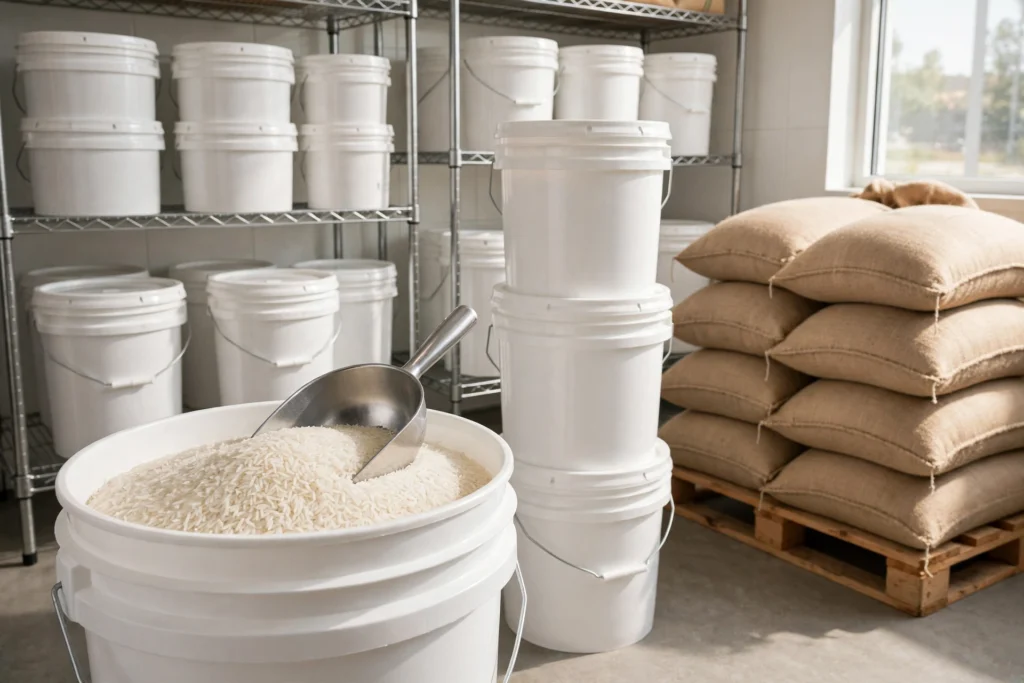
Buckets for rice storage are food-grade HDPE pails — usually 2-gallon or 5-gallon — lined with a Mylar bag and an oxygen absorber, that keep bulk rice dry, pest-free, and fresh for decades. A 5-gallon bucket holds about 35 pounds of white rice, and a gamma seal lid turns it into a scoop-friendly bin for restaurants, food banks, and bulk buyers.
Why Rice Storage Goes Wrong So Often
Rice looks indestructible on the shelf, but it is a sitting target for the four things that ruin dry food: air, moisture, light, and pests. Left in its original paper or thin plastic bag, a 25-pound sack of rice absorbs humidity, picks up pantry odors, and invites weevils and mice — a mouse can chew through a paper sack in a single night, and weevil eggs are already present in most bulk rice, waiting for warm, oxygen-rich conditions to hatch. Heat is the quiet killer: the same rice that keeps for decades in a cool room degrades in a year or two in a hot garage. And the most common mistake is buying the wrong rice for the job — brown rice looks like the healthier choice, but its bran layer is full of oils that go rancid within months no matter how well you seal it. The fix is not a fancier bag. It is a hard, airtight, food-grade container with a Mylar liner and an oxygen absorber, stored cool and dry — the setup this guide walks through step by step.
What Makes a Good Bucket for Rice Storage
A bucket built for rice storage earns its place in a pantry or food bank on five features: (1) Food-grade material — the bucket must be molded from virgin HDPE (#2) or polypropylene (#5) that is FDA-compliant for food contact and BPA-free. For the full checklist, see our guide, HDPE buckets food grade explained. Never store rice in a used bucket unless you know exactly what it held before. (2) A Mylar liner — a bucket alone allows a slow trickle of air exchange over months and years. A 5–7 mil Mylar bag inside the bucket is essentially impermeable to oxygen, moisture, and light, and it is what turns a 5-year bucket into a 25-year bucket. (3) The right oxygen absorber — absorbers are iron-based packets that chemically bind free oxygen inside the bag, starving spoilage organisms and any insect eggs already in the rice. Size them at 1,500–2,000cc per 5-gallon bag (up to 2,500cc total) and 300cc per 1-gallon bag. (4) A lid that seals and reopens — a snap lid works for the working pantry, but a gamma seal lid screws on and off for an airtight, gasketed seal you can open daily without prying. See our gamma seal lids guide for sizing. (5) Heavy-duty walls — 90-mil HDPE resists dents, cracking, and most chewing, and it stacks four-high when full without bowing.
Buckets for Rice Storage: Comparison Table at a Glance
| Storage option | Typical capacity | White-rice shelf life | Airtight? | Typical retail (2026) | Best bulk buyer |
|---|---|---|---|---|---|
| 5-gallon food-grade HDPE bucket + Mylar bag + absorber + gamma seal lid | ~35 lb rice | 25–30 years | Yes | ~$12–$22 per set | Restaurants, food banks, bulk buyers |
| 2-gallon food-grade HDPE bucket + Mylar bag + absorber | ~14 lb rice | 25–30 years | Yes | ~$6–$12 per set | Small kitchens, grocers selling by weight |
| 6-gallon food-grade bucket + Mylar bag + absorber | ~42 lb rice | 25–30 years | Yes | ~$14–$24 per set | High-volume buyers, disaster-prep stockpiles |
| 5-gallon bucket + gamma seal lid, no Mylar | ~35 lb rice | 5–10 years | Yes | ~$8–$15 per set | Working pantry, fast-turnover kitchens |
| 5-gallon bucket + snap lid, no Mylar | ~35 lb rice | 1–2 years | Partial | ~$5–$10 per set | Short-term storage only |
| Commercially packed #10 cans | ~5–6 lb per can | ~30 years | Yes | ~$8–$15 per can | Buyers who want zero packing work |
Choosing the Right Size for Your Rice
Match the bucket to how fast the rice moves. 2-gallon buckets suit small kitchens and grocers selling rice by weight: about 14 pounds of rice, light enough to carry one-handed, and small enough that an opened bucket gets used before the rice ages. See our guide to 2-gallon buckets in bulk for the full breakdown. 5-gallon buckets are the standard for restaurants and food banks: about 35 pounds of white rice per bucket, the size every Mylar bag, oxygen absorber, and gamma seal lid on the market is built for, and stackable four-high when full. 6-gallon buckets in bulk work for high-volume buyers and disaster-prep stockpiles: roughly 42 pounds per bucket with the same footprint, so fewer containers to seal and label. For planning quantities, use about 10 pounds of rice per person per month — that covers rice as roughly a third of one adult’s eating. A restaurant going through a 50-pound sack a week needs two 5-gallon buckets per week of stock; a food bank packing family boxes should plan one 5-gallon bucket per household box.
White Rice vs Brown Rice: What the Bucket Can’t Fix
No bucket, however well sealed, can make brown rice a long-term food. White rice — long grain, jasmine, basmati, and sushi rice — has had its bran removed, which means no oils to spoil and nothing to go rancid; sealed in Mylar with an absorber at 75°F or cooler, it keeps 25–30 years according to LDS and University of Georgia Extension storage tables. Brown rice still carries its bran layer, and the oils in that bran go rancid in about six months at room temperature no matter how it is packed — even sealed, it tops out at 1–2 years, and freezing only stretches it to 12–24 months. The practical split for buyers: stock white rice in sealed buckets for the deep shelf, and keep brown rice in the working pantry in a gamma-sealed bucket you rotate through within months. If you are buying in bulk for a food bank or a restaurant, white rice is the only rice that justifies the Mylar-and-absorber investment.
Buying Buckets for Rice Storage in Bulk: What to Ask Your Supplier
Rice storage is a volume game for restaurants, Asian grocers, food banks, and disaster-prep suppliers — the per-unit price drops fast once you order by the case or pallet. Before placing a bulk order, confirm these details: Order buckets and lids together — mismatched lids are the number-one bucket complaint in any commercial operation, and gamma seal lids must match the bucket’s rim exactly. See our buckets with lids in bulk guide for matched-set buying. Check the resin — insist on virgin food-grade HDPE with the #2 recycling code; recycled-content buckets can carry odors that transfer to rice. Standardize sizes across the operation — one 2-gallon bucket for small lots and one 5-gallon bucket for bulk sacks simplifies restocking and staff training. Plan for seasonality — rice demand spikes with harvest cycles, holiday cooking, and disaster-prep buying surges; order storage buckets before the rush so freight delays do not leave the pantry short. Ask about volume pricing — if you run multiple locations or a food bank network, request a quote for your actual quantities rather than paying list price. For restaurant-specific storage rules, see our guide to commercial buckets for restaurants.
Keeping Rice Fresh: The Rules That Matter More Than the Bucket
The best bucket in the world cannot save rice that was already damp or stored wrong. Share these rules with your customers — it is the kind of advice that brings them back to your counter: Store cool and dry, ideally 40–70°F — heat is the main shelf-life killer, and a bucket in a hot garage is a different, shorter food than the same bucket in a cool pantry. Keep containers off the floor — a 6-inch gap stops floor moisture and makes it harder for rodents to reach the lid; never set buckets directly on concrete. Freeze first if you skip the absorber — four days at 0°F kills weevils at every stage, then let the closed bag reach room temperature before packing so condensation does not seal moisture in with the rice; with an absorber, skip the freezer entirely. Check the seal the next day — a properly sealed Mylar bag with an oxygen absorber pulls tight overnight; if the bag is still puffy, reseal it. Label and date everything — write the contents and pack date on the bag and the bucket, and use the oldest stock first. Inspect before every use — fresh rice smells neutral and flows loosely; clumps, a musty smell, webbing, or live insects mean the batch goes in the trash. For a step-by-step repackaging walkthrough, see PreparednessMama’s guide to repackage bulk food.
Frequently Asked Questions
How long does rice last in a bucket?
White rice sealed in a Mylar bag with an oxygen absorber inside a food-grade bucket, kept at 75°F or cooler, lasts 25–30 years. A bare bucket with a gamma seal lid alone keeps rice 5–10 years, and brown rice lasts only 6–12 months even sealed.
How much rice fits in a 5-gallon bucket?
About 35 pounds of dry white rice. A 2-gallon bucket holds roughly 14 pounds and a 6-gallon bucket about 42 pounds, so use 7 pounds per gallon as your planning figure.
What size oxygen absorber do I need for a 5-gallon bucket of rice?
Use 1,500–2,000cc of absorber per 5-gallon bag (up to 2,500cc total), split across multiple packets if needed. A 1-gallon bag needs about 300cc. Open absorbers only when you are ready to seal.
Do I need a Mylar bag inside the bucket?
Yes, for long-term storage. A bucket alone allows slow air exchange over months and years, while a 5–7 mil Mylar bag is essentially impermeable to oxygen, moisture, and light — it is what turns a 5-year bucket into a 25-year one.
Can I store brown rice in a bucket long term?
No. The oils in brown rice’s bran go rancid in 6–12 months at room temperature no matter how it is packed. Keep brown rice in the working pantry in a gamma-sealed bucket and rotate through it within months.
Are food-grade buckets safe for rice?
Yes, when they are molded from virgin HDPE (#2) or polypropylene (#5) that is FDA-compliant and BPA-free. Never store rice in a used bucket unless you know exactly what it held before — chemical residues can transfer to food.
How much rice should I store per person?
About 10 pounds per person per month covers rice as roughly a third of one adult’s eating. The broader LDS minimum is 25 pounds of all grains plus 5 pounds of beans per adult per month.
Get Buckets for Rice Storage in Bulk from ThoseBucketPeople
Whether you run a restaurant, an Asian grocery, a food bank, or a disaster-prep supply business, we supply buckets in the sizes rice buyers actually use — including 5-gallon buckets that pair with gamma seal lids, 2-gallon buckets for small lots and by-weight sales, and lids to match, in pallet quantities with nationwide delivery. Request a quote through our Get a Quote page or contact us for volume pricing and delivery options.