
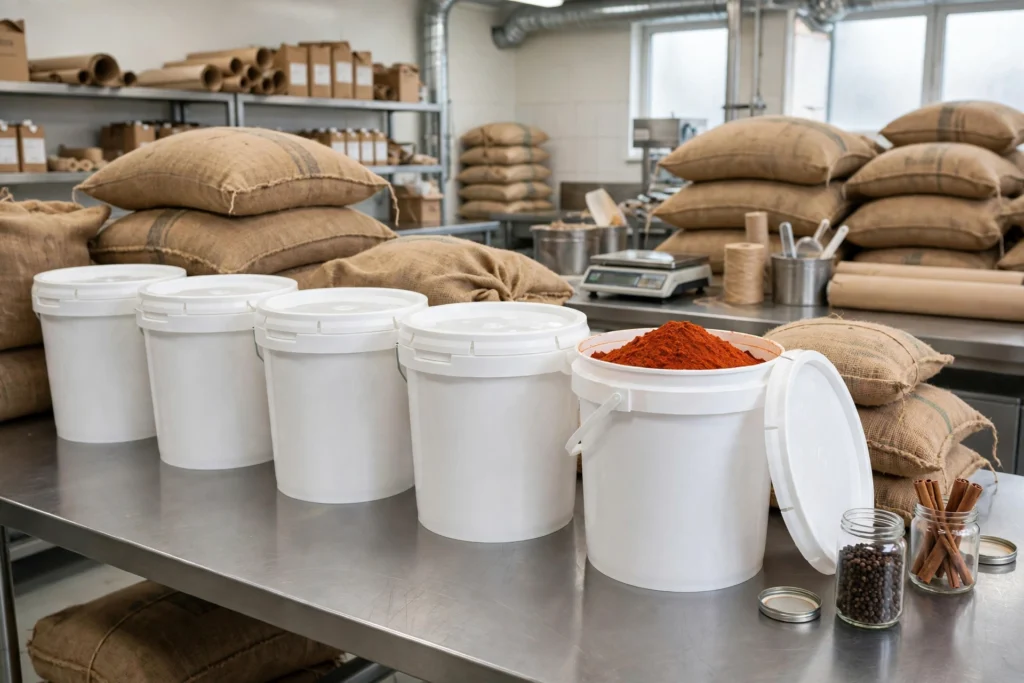
Buckets for spice storage wholesale are food-grade HDPE pails bought by the case or pallet by spice packers, restaurants, delis, and food-service operations. The 5-gallon size is the workhorse for bulk ground and whole spices, while 1.3- and 2-gallon pails handle small batches, blends, and daily scooping — all with airtight lids that protect aroma, color, and flavor.
Spices are the most unforgiving dry good a buyer can store. Rice forgives a loose lid for a month; paprika does not. The volatile oils that make cumin smell like cumin escape through every gap, light bleaches chili powder from red to rust, humidity turns garlic powder into a brick, and one open bucket of smoked paprika can flavor every mild spice stored beside it. The bucket is the spice trade’s cheapest piece of quality control — and the one most often bought wrong. A hardware-store pail, a recycled bucket of unknown history, or a lid that never quite seals will quietly drain the value out of a pallet of spice. This guide covers what makes a bucket spice-ready, which sizes fit which spice and buyer, how long spices actually keep, and how to buy in bulk without stocking pails your packers will not use.
What Makes a Bucket a “Spice Bucket”?
A spice bucket is a food-grade HDPE pail built for direct contact with ground and whole spices. Five things separate it from a general-purpose bucket: (1) Virgin HDPE #2 resin — no recycled content of unknown origin, BPA-free, and certified for food contact under the FDA food-contact rule for olefin polymers (21 CFR 177.1520). Look for the #2 recycling symbol and the cup-and-fork food-safe mark, and ask the supplier for the compliance statement for the exact resin — plain HDPE without certification is not the same thing. See our guide to HDPE buckets food grade explained for the full 3-step check. (2) An opaque wall — light degrades spice color and aroma, so white or natural HDPE that blocks light beats any clear container for storage; keep the clear jars for the display shelf, not the storeroom. (3) A lid that actually seals — spices lose aroma through every gap, so the lid matters as much as the bucket: snap lids for the working bench, gamma seal lids for daily scooping, tamper-evident lids for anything sold or shipped. (4) A smooth, cleanable interior — ground spice clings to scratches and seams, and residue from one spice flavors the next; the inside wall must wash clean and dry fully. (5) Wall thickness — 70–90 mil walls survive daily commercial handling, stacking, and washing; thin-wall pails crack at the rim and the handle mounts first. A spice bucket without a matching lid is an open bowl with a handle.
Buckets for Spice Storage Wholesale: Sizes & What Each Holds
When you buy buckets for spice storage wholesale, size is the first decision — and the wrong size is the most common bulk-buying mistake. Spices vary enormously in density, so a 5-gallon pail holds roughly 20 lb of light ground paprika but close to 50 lb of salt — buy the size your staff can actually lift full, and check the weight for your exact spice before ordering a pallet.
| Size | Spice use | Approx. weight full (varies by spice) | Best bulk buyer |
|---|---|---|---|
| 1.3-gallon | Small batches, blends, test lots, bench scooping | ~5–13 lb | Delis, small spice shops, pastry kitchens |
| 2-gallon | Retail repack lots, portioned blends, small restaurant stock | ~8–20 lb | Restaurants, cafés, small packers |
| 3.5-gallon | Mid-size batches, one spice lot, bulk herbs | ~14–35 lb | Mid-size packers, grocers |
| 5-gallon | Bulk ground and whole spices, the standard storage pail | ~20–50 lb | The all-rounder: packers, restaurants, delis |
| 6-gallon | Larger spice lots, blending batches | ~24–60 lb | High-volume packers, commissaries |
| 7-gallon | Tall pails for storage, large lots | ~28–70 lb | Commercial packers, co-packers |
Whole vs Ground: The Shelf Life That Decides Your Lid
Spices do not spoil like milk — they fade. The flavor clock runs on form, not on the calendar date alone, and it decides how airtight your bucket needs to be. McCormick’s spice shelf-life guide puts whole spices at 3–4 years, ground spices at 2–4 years, and dried herbs and seasoning blends at 1–3 years — and notes that dried seasonings in jars last about 1–2 years as a rule of thumb. Those are flavor windows, not safety dates: an old spice is weaker, not dangerous. The practical split for buyers: whole spices (peppercorns, cinnamon sticks, cumin seed, whole nutmeg) keep their volatile oils locked inside the seed and survive years in a sealed bucket; ground spices expose far more surface area to air, so they lose aroma in months once the bucket is opened and scooped from daily. Paprika and chili powder fade fastest — color goes first, then heat — and refrigeration helps them hold color. Buy whole where your process allows it and grind to order; buy ground only in quantities you will use inside its flavor window. For the full rundown on dry goods, see our guide to buckets for rice storage — the same airtight, food-grade rules apply, but spices punish a loose lid far faster than rice does.
| Spice form | Best flavor window | What fades first | Bucket + lid to buy |
|---|---|---|---|
| Whole spices (peppercorns, cinnamon sticks, cumin seed) | 3–4 years | Aroma, slowly | 5-gallon pail + snap or gamma seal lid |
| Ground spices (cumin, paprika, turmeric, chili powder) | 2–4 years sealed; months once opened daily | Aroma, then color | 5-gallon pail + gamma seal lid for daily scooping |
| Dried herbs & blends (basil, oregano, seasoning mixes) | 1–3 years | Leaf color, then flavor | 2-gallon pail + gamma seal lid, small lots |
| Salt & pure extracts | Indefinite | Nothing (salt) | Any food-grade pail with a dry lid |
What Spice Packers, Restaurants & Delis Actually Use Buckets For
Bulk spice storage
The core job: a 5-gallon food-grade pail holds a whole lot of one spice, sealed against air, moisture, light, and pests. Spice packers buy by the pallet — one spice per pail, labeled on the lid and the side — and pull from the working pail while the sealed spares wait on the shelf. Keep strong spices (cumin, chili, smoked paprika, curry blends) in their own pails and never store them open beside mild ones: aroma migrates, and a mild spice stored next to an open chili bucket will taste like chili by the end of the week.
Blending & portioning
Small pails are the spice trade’s portioning system. A 1.3- or 2-gallon bucket holds a weighed batch of a house blend, a day’s worth of taco seasoning, or pre-scaled spices for the next shift. Because the pails are cheap, stackable, and lidded, a packer can prep a whole day’s blends the night before and pull them in order. The same logic applies in restaurant kitchens — see our guide to commercial buckets for restaurants for the food-service side of the same system.
Retail repack & resale
Spice shops and grocers buy bulk spice in 5-gallon pails and repack into retail jars, bags, and tins. The pail is the bulk format; the 2-gallon size is the right working size for the repack bench — light enough to lift and pour, small enough that an opened lot gets used before it fades. Tamper-evident lids matter here: a sealed pail proves the lot was not opened in transit or on the shelf.
Daily scooping at the bench
Restaurants and delis scoop from the same pail dozens of times a day, and that is where the lid earns its keep. A gamma seal lid screws on and off without prying, so the seal is the same on the hundredth opening as on the first. A snap lid pried open fifty times a day cracks at the rim, and a cracked lid is an open bucket. Keep a dedicated scoop in each pail, never a shared one, and never scoop with wet hands: one damp scoop clumps a whole pail of garlic powder.
Lids That Matter for Spices
The lid decides whether a spice bucket is a storage container or an open bowl. Match the lid to how often the bucket gets opened, not to the price.
| Lid type | Seal | Best for spices | Watch out for |
|---|---|---|---|
| Snap-on lid | Good at first, wears with prying | Sealed storage opened rarely | Cracks at the rim with daily prying |
| Gamma seal lid | Airtight, consistent every open | Daily scooping, working pails | Costs more per lid; needs the right rim size |
| Tamper-evident lid | Sealed until first open | Retail repack, shipped lots, sold pails | One-time use; replace after opening |
| Mylar bag + oxygen absorber inside the pail | Near-impermeable | Whole spices stored for years | Overkill for fast-turnover ground spice |
Buying Buckets for Spice Storage Wholesale: What to Check First
Work through this checklist before you commit to a pallet. It catches the problems that only show up after the order lands.
- Resin: virgin HDPE #2, food-grade certified, BPA-free; ask for the FDA 177.1520 statement for the exact resin.
- Opaque walls: white or natural HDPE that blocks light — never clear containers for spice storage.
- Wall thickness: 70–90 mil for daily commercial use; thin-wall pails crack at the rim and handle mounts first.
- Size mix: 5-gallon is the default, 2-gallon for repack and bench work, 1.3-gallon for blends and test lots — order the sizes your staff actually lift full.
- Lid compatibility: snap lids and gamma seal lids must fit the same rim; test one case before ordering a pallet.
- One spice per pail: never mix spices in a bucket, and keep strong spices sealed away from mild ones — aroma migrates.
- Case-pack math: small food-grade containers run about $2.34 each in a 120-unit case ($281.17 per case) — compare that against pallet-quoted 5-gallon pricing before you commit.
- MOQs: US suppliers typically sell by the case or pallet — confirm freight before committing, since a pallet of buckets is mostly air.
- Labeling: label the lid and the side with the spice, lot, and pack date — FIFO rotation only works if the oldest pail is the one on top.
- Documentation: keep the supplier’s food-contact compliance statement on file; a health inspector can ask for it.
Spice Bucket Specs at a Glance
The table below pulls published manufacturer specs for the two sizes spice buyers order most, so you can compare any supplier’s quote against real numbers instead of marketing copy.
| Spec | 5-gallon spice pail (typical) | 1.3-gallon spice container |
|---|---|---|
| Material | Virgin HDPE (#2), BPA-free | Virgin HDPE (#2), BPA-free |
| Wall | 70–90 mil (heavy-duty 90 mil) | Nine-panel sidewall |
| Dimensions | ~12.3 in top dia × 10.4 in bottom dia × 14.6 in H | 8.74 in diameter |
| Tare weight | ~973 g (about 2.1 lb) | Not published — ask the supplier |
| Temperature range | −5°F to 160°F | −5°F to 160°F |
| Hot-fill | Up to 160°F | Up to 160°F |
| Case pack | By the pallet | 120 per case, $281.17/case (~$2.34 each) |
| Lid options | Snap-on, tear-strip, gamma seal | L811 snap-on, tamper-evident optional |
Keeping Spices Fresh: The Rules That Matter More Than the Bucket
The best bucket in the world cannot save spices that were already stale or stored wrong. Share these rules with your customers — it is the kind of advice that brings them back to your counter: Store cool and dark, ideally 59–68°F (15–20°C) — heat is the main flavor killer, and a bucket in a hot storeroom is a different, shorter-lived spice than the same bucket in a cool pantry. Keep containers off the floor — a 6-inch gap stops floor moisture and makes it harder for pests to reach the lid; never set buckets directly on concrete. Keep it dry — ground spices act like sponges, so store below 60% humidity and never scoop with wet hands; one damp scoop clumps a whole pail. Seal it every time — an open bucket loses aroma by the hour, so close the lid between scoops, not at the end of the shift. Label and date everything — write the spice, lot, and pack date on the lid and the side, and use the oldest stock first. Smell before you use — fresh spice smells sharp and distinct; a dusty smell or no smell at all means the flavor is gone, whatever the date says. Buy whole and grind fresh where you can — whole peppercorns and cumin seed keep their oils years longer than the same spice ground.
Cleaning & Sanitizing Spice Buckets
A spice bucket is only food-safe while it is clean and unscratched. Wash pails with hot water and unscented detergent after every use, rinse thoroughly, and let them dry fully before lidding — trapped moisture breeds odor and film, and a damp pail clumps the next spice that goes in. Never use scented soaps or leave bleach residue: if you sanitize, use a food-safe sanitizer at the labeled dilution and rinse again. Inspect the inside wall every wash: scratches and gouges harbor spice residue and bacteria that no rinse removes, and a scratched pail should move to non-food duty or the bin. Strong spices stain and scent plastic — a pail that held chili or curry should stay a chili pail, or be retired from spice duty entirely. For the full step-by-step, see our guide on how to clean food grade buckets.
Frequently Asked Questions About Buckets for Spice Storage Wholesale
What size bucket is best for storing spices?
A 5-gallon food-grade bucket is the standard for bulk spice storage — it holds roughly 20–50 lb depending on the spice’s density, and every gamma seal lid on the market is built for its 12-inch rim. For small lots, blends, and bench scooping, a 2-gallon pail is the right working size.
Are buckets for spice storage wholesale food grade?
Real spice buckets are food-grade virgin HDPE (#2 resin), BPA-free, and certified for direct food contact under FDA rule 21 CFR 177.1520. Check for the #2 recycling symbol and the cup-and-fork mark, and ask the supplier for the compliance statement — plain HDPE without certification is not the same thing.
How long do spices last in a bucket?
Whole spices keep best flavor for 3–4 years sealed, ground spices for 2–4 years sealed, and dried herbs and blends for 1–3 years, per McCormick’s shelf-life guide. Once a bucket is opened and scooped from daily, ground spices fade in months — buy ground only in quantities you will use inside that window.
Do spices need airtight buckets?
Yes. The volatile oils that carry flavor escape through every gap, and humidity clumps ground spice. An airtight lid — gamma seal for daily scooping, snap or tamper-evident for sealed storage — is what keeps aroma, color, and flavor in the bucket instead of in the storeroom air.
Can I store different spices in the same bucket?
No. Strong spices like cumin, chili, and smoked paprika flavor everything stored beside them, and residue from one spice carries into the next. Use one spice per pail, keep a dedicated scoop in each, and retire any pail that held a strong spice from mild-spice duty.
Should spice buckets be clear or opaque?
Opaque. Light bleaches spice color and degrades aroma, so white or natural HDPE that blocks light is the right choice for storage. Keep clear jars for the display shelf, where customers can see the product — not for the storeroom, where it sits for months.
Where can I buy buckets for spice storage wholesale?
Order by the case or pallet from a US bucket supplier, and confirm the resin, wall thickness, and lid fit before committing. Small food-grade containers run about $2.34 each in a 120-unit case, while 5-gallon pails are quoted by the pallet. Request a quote for delivered pallet pricing.
Get Buckets for Spice Storage in Bulk from ThoseBucketPeople
Whether you run a spice packing operation, a restaurant, a deli, or a grocery, we supply the buckets commercial buyers actually use — including 5-gallon buckets for bulk spice storage, 2-gallon buckets for repack and bench work, and lids to match. When you buy buckets for spice storage wholesale from ThoseBucketPeople, request a quote through our Get a Quote page or contact us for volume pricing and delivery options.