
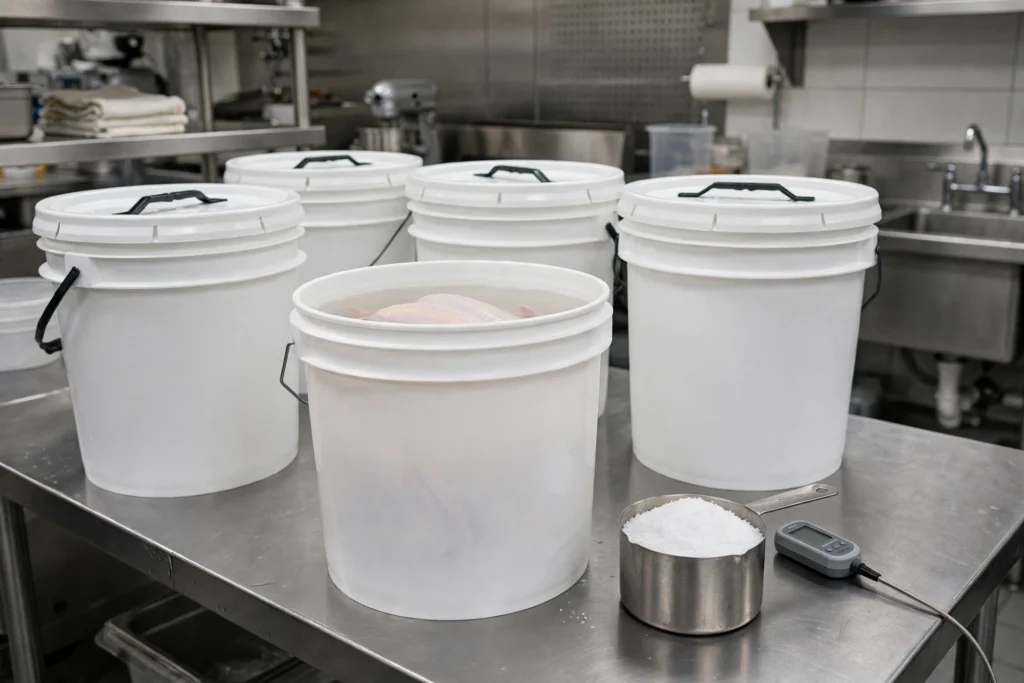
Buckets for brining wholesale are food-grade HDPE pails bought by the case or pallet by restaurants, butcher shops, delis, and caterers. The 5-gallon size is the workhorse — big enough to submerge a whole turkey in brine — while 2- and 3.5-gallon pails handle chickens, pork, and small batches, all kept cold at 40°F or below.
Brining is the one bucket job where the wrong pail is a food-safety problem, not just a nuisance. A hardware-store bucket of unknown history, a trash bag used as a liner, or a pail left uncovered in a shared fridge can turn a Thanksgiving turkey program into a health-inspector visit. The USDA is explicit about what the container must be — food-grade plastic, stainless steel, or glass, or a brining bag — and just as explicit about the cold chain: 40°F or below, never longer than two days, cook to 165°F. Thanksgiving 2026 falls on Thursday, November 26, so restaurants and caterers are ordering their brining pails now. This guide covers what makes a bucket brining-safe, which size fits which bird, the exact USDA brine ratios, and how to buy in bulk without stocking pails your kitchen cannot use.
What Makes a Bucket a “Brining Bucket”?
A brining bucket is a food-grade HDPE pail built to hold raw meat in salt water, cold, for up to two days. Five things separate it from a general-purpose bucket: (1) Virgin HDPE #2 resin — no recycled content of unknown origin, BPA-free, and certified for food contact under the FDA food-contact rule for olefin polymers (21 CFR 177.1520). Salt water is a solvent: it will pull whatever it can out of the wrong plastic, so the resin certification matters more here than in any dry-storage job. Look for the #2 recycling symbol and the cup-and-fork food-safe mark, and ask the supplier for the compliance statement for the exact resin. See our guide to HDPE buckets food grade explained for the full 3-step check. (2) A lid that actually closes — the USDA’s rule is to secure the container with a lid or cover so raw poultry water cannot splash onto other foods in the refrigerator; an open pail in a shared walk-in is a cross-contamination risk, not a storage solution. (3) A smooth, cleanable interior — raw-meat brine leaves protein film in every scratch, so the inside wall must wash clean and dry fully between uses. (4) Wall thickness — 70–90 mil walls survive daily commercial handling and the weight of a full pail; a full 5-gallon pail of water weighs about 42 pounds before the bird goes in, and a thin-wall pail flexes, cracks at the rim, and spills brine across a fridge shelf. (5) The right shape for the fridge — a brining pail is useless if it does not fit in the refrigerator with the lid on, so measure shelf height and depth before you order a pallet. A brining bucket without a matching lid is an open bowl of raw poultry water.
Buckets for Brining Wholesale: Sizes & What Each Holds
When you buy buckets for brining wholesale, size is the first decision — and the mistake is buying by the bucket’s rated gallons instead of by the bird. The bird displaces brine, so a 5-gallon pail realistically holds about 2.5–3 gallons of brine with a turkey in it. Buy the size your bird actually submerges in, and check the weight for your exact cut before ordering a pallet.
| Size | Brine it realistically holds (bird in) | Typical bird | Best bulk buyer |
|---|---|---|---|
| 2-gallon | ~1 gallon | Whole chicken, small turkey up to ~8 lb | Delis, small restaurants, caterers |
| 3.5-gallon | ~2 gallons | Turkey 10–14 lb, pork loin, whole chickens | Restaurants, caterers, butcher shops |
| 5-gallon | ~2.5–3 gallons | Turkey 14–18 lb, pork shoulder, multiple chickens | The all-rounder: restaurants, butchers, smokehouses |
| 6-gallon | ~3–3.5 gallons | Turkey 18–22 lb, two chickens, pork batches | High-volume kitchens, smokehouses |
| 7-gallon | ~4 gallons | Large turkey, ham, multi-bird batches | Processors, commissaries, large caterers |
Wet Brine vs Dry Brine: The Ratios That Decide Your Bucket
There are two ways to brine, and they need different buckets. A wet brine is a salt-water bath — the bird soaks submerged, so the bucket must be big enough to cover it completely. A dry brine is salt rubbed on the bird, sealed in a food-grade bag — no bucket of liquid at all, and far less fridge space. The USDA FSIS ratios below are the numbers to build your program around; do not improvise them, because too little salt does nothing and too much makes the meat inedible.
| Method | Salt ratio (USDA FSIS / Illinois Extension) | Time | Bucket needed |
|---|---|---|---|
| USDA wet brine | ¾ cup table salt per gallon of water (3 Tbsp per quart) | At least overnight, up to 2 days | 5-gallon pail for a turkey |
| Illinois Extension strong wet brine | 2 cups table salt (or 4 cups kosher) in 2 gallons + 1 cup sugar | 6–8 hours | 3.5- or 5-gallon pail |
| Dry brine | 1 Tbsp kosher salt per 5 lb of poultry | Up to 2 days in a food-grade bag | Any food-grade pail as a drip tray, or none |
| What not to brine | Pre-basted, self-basting, or kosher birds — already salted | — | — |
What Restaurants, Butchers & Smokehouses Actually Use Buckets For
Thanksgiving Turkey Programs
The peak brining job in American food service. Restaurants and caterers that sell brined turkeys for Thanksgiving need one pail per bird, all of them in refrigeration at the same time — which is why they order by the pallet in November, not by the case. A 5-gallon pail per turkey is the standard, and the lid is what keeps raw poultry water off every other shelf in the walk-in. Plan the fridge space first: a pallet of pails is useless if only twelve of them fit in the cold room.
Fried Chicken & Pork
Brining is not a once-a-year job. Fried-chicken shops brine chicken overnight, barbecue joints brine pork shoulder and ribs, and delis brine corned beef and pastrami cuts — all in the same 5-gallon pails, rotated daily. The pail that held yesterday’s chicken gets washed, dried, and refilled today, which is why commercial buyers care about wall thickness and a smooth interior more than home cooks do. See our guide to commercial buckets for restaurants for the food-service side of the same system.
Smokehouses & Fish Curing
Smokehouses brine fish, bacon, and hams before they hit the smoker, and the salt concentrations run higher than a turkey brine — which is exactly why the bucket must be HDPE and never metal. Salt brine corrodes reactive metals and can pick up metallic off-flavors; HDPE does not react with brine at all. A dedicated set of pails for the smokehouse, labeled and never swapped with the kitchen’s general-purpose buckets, is standard practice.
Brining vs. Fermenting: Different Buckets, Different Jobs
Buyers sometimes confuse brining with fermenting because both involve food in a bucket. They are opposite jobs: brining is cold, wet, salt-water curing of raw meat under refrigeration, with the brine discarded after one use; fermenting is room-temperature culturing with airlocks, where the whole point is keeping microbes alive. A brining pail needs a tight lid and a cold fridge; a fermentation bucket needs an airlock and a warm shelf. Do not swap them — see our guide to fermentation buckets for the other side of the trade.
Lids That Matter for Brining
The lid is a food-safety device on a brining bucket, not an accessory. Match the lid to how the pail will be stored, not to the price.
| Lid type | Seal | Best for brining | Watch out for |
|---|---|---|---|
| Snap-on lid | Good, keeps brine covered in the fridge | Standard fridge storage, one bird per pail | Prying wears the rim; check it still seals after repeated use |
| Gamma seal lid | Airtight, screws on and off | Repeated access — checking, tasting, rotating birds | Costs more per lid; needs the right rim size |
| Food-grade brining bag inside the pail | Bag holds bird + brine, pail holds the bag | Less brine needed, easier cleanup, tight fridge fit | Bag must be food-grade — never a household trash bag (USDA) |
| No lid | None | Nothing — never brine uncovered | Raw poultry water splashes onto other fridge food |
Buying Buckets for Brining Wholesale: What to Check First
Work through this checklist before you commit to a pallet. It catches the problems that only show up after the order lands.
- Resin: virgin HDPE #2, food-grade certified, BPA-free; ask for the FDA 177.1520 statement for the exact resin.
- Lid included: every brining pail needs a lid that closes — order lids with the pails, in the same count, and test the fit on one case first.
- Wall thickness: 70–90 mil for daily commercial use; a full 5-gallon pail weighs about 42 lb of water plus the bird.
- Size mix: 5-gallon is the default for turkeys, 3.5-gallon for pork and mid-size birds, 2-gallon for chickens and small batches — order the sizes your menu actually brines.
- Fridge fit: measure shelf height and depth with the lid on — a pail that does not fit in the refrigerator cannot brine safely.
- Smooth interior: no deep scratches or seams that trap protein film; a scratched pail should move to non-food duty.
- One bird per pail: never crowd two birds into one bucket — the bird must be fully submerged, breast down, and covered by brine.
- Case-pack math: small food-grade containers run about $2.34 each in a 120-unit case ($281.17 per case) — compare that against pallet-quoted 5-gallon pricing before you commit.
- MOQs: US suppliers typically sell by the case or pallet — confirm freight before committing, since a pallet of buckets is mostly air.
- Documentation: keep the supplier’s food-contact compliance statement on file; a health inspector can ask for it, and a brining program is exactly the kind of thing they check.
Brining Bucket Specs at a Glance
The table below pulls published manufacturer specs for the two sizes brining buyers order most, so you can compare any supplier’s quote against real numbers instead of marketing copy.
| Spec | 5-gallon brining pail (typical) | 2-gallon brining pail |
|---|---|---|
| Material | Virgin HDPE (#2), BPA-free | Virgin HDPE (#2), BPA-free |
| Wall | 70–90 mil (heavy-duty 90 mil) | 70–90 mil |
| Dimensions | ~12.3 in top dia × 10.4 in bottom dia × 14.6 in H | Not published — ask the supplier |
| Tare weight | ~973 g (about 2.1 lb) | Not published — ask the supplier |
| Full weight | ~42 lb of water + bird | ~17 lb of water + bird |
| Temperature range | −5°F to 160°F | −5°F to 160°F |
| Lid options | Snap-on, gamma seal, tamper-evident | Snap-on, gamma seal |
| Case pack | By the pallet | By the case or pallet |
Keeping It Safe: The USDA Rules That Matter More Than the Bucket
The best bucket in the world cannot save a brine that was handled wrong. The USDA’s safe-brining rules are short, and every one of them is a pass/fail for a commercial kitchen: Wash hands for 20 seconds and sanitize surfaces (1 tablespoon of unscented liquid chlorine bleach per gallon of water) before you start. Do not wash the bird — rinsing raw poultry splashes bacteria around the sink without making the meat safer. Dissolve the salt fully, and if the recipe calls for heating the brine, cool it completely before the bird goes in — warm brine is a bacterial incubator. Place the bird breast down in a food-grade plastic, stainless steel, or glass container, or a brining bag, that fits in the fridge. Cover the bird entirely with brine and secure the container with a lid. Keep the turkey and brine refrigerated at 40°F or below for the entire brine — never at room temperature, and never longer than two days. If the fridge is full, a cooler with 5–6 ice packs works, as long as the temperature stays at 40°F or below. Discard the brine after use — never reuse brine that held raw meat. Cook to 165°F in the innermost thigh, wing, and thickest breast, and rest the bird 20 minutes before carving. Brining adds moisture and flavor; it does not cook or sanitize the meat, so the thermometer is what makes it safe. For the USDA’s own wording, see the USDA’s safe brining guide.
Cleaning & Sanitizing Brining Buckets
A brining bucket is only food-safe while it is clean and unscratched. Wash pails with hot water and unscented detergent after every use, rinse thoroughly, and let them dry fully before lidding — trapped moisture breeds odor and film, and a damp pail contaminates the next brine that goes in. Never use scented soaps or leave bleach residue: if you sanitize, use a food-safe sanitizer at the labeled dilution and rinse again. Inspect the inside wall every wash: scratches and gouges harbor protein film and bacteria that no rinse removes, and a scratched pail should move to non-food duty or the bin. A pail that held raw-meat brine is a raw-meat pail until it is washed — never set clean produce or dry goods in it first. For the full step-by-step, see our guide on how to clean food grade buckets.
Frequently Asked Questions About Buckets for Brining Wholesale
What size bucket is best for brining a turkey?
A 5-gallon food-grade bucket is the standard for brining a turkey — it holds a 14–18 lb bird submerged in about 2.5–3 gallons of brine, and every gamma seal lid on the market is built for its 12-inch rim. For chickens and small batches, a 2-gallon pail is the right working size.
Are buckets for brining wholesale food grade?
Real brining buckets are food-grade virgin HDPE (#2 resin), BPA-free, and certified for direct food contact under FDA rule 21 CFR 177.1520. Check for the #2 recycling symbol and the cup-and-fork mark, and ask the supplier for the compliance statement — plain HDPE without certification is not the same thing.
How much salt goes in a brine?
The USDA FSIS ratio is ¾ cup of table salt per gallon of water (3 tablespoons per quart), brined at least overnight and up to two days. Illinois Extension’s stronger brine uses 2 cups of table salt (or 4 cups kosher) in 2 gallons plus 1 cup of sugar, for 6–8 hours. Do not improvise the ratio — too little salt does nothing, too much ruins the meat.
How long can you brine meat in a bucket?
At least overnight and never longer than two days, refrigerated at 40°F or below the entire time, per the USDA. A fresh turkey only keeps 1–2 days in the refrigerator anyway, so the brine window and the bird’s shelf life run out together.
Can I brine in a regular hardware-store bucket?
No. A hardware-store bucket is not certified food-grade, its prior contents are unknown, and salt water can pull chemicals out of the wrong plastic. Use only virgin HDPE #2 pails certified for food contact — and never line a bucket with a household trash bag, which the USDA explicitly rules out.
Can I reuse brine?
No. Discard brine after use and never reuse brine that held raw meat, poultry, or fish. Brining does not sanitize the meat — it only adds moisture and flavor — so cook poultry to 165°F internal temperature to make it safe.
Where can I buy buckets for brining wholesale?
Order by the case or pallet from a US bucket supplier, and confirm the resin, wall thickness, lid fit, and fridge fit before committing. Small food-grade containers run about $2.34 each in a 120-unit case, while 5-gallon pails are quoted by the pallet. Request a quote for delivered pallet pricing.
Get Buckets for Brining in Bulk from ThoseBucketPeople
Whether you run a restaurant, a butcher shop, a deli, a smokehouse, or a catering operation, we supply the buckets commercial buyers actually use — including 5-gallon buckets for whole-turkey brining, 2-gallon buckets for chickens and small batches, and lids to match. When you buy buckets for brining wholesale from ThoseBucketPeople, request a quote through our Get a Quote page or contact us for volume pricing and delivery options.