
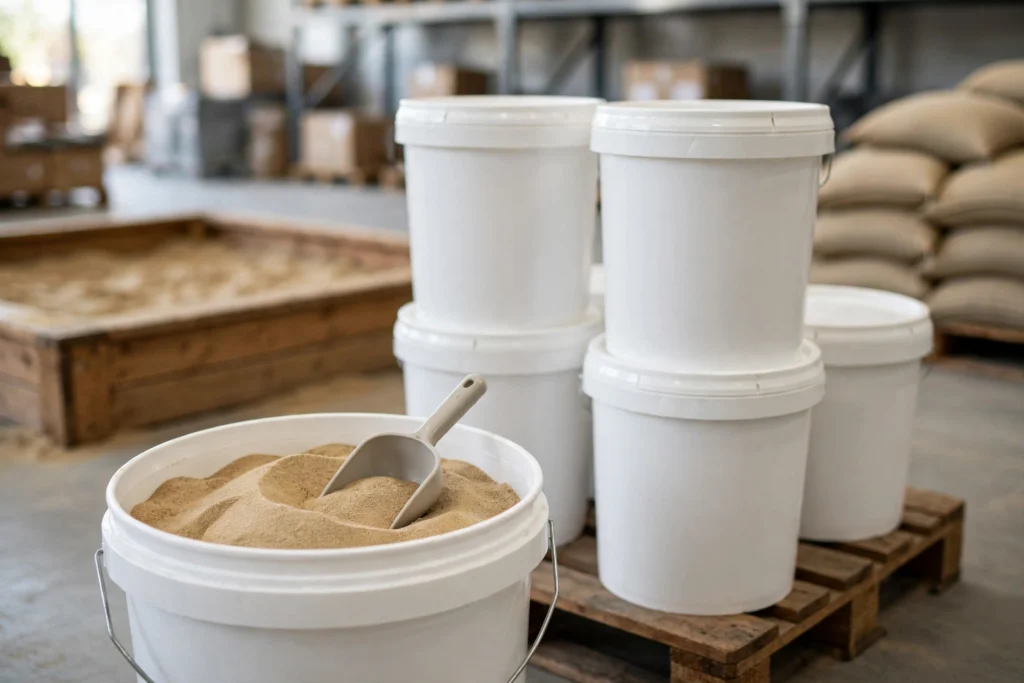
Buckets for sand storage wholesale are HDPE pails bought by the case or pallet by schools, daycares, playground installers, landscapers, and contractors to store, move, and portion play sand, traction sand, and paver sand. The 5-gallon size is the workhorse — it holds about 67 pounds of dry sand — while 2-gallon pails suit small top-ups and 6- and 7-gallon pails handle bulk jobs.
Sand is the heaviest thing most bucket buyers ever store. A pail of water weighs about 42 pounds; the same pail filled with dry sand weighs about 67 pounds, and wet sand pushes it past 80. That weight changes every decision: the wall thickness you need, whether the handle is safe to carry by, how many pails a pallet can hold, and whether your crew should be filling buckets at all or ordering bulk delivery instead. The other mistake is treating all sand as one product — play sand, traction sand, and paver sand are different materials with different grain sizes, and the wrong one in the wrong job is a failed inspection or a ruined patio. This guide covers which bucket fits which sand, the weight math for ordering, the CPSC playground depths that decide how much sand a job actually needs, and how to buy in bulk without stocking pails your crew cannot lift.
What Makes a Bucket a “Sand Storage Bucket”?
A sand storage bucket is a heavy-duty HDPE pail built to hold a dense, abrasive, dusty material that never gets lighter. Five things separate it from a general-purpose bucket: (1) Wall thickness — 70–90 mil walls resist the outward pressure of 67 pounds of sand and the abrasion of scooping it in and out; a thin-wall pail bulges, cracks at the rim, and splits when a full bucket is set down hard. (2) A lid that keeps sand dry and clean — rain turns dry sand into an 80-pound block that clumps and will not pour, and an open pail outdoors collects leaves, debris, and animal droppings; a snap-on lid is the minimum, and a gamma seal lid is worth it for sand that must stay dry for months. (3) A handle rated for the load — a standard 5-gallon bucket handle safely supports about 65–70 pounds, and a full pail of dry sand sits right at that limit, so a bucket you plan to carry by the handle needs a heavy-duty wire bail, not a thin plastic grip. (4) A smooth, cleanable interior — sand grinds into every scratch, so the inside wall must rinse clean between sand types; a pail that held traction sand should not be refilled with play sand without a wash. (5) UV resistance for outdoor storage — pails staged on a job site or in a schoolyard spend months in the sun, and unstabilized plastic turns brittle; ask the supplier whether the resin carries UV stabilizer if the buckets will live outdoors. A sand bucket without a lid is a rain gauge that weighs 80 pounds.
Buckets for Sand Storage Wholesale: Sizes & What Each Holds
When you buy buckets for sand storage wholesale, size is the first decision — and the mistake is buying by the bucket’s rated gallons instead of by the weight your crew can actually move. A full 5-gallon pail of dry sand weighs about 70 pounds with the bucket, which is at the top of what one person should carry by the handle. Buy the size your job actually moves, and check the weight for your exact sand before ordering a pallet.
| Size | Dry sand it holds | Full weight (sand + bucket) | Best bulk buyer |
|---|---|---|---|
| 1-gallon | ~13 lb | ~15 lb | Small top-ups, sample kits, retail counter sales |
| 2-gallon | ~27 lb | ~29 lb | Daycares, classrooms, small sandbox refills |
| 3.5-gallon | ~47 lb | ~50 lb | Landscapers, paver crews, playground maintenance |
| 5-gallon | ~67 lb | ~70 lb | The all-rounder: schools, playground installers, contractors |
| 6-gallon | ~80 lb | ~83 lb | Bulk jobs, municipal crews, two-person carries |
| 7-gallon | ~94 lb | ~97 lb | Pallet-staged storage, forklift moves — not hand-carry |
Which Sand Goes in Which Bucket
Not all sand is the same material, and the grain size on the bag decides whether the bucket job works. Match the sand to the job before you match the bucket to the sand.
| Sand type | Grain & character | Typical use | Bucket note |
|---|---|---|---|
| Play sand | Fine, washed, screened | Sandboxes, playgrounds, daycare play areas | Keep lidded and dry; fine grain packs hard when wet |
| All-purpose sand | Coarser, washed | Landscaping, leveling, general fill | The default bulk sand; heaviest per scoop |
| Traction sand | Coarse, angular grit | Winter grip on ice, walkways, parking lots | Store dry — wet traction sand freezes into a block |
| Paver / polymeric sand | Fine, sets with water | Filling joints between pavers | Must stay bone dry until use; gamma seal lid recommended |
| Pool filter sand | #20 mesh silica, uniform | Pool filters, aquariums | Fine and dusty — handle outdoors, lid on |
Who Buys Sand Buckets in Bulk — and What Each Buyer Needs
Schools, Daycares & Playgrounds
The biggest sand-bucket buyers, and the ones with a safety standard to meet. The CPSC Public Playground Safety Handbook sets sand at a 9-inch minimum compressed depth, which protects to a 4-foot fall height — and because loose fill compresses at least 25% in use, you install 12 inches to end at 9. That depth is what decides the order quantity: an 8×8-foot sandbox at 9 inches deep needs about 72 five-gallon buckets of sand, roughly 4,800 pounds. Order the sand in buckets only if you can store them lidded and dry; a pallet of open pails in a schoolyard is a rain problem, not a supply. See our guide to the best buckets for gardening and composting for the other half of a schoolyard’s bucket needs.
Playground Installers & Maintenance Crews
Installers buy sand by the cubic yard and buckets by the pallet: the bulk sand fills the pit, and the buckets are the portioning and top-up system. A cubic yard of sand is about 40 five-gallon buckets and about 2,700 pounds, so a crew refilling a playground after a season of displacement works out of buckets, not out of a dump truck. Keep a dedicated set of pails for play sand, labeled and never swapped with traction sand or paver sand — the grain sizes are different, and a playground inspector can spot the wrong sand.
Landscapers & Paver Crews
Landscapers and paver installers buy buckets to move sand to the exact spot it is needed: leveling sand under pavers, polymeric sand for joints, and traction sand for winter call-outs. Polymeric sand is the demanding one — it must stay bone dry until it is swept into the joints and watered, so a gamma seal lid is not a luxury here; one rained-on pail of polymeric sand is a wasted pail. See our guide to deicing salt buckets for the winter side of the same truck.
Municipalities & Contractors
Cities, highway crews, and facilities contractors store traction sand in buckets for winter deployment: one pail per doorway, stairwell, or icy patch, staged where the crew can grab it. The buying logic is the same as deicing salt — staged, lidded, and dry — but the material is inert, so it never corrodes the bucket and never expires. A 5-gallon pail of traction sand is a one-person carry at about 70 pounds; a 6- or 7-gallon pail is a two-person carry or a forklift move.
The Weight Math: How Many Buckets Does Your Job Need?
Sand is sold by the bag, the cubic yard, and the ton — and buckets are the unit in the middle. Use these conversions before you order, because a sand order that is short by ten buckets is a second delivery fee.
| Conversion | Number | What it means for your order |
|---|---|---|
| 5-gallon bucket, dry sand | ~67 lb sand (~70 lb with bucket) | At the handle’s ~65–70 lb safe limit — carry by the body or half-fill |
| 5-gallon bucket, wet sand | ~80 lb sand (~83 lb with bucket) | Over the handle limit — two people or a dolly |
| 50-lb bag of play sand | ~0.75 of a 5-gallon bucket | Four bags fill about three buckets |
| 1 cubic yard of sand | ~202 gallons ≈ 40 five-gallon buckets | ~2,700 lb of dry sand per cubic yard |
| 8×8 ft sandbox, 9 in deep | 48 cu ft = 1.78 cu yd | ~72 five-gallon buckets ≈ 4,800 lb of sand |
| Bulk sand, delivered | $40–$65 per cubic yard | Bags run $5–$7 per 50 lb — bulk wins past a few cubic yards |
Lids That Matter for Sand Storage
The lid is what keeps sand usable between jobs, not an accessory. Match the lid to how the pail will be stored, not to the price.
| Lid type | Seal | Best for sand storage | Watch out for |
|---|---|---|---|
| Snap-on lid | Good, keeps rain and debris out | Standard outdoor staging, playground top-ups | Prying wears the rim; check it still seals after repeated use |
| Gamma seal lid | Airtight, screws on and off | Polymeric sand, long-term dry storage, repeated access | Costs more per lid; needs the right rim size |
| Tamper-evident lid | Sealed until opened | Retail sand kits, pre-filled pails sold to customers | One-time use; not for refilling |
| Open-top, no lid | None | Nothing — never store sand uncovered | Rain, debris, animals, and a pail that gains 13 lb when wet |
Buying Buckets for Sand Storage Wholesale: What to Check First
Work through this checklist before you commit to a pallet. It catches the problems that only show up after the order lands.
- Wall thickness: 70–90 mil HDPE for daily commercial use; a full 5-gallon pail weighs about 70 lb dry and 83 lb wet.
- Lid included: every sand pail needs a lid that closes — order lids with the pails, in the same count, and test the fit on one case first.
- Handle rating: a standard handle supports about 65–70 lb — a full 5-gallon pail of dry sand is at the limit, so specify a heavy-duty wire bail if crews carry by the handle.
- Size mix: 5-gallon is the default, 3.5-gallon for crews that hand-carry, 2-gallon for daycares and small top-ups, 6- and 7-gallon for pallet-staged storage moved by forklift.
- UV stabilizer: ask whether the resin is UV-stabilized if pails will sit outdoors on a job site or in a schoolyard.
- Smooth interior: no deep scratches that trap one sand type and contaminate the next; label pails by sand type.
- Sand type on the order: play, all-purpose, traction, polymeric, or pool filter — confirm the grain before the sand ships, not after it lands.
- Dry storage: confirm where lidded pails will be staged — rain adds about 13 lb per 5-gallon pail and turns pourable sand into a block.
- Case-pack math: small food-grade containers run about $2.34 each in a 120-unit case ($281.17 per case) — compare that against pallet-quoted 5-gallon pricing before you commit.
- MOQs: US suppliers typically sell by the case or pallet — confirm freight before committing, since a pallet of buckets is mostly air.
Sand Storage Bucket Specs at a Glance
The table below pulls published manufacturer specs for the two sizes sand buyers order most, so you can compare any supplier’s quote against real numbers instead of marketing copy.
| Spec | 5-gallon sand pail (typical) | 2-gallon sand pail |
|---|---|---|
| Material | Virgin HDPE (#2), BPA-free | Virgin HDPE (#2), BPA-free |
| Wall | 70–90 mil (heavy-duty 90 mil) | 70–90 mil |
| Dimensions | ~12.3 in top dia × 10.4 in bottom dia × 14.6 in H | Not published — ask the supplier |
| Tare weight | ~973 g (about 2.1 lb) | Not published — ask the supplier |
| Full weight, dry sand | ~70 lb | ~29 lb |
| Full weight, wet sand | ~83 lb | ~34 lb |
| Temperature range | −5°F to 160°F | −5°F to 160°F |
| Lid options | Snap-on, gamma seal, tamper-evident | Snap-on, gamma seal |
| Case pack | By the pallet | By the case or pallet |
Keeping It Safe: Dust, Moisture & the Weight Rule
Sand is inert, which makes it safer than most things stored in buckets — but it has three hazards buyers underestimate. First, dust: dry sand handling creates dust, and fine silica dust is a respiratory hazard — OSHA sets the permissible exposure limit for respirable crystalline silica at 50 micrograms per cubic meter over an 8-hour shift, so fill and pour outdoors or upwind, keep lids on stored sand, and never dry-sweep a sand spill indoors. Second, moisture: rain is the enemy of stored sand — a wet pail weighs about 13 pounds more, clumps instead of pouring, and polymeric sand ruined by rain cannot be dried back into usable jointing sand. Third, weight: a full 5-gallon pail of dry sand is about 70 pounds, which is a two-person lift or a dolly job for many workers, not a one-handed carry — half-fill pails that must be hand-carried, and stage full pails where the work happens instead of carrying them across the site. And one hard rule: never store hot ash or charcoal in a plastic bucket — sand is for cold storage only, and a hot ember will melt through HDPE. For the food-grade side of the same material standard, see our guide to HDPE buckets food grade explained.
Cleaning & Reusing Sand Buckets
A sand bucket is only as good as its last fill. Dump the pail completely, rinse the inside wall with water, and let it dry fully before refilling — trapped moisture turns the next load of dry sand into a clump. Inspect the inside wall every wash: sand grinds scratches into HDPE over time, and a deeply scored pail should move to traction-sand duty or the bin, never to play sand. Never mix sand types in one pail without a wash — a scoop of coarse traction grit in a play-sand pail is a failed playground inspection. Label every pail by sand type with a marker or a tag; five identical white buckets are five chances to grab the wrong sand. For the full step-by-step on washing food-grade pails, see our guide on how to clean food grade buckets — the same wash-and-dry discipline applies, minus the sanitizer.
Frequently Asked Questions About Buckets for Sand Storage Wholesale
How much does a 5-gallon bucket of sand weigh?
About 67 pounds of dry sand, or about 70 pounds with the bucket — wet sand runs about 80 pounds of sand, 83 with the bucket. A standard bucket handle safely supports about 65–70 pounds, so a full pail of dry sand is at the limit: carry it by the body, half-fill it, or use a dolly.
How many 5-gallon buckets are in a cubic yard of sand?
About 40. One cubic yard is 202 gallons, and a cubic yard of dry sand weighs about 2,700 pounds. An 8×8-foot sandbox filled to the CPSC’s 9-inch depth needs about 72 five-gallon buckets, roughly 4,800 pounds of sand.
Are buckets for sand storage wholesale food grade?
Most sand buckets are HDPE, and food-grade virgin HDPE (#2 resin) is the safest buy even for non-food sand — it is BPA-free and certified for direct food contact under FDA rule 21 CFR 177.1520. Check for the #2 recycling symbol and ask the supplier for the compliance statement.
What size bucket is best for storing sand?
A 5-gallon bucket is the standard for schools, playground crews, and contractors — it holds about 67 pounds of dry sand and stacks on a pallet. Use 2-gallon buckets for daycares and small top-ups, and 3.5-gallon pails when crews hand-carry sand across a site.
How deep should playground sand be?
The CPSC Public Playground Safety Handbook sets sand at a 9-inch minimum compressed depth, which protects to a 4-foot fall height. Install 12 inches to end at 9 after settling, and test surfacing to ASTM F1292 — loose fill compresses at least 25% in use.
Can I store sand in a bucket outside?
Yes, if the bucket has a lid and the resin is UV-stabilized. An open pail collects rain and debris, and wet sand gains about 13 pounds per 5-gallon pail and clumps instead of pouring. Polymeric sand must stay bone dry until use — a gamma seal lid is the right call there.
Where can I buy buckets for sand storage wholesale?
Order by the case or pallet from a US bucket supplier, and confirm the wall thickness, handle rating, lid fit, and UV stabilizer before committing. Small food-grade containers run about $2.34 each in a 120-unit case, while 5-gallon buckets are quoted by the pallet. Request a quote for delivered pallet pricing.
Get Buckets for Sand Storage in Bulk from ThoseBucketPeople
Whether you run a school, a daycare, a playground crew, a landscaping business, or a municipal works department, we supply the buckets commercial buyers actually use — including 5-gallon buckets for play and traction sand, 2-gallon buckets in bulk for small top-ups, and lids to match. When you buy buckets for sand storage wholesale from ThoseBucketPeople, request a quote through our Get a Quote page or contact us for volume pricing and delivery options.