
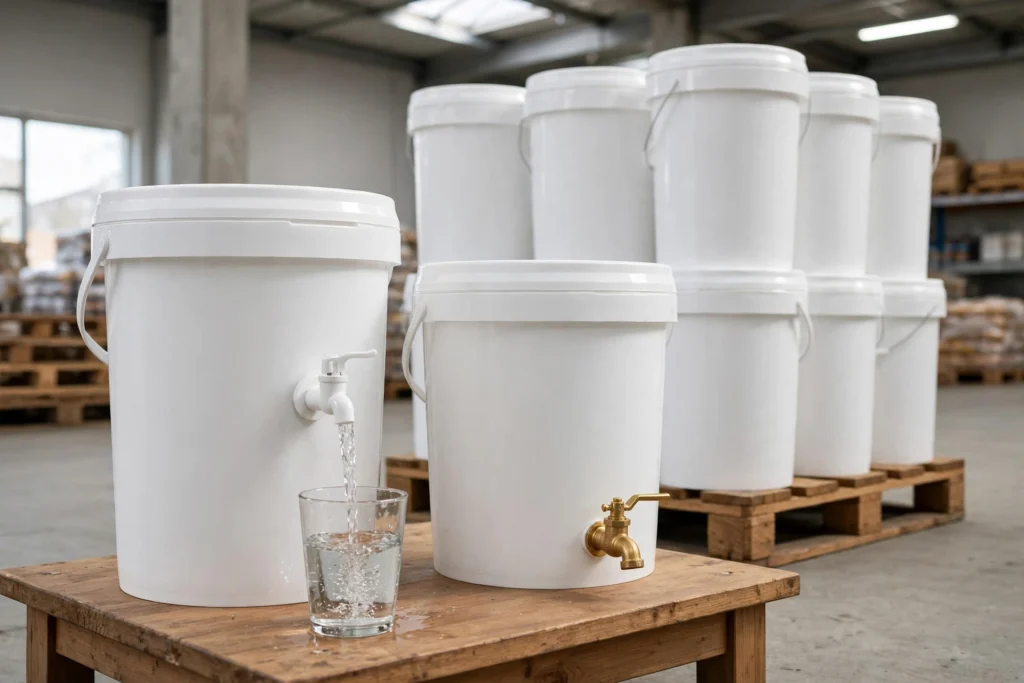
Buckets with spigots wholesale are food-grade HDPE pails bought by the case or pallet by camps, caterers, homebrew shops, beekeepers, and emergency-prep suppliers to dispense water, beverages, and honey without lifting or pouring. A valve fitted low on the bucket wall turns a storage pail into a gravity-fed dispenser — the 5-gallon size is the workhorse, holding about 42 pounds of water.
The spigot is a small fitting that changes what a bucket can do. Without one, every cup of water means lifting a 42-pound pail and pouring — fine once, miserable the fiftieth time, and impossible for a child, a guest, or a tired volunteer to do safely. With one, the bucket sits on a table and the liquid comes out at a turn of the wrist. That is why the same product shows up in five different buying worlds: a camp’s drinking-water station, a caterer’s lemonade table, a homebrew shop’s bottling shelf, a beekeeper’s honey room, and an emergency-prep warehouse. The buyers look alike — they all buy by the case or pallet — but they need different valves, different hole sizes, and different lids, and the wrong combination leaks. This guide covers which spigot fits which job, the sizes and weights that decide an order, how the valve is installed, and how to buy in bulk without stocking pails that drip.
Buckets with Spigots Wholesale: Sizes & What Each Holds
When you buy buckets with spigots wholesale, size is the first decision — and the mistake is buying by the bucket’s rated gallons instead of by the weight your crew can actually move and the volume your event actually serves. A full 5-gallon pail of water weighs about 45 pounds with the bucket, which is a comfortable two-handed carry and a safe load for a standard handle — per the ePackageSupply bucket weight guide, a standard bucket handle safely supports about 65–70 pounds. Buy the size your job actually dispenses — 2-gallon buckets in bulk suit small tables and classrooms — and check the water weight for your exact size before ordering a pallet.
| Size | Water it holds | Full weight (water + bucket) | Best bulk buyer |
|---|---|---|---|
| 1-gallon | ~8 lb | ~9 lb | Sample kits, retail counter sales, single-serve stations |
| 2-gallon | ~17 lb | ~18 lb | Classrooms, daycares, small catering tables |
| 3.5-gallon | ~29 lb | ~31 lb | Food trucks, market stalls, small events |
| 5-gallon | ~42 lb | ~45 lb | The all-rounder: camps, caterers, homebrew shops, emergency prep |
| 6.5-gallon | ~54 lb | ~57 lb | Homebrew bottling — the standard size for a 5-gallon batch |
| 7-gallon | ~58 lb | ~61 lb | Pallet-staged storage, high-volume dispensing stations |
Spigot Types Compared: Which Valve Fits Your Liquid
The valve is the product. Two buckets can be identical and still be wrong for the job if the spigot is wrong — a push-button tap that is perfect for a child’s handwashing station will clog on honey, and a honey gate will pour lemonade too fast to control. Match the valve to the liquid before you match the bucket to the valve.
| Spigot type | How it works | Mounting hole | Best for | Watch out for |
|---|---|---|---|---|
| Push-button / lever tap | Press or lift to open, spring closes | 1 inch | Drinking water, handwashing stations, camps | Small bore — slow for thick liquids; spring wears with heavy use |
| Quarter-turn ball valve | 90-degree handle, full flow | 1 inch | Beverages, iced tea, lemonade, general dispensing | Brass costs more; check it is lead-free for drinking water |
| Garden-hose thread spigot | Ball valve with 3/4-inch hose outlet | 1 inch | Garden watering, filling cans, draining rain barrels | Hose threads leak if the gasket is missing or cross-threaded |
| Honey gate | Wide slide gate, slow controlled flow | 1.75 inch | Honey bottling, thick syrups | Needs the wider hole — a 1-inch hole will not fit it |
| Bottling spigot with wand | Spring tip fills bottles from the bottom | 1 inch | Homebrew bottling, kombucha, wine | Needs a bottling wand; drips if the spring sticks |
Who Buys Spigot Buckets in Bulk — and What Each Buyer Needs
Camps, event operators & caterers
The biggest spigot-bucket buyers, and the ones where the valve choice is a service decision. A catered beverage table runs on 5-gallon buckets with lever taps or ball valves — iced tea, lemonade, and water, one bucket per drink, set on a table so guests serve themselves. The Carlisle 5-gallon beverage dispenser with its bottom-centered spigot and snap-on lid is the polished version of the same idea, and Cambro’s 6-gallon dispenser covers the larger table. For hot drinks, insulated dispensers with two-stage spigots run about $99–$105 for a 5-gallon unit — worth it when coffee or tea must stay hot through a four-hour service. Buy the bucket, the spigot, and the lid as a set, and test the seal on one case before the event order lands.
Emergency-prep suppliers & relief organizations
The buyer where the spigot is a safety feature, not a convenience. Ready.gov’s water storage guidance says to store at least 1 gallon of water per person per day for several days, for drinking and sanitation, and the CDC says to aim for a 2-week supply — a family of four needs 12 gallons for 3 days and 56 gallons for 2 weeks. A 5-gallon spigot bucket is the unit that makes that water usable: fill it, lid it, and when the tap stops, the family draws water a cup at a time without lifting 45 pounds or pouring into the dirt. Relief kits pair the bucket with a snap-on lid and a gamma seal lid for the long-stored pails — see our guide to gamma seal lids for the lid side of the same kit.
Homebrew shops & craft breweries
The buyer who treats the spigot as a tool, not a tap. A 6.5-gallon bottling bucket is the standard size for racking a 5-gallon batch — the extra 1.5 gallons leaves headspace above the spigot and room for the sediment to settle below it. The valve is a bottling spigot with a spring-tip wand that fills bottles from the bottom up, keeping oxygen out of the beer. For the fermentation side of the same shelf, see our guide to fermentation buckets — the bottling bucket is the second half of that workflow, and shops that stock one should stock the other.
Beekeepers & honey packers
The buyer with the widest valve in the range. Honey is too thick for a standard 1-inch tap, so honey buckets use a honey gate — a wide slide valve that mounts through a 1.75-inch hole and pours a slow, controlled stream into jars. Little Giant’s 5-gallon honey bucket ships with exactly that gate fitted. Order the gate and the bucket together: a gate bought separately needs the wider hole drilled, and a bucket drilled for a 1-inch spigot cannot take a honey gate without a second, larger hole. For the storage side of the same operation, see our guide to buckets for honey storage.
Farms, poultry keepers & handwashing stations
The buyer who puts the spigot to work outdoors. Poultry keepers fit buckets with gravity-fed drinkers so a flock waters itself for days from one 5-gallon pail, and schools, job sites, and disaster-relief teams build portable handwashing stations from a spigot bucket, a bar of soap in a stocking, and a foot pedal — the spigot is the tap, the bucket is the tank, and the whole station costs less than a single plumbed sink. For these buyers the valve must be food-grade plastic or lead-free brass, because the water is drinking water, and the bucket must be virgin HDPE — see our guide to HDPE buckets food grade explained for the #2 resin check.
The Water Math: How Many Spigot Buckets Does Your Job Need?
Spigot buckets are ordered by the person and the day, not by the pallet. Use the federal water-storage numbers before you order, because a water order that is short by two buckets is a family without drinking water.
| Need | Gallons | 5-gallon spigot buckets | What it means for your order |
|---|---|---|---|
| 1 person, 3 days (minimum) | 3 gal | 1 bucket | One bucket covers a single person for the federal minimum |
| 1 person, 2 weeks (goal) | 14 gal | 3 buckets | Three pails per person for the full two-week goal |
| Family of 4, 3 days | 12 gal | 3 buckets | Three pails, one per four gallons, with a little headroom |
| Family of 4, 2 weeks | 56 gal | 12 buckets | Twelve pails — a case-plus order, not a single bucket |
| 100-person camp, 1 day | 100 gal | 20 buckets | Twenty pails a day; refill stations beat single-use bottles |
| 50-guest event, beverages | ~25 gal | 5 buckets | About half a gallon per guest across water, tea, and lemonade |
Installing a Spigot: Hole Size, Gaskets & Leak Tests
A spigot bucket leaks at the gasket, never at the bucket. Get the hole and the seal right and the valve will hold for years; get either wrong and the pail drips from day one.
| Step | Spec | Why it matters |
|---|---|---|
| Hole diameter | 1 inch for standard spigots; 1.75 inch for honey gates | The spigot’s threaded stem must pass through with the gasket seated flat |
| Hole position | Low on the side wall, bottom of the hole at least 1 inch from the base | Clearance to tighten the nut and to fit a cup under the tap |
| Gasket | Rubber or silicone, one inside and one outside the wall | Compresses against the curved wall to make the watertight seal |
| Valve material | Food-grade plastic or lead-free brass | Brass is stronger; plastic resists corrosion from acidic liquids |
| Leak test | Fill with water, leave 24 hours on a dry surface | A slow drip shows up as a wet ring — catch it before the pallet ships |
Buying Buckets with Spigots Wholesale: What to Check First
Work through this checklist before you commit to a pallet. It catches the problems that only show up after the order lands.
- Food-grade resin: virgin HDPE (#2), BPA-free, certified for direct food contact under FDA rule 21 CFR 177.1520 — ask the supplier for the compliance statement.
- Valve matched to the liquid: lever tap for water, ball valve for beverages, honey gate for honey — a 1-inch spigot cannot serve thick liquids.
- Hole size on the order: 1 inch for standard spigots, 1.75 inch for honey gates — confirm which hole the bucket ships with before the pallet lands.
- Gaskets included: two per spigot, rubber or silicone — a spigot without gaskets is a leak, not a product.
- Lead-free brass: if you order brass valves for drinking water, confirm lead-free — brass is stronger, but only lead-free brass belongs in a water bucket.
- Lid included: every dispensing pail needs a lid — snap-on for service, gamma seal for long-stored water — order lids with the pails, in the same count.
- Wall thickness: 70–90 mil HDPE for daily commercial use; a full 5-gallon pail weighs about 45 lb with water.
- Size mix: 5-gallon is the default, 6.5-gallon for homebrew bottling, 2-gallon for small tables and classrooms, 7-gallon for high-volume stations.
- Flow check: gravity-fed spigots run fastest when the bucket is full and slow as the level drops — test the flow at half-full, not just at full.
- Case-pack math: small food-grade containers run about $2.34 each in a 120-unit case ($281.17 per case) — compare that against pallet-quoted 5-gallon pricing before you commit.
Spigot Bucket Specs at a Glance
The table below pulls published manufacturer specs for the two sizes spigot buyers order most, so you can compare any supplier’s quote against real numbers instead of marketing copy.
| Spec | 5-gallon spigot pail (typical) | 2-gallon spigot pail |
|---|---|---|
| Material | Virgin HDPE (#2), BPA-free | Virgin HDPE (#2), BPA-free |
| Wall | 70–90 mil (heavy-duty 90 mil) | 70–90 mil |
| Dimensions | ~12.3 in top dia × 10.4 in bottom dia × 14.6 in H | Not published — ask the supplier |
| Tare weight | ~973 g (about 2.1 lb) | Not published — ask the supplier |
| Full weight, water | ~45 lb | ~18 lb |
| Temperature range | −5°F to 160°F | −5°F to 160°F |
| Spigot hole | 1 inch (1.75 inch for honey gates) | 1 inch |
| Lid options | Snap-on, gamma seal, tamper-evident | Snap-on, gamma seal |
| Case pack | By the pallet | By the case or pallet |
Keeping It Safe: Food-Grade Rules, Cleaning & What Never Goes in a Spigot Bucket
A spigot bucket holds drinking water, so the safety bar is higher than for a storage pail. First, the resin: only virgin HDPE (#2) that is BPA-free and certified for direct food contact under the FDA food-contact rule for olefin polymers (21 CFR 177.1520) — check for the #2 recycling symbol and the cup-and-fork mark, and ask the supplier for the compliance statement. Second, the valve: food-grade plastic or lead-free brass only, with food-grade silicone gaskets — a garden-hose spigot from the plumbing aisle is not a drinking-water spigot unless it is rated lead-free. Third, the cleaning: the spigot is the dirtiest part of the bucket — its bore and seals trap biofilm that a rinse never reaches, so disassemble the valve, scrub the bore, and sanitize it on the same schedule as the bucket. Fourth, the temperature: HDPE pails are rated from −5°F to 160°F — never pour boiling water through a spigot bucket, and never store a spigot bucket in a hot vehicle. And two hard rules: never store fuel, solvents, or chemicals in a food-grade spigot bucket — one chemical fill ruins the pail for drinking water forever — and never use a spigot bucket for hot ash or charcoal, which melts through HDPE. Every spigot bucket also needs a lid that fits — see our guide to buckets with lids in bulk for the snap-on, gamma seal, and tamper-evident options that keep stored water clean. For the full step-by-step on washing food-grade pails, see our guide on how to clean food grade buckets — the same wash-and-dry discipline applies, plus a valve teardown.
Cleaning & Reusing Spigot Buckets
A spigot bucket is only as clean as its valve. Dump the pail completely, remove the spigot, and wash the valve bore and both gaskets with warm soapy water — a bottle brush reaches the inside of the tap where a sponge cannot. Rinse the inside wall, let the bucket and the valve dry fully before reassembly, and inspect the gaskets every wash: a flattened or cracked gasket is a leak waiting to happen, and gaskets are the cheapest part of the whole unit. Never swap a spigot between a water bucket and a chemical bucket — one valve, one liquid, for the life of the pail. Label every pail by its liquid with a marker or a tag; five identical white buckets are five chances to pour the wrong drink. For the food-grade side of the same material standard, see our guide to HDPE buckets food grade explained.
Frequently Asked Questions About Buckets with Spigots Wholesale
What size hole do I drill for a bucket spigot?
A standard bucket spigot needs a 1-inch diameter hole, drilled low on the side wall with the bottom of the hole at least 1 inch from the base. Honey gates are wider and need a 1.75-inch hole. Always check the spigot’s own spec before drilling — a hole cut too large cannot be shrunk.
Are buckets with spigots wholesale food grade?
The good ones are: virgin HDPE (#2 resin), BPA-free, and certified for direct food contact under FDA rule 21 CFR 177.1520. Check for the #2 recycling symbol and ask the supplier for the compliance statement — and make sure the spigot itself is food-grade plastic or lead-free brass.
How much water does a 5-gallon spigot bucket hold?
Five gallons, about 42 pounds of water, or about 45 pounds with the bucket. That is well inside a standard bucket handle’s ~65–70-pound safe limit, so one person can carry a full 5-gallon spigot bucket by the handle.
What size bucket is best for a water dispensing station?
A 5-gallon bucket is the standard for camps, caterers, and emergency prep — it holds about 42 pounds of water, serves roughly 40 cups, and stacks on a pallet. Use 2-gallon pails for classrooms and small tables, and 6.5-gallon pails for homebrew bottling.
How many spigot buckets do I need for emergency water storage?
Ready.gov says to store at least 1 gallon per person per day for several days, ideally a 2-week supply. A family of four needs 12 gallons for 3 days — three 5-gallon spigot buckets — and 56 gallons for 2 weeks, or twelve buckets.
Can I put a spigot in any 5-gallon bucket?
Yes, if the bucket is food-grade HDPE and the wall is thick enough to hold the gasket seal — 70–90 mil walls work. Drill a 1-inch hole low on the wall, fit the spigot with a rubber or silicone gasket inside and out, and leak-test it full for 24 hours before use.
Where can I buy buckets with spigots wholesale?
Order by the case or pallet from a US bucket supplier, and confirm the resin grade, valve type, hole size, and gasket count before committing. Small food-grade containers run about $2.34 each in a 120-unit case, while 5-gallon pails are quoted by the pallet. Request a quote for delivered pallet pricing.
Get Buckets with Spigots in Bulk from ThoseBucketPeople
Whether you run a camp, a catering business, a homebrew shop, a beekeeping operation, or an emergency-prep warehouse, we supply the buckets commercial buyers actually use — including 5-gallon buckets for water and beverage dispensing, 2-gallon buckets for small tables, and spigots and lids to match. When you buy buckets with spigots wholesale from ThoseBucketPeople, request a quote through our Get a Quote page or contact us for volume pricing and delivery options.