
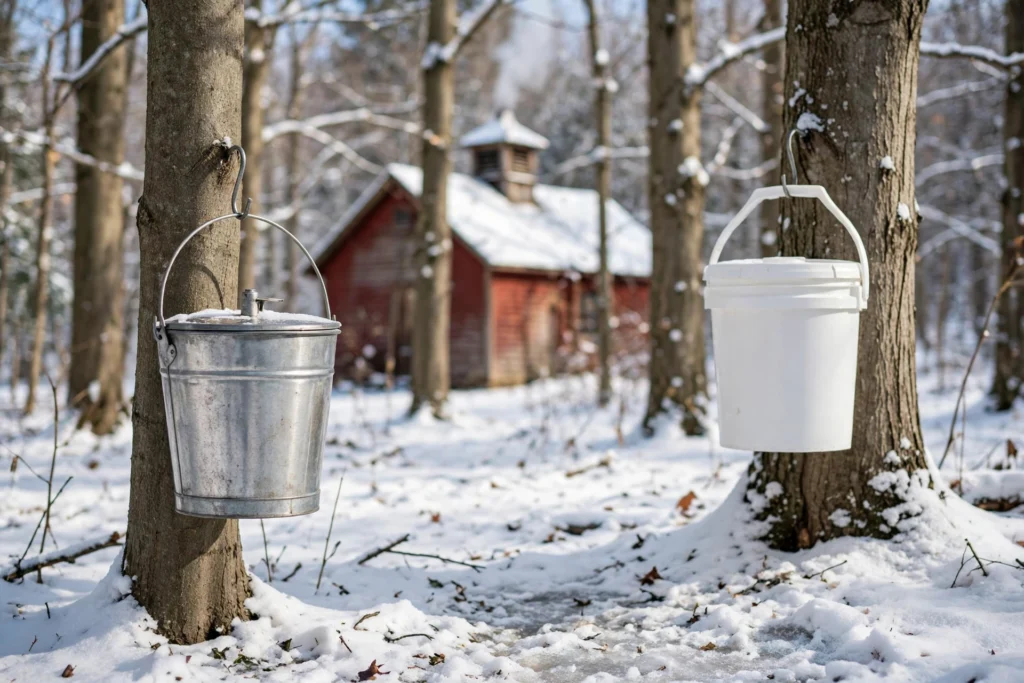
For maple syrup buckets wholesale, buy food-grade plastic or aluminum 2-gallon hanging buckets for traditional single taps, and food-grade 5-gallon buckets set at the base of multi-tap trees for tubing collection, each with a matched lid. Avoid galvanized and non-food-grade buckets entirely, because lead and off-flavors can ruin a season’s syrup.
Sap runs in late winter, when freezing nights and thawing days push sap up the tree. That short, weather-driven window is why bucket choice matters more than it looks. The wrong bucket leaks, tips, lets in rain and insects, or taints the sap — and sap is mostly water, so roughly 40 gallons of it must be boiled down to make a single gallon of syrup. Every gallon lost to a bad container is hours of boiling wasted.
This guide is written for maple producers, sugarbushes, farm stores, and maple equipment dealers buying maple syrup buckets wholesale. It covers the two collection systems, the food-safety rules that decide what a sap bucket may be made of, how to size an order by tap count, and how to clean buckets so they last season after season.
Maple Syrup Buckets Wholesale: The Two Collection Systems
Most wholesale orders fall into one of two systems, and mixing them up is the most common buying mistake. The hanging-bucket system is traditional: one bucket hangs from a spout hook on each tap. The tubing-bucket system runs short lengths of food-grade tubing from one to three taps into a single larger bucket at the base of the tree.
The hanging system suits small to mid-size sugarbushes, roadside trees, and producers who value simplicity and the classic look that visitors expect. The tubing-bucket system suits larger trees and producers who want fewer containers to empty on a sap run. Both still need the same thing: a food-grade bucket, a lid that fits it, and a spout made for that system.
Comparison Table: Maple Syrup Buckets Wholesale Options at a Glance
| System | Bucket size | How it collects | Best wholesale buyer |
|---|---|---|---|
| 2-gallon hanging bucket | 2 gallons | Hangs from a hook spout on one tap | Small sugarbushes, hobby producers scaling up, farm stores |
| 5-gallon tubing bucket | 5 gallons | Sits at the tree base; tubing from 1–3 taps feeds it | Mid-size sugarbushes (50–500 taps), multi-tap trees |
| 5-gallon storage bucket | 5 gallons | Holds gathered sap before boiling | Any producer needing covered, food-grade holding capacity |
| Sealed 5-gallon bucket with gamma seal lid | 5 gallons | Airtight, screw-on reseal for stored goods and supplies | Sugarhouses storing dry goods, finished-product handling, and supplies |
What Makes a Bucket Safe for Sap
Sap becomes food, so the bucket standard is stricter than for a general-purpose pail. The University of Maine Extension maple quality guide is blunt: avoid non-food-grade plastic buckets and galvanized metal buckets for collection, because galvanized buckets very commonly contain lead that is likely to leach into the sap. Old tin spouts carry the same lead warning and should be avoided too.
Food-grade plastic buckets are the workhorse choice for maple syrup buckets wholesale. Look for virgin HDPE (resin code #2) or another explicitly food-grade plastic, FDA-compliant and BPA-free, the same standard used for food-grade storage across this site’s guides. Aluminum buckets are the other accepted traditional option in the University of Maine Extension’s 50-to-500-tap equipment guide, which lists food-grade plastic or aluminum as the bucket materials for 2-gallon sap systems.
Previous use matters as much as material. Extension warns that buckets once used for strong-smelling or flavored foods — pickles, grape juice, even vanilla frosting — will likely impart off-flavors into the sap, and that used food-grade buckets may have been used for non-food purposes. When buying used buckets, ask about past uses before you buy. A cheap used bucket with an unknown history is the most expensive bucket in the sugarbush if it taints a batch.
If you already own galvanized buckets, Extension notes that food-grade plastic sap-bucket liners can create a barrier between the sap and the metal. Liners are a stopgap, not a wholesale strategy: for a new bulk order, buy food-grade buckets outright and skip the liner workaround.
Sizing Your Order: Taps, Trees, and Sap Volume
Order by taps, not by guesswork. The University of Maine Extension’s 50-to-500-tap equipment guide sets the tap rules by trunk diameter at breast height: trees should be at least 10 inches in diameter before tapping, over 18 inches before a second tap, and over 25 inches before a third — and never more than three taps per tree.
That rule drives the bucket count directly. A 100-tap sugarbush on mostly single-tap trees needs roughly 100 hanging buckets, plus spares for breakage and for trees that get a second tap. A sugarbush with many large trees can cut its container count with the 5-gallon base-bucket system, since one 5-gallon bucket serves up to three taps on one tree — but it still needs one bucket per multi-tap tree, securely supported so melting snow on sap-run days does not tip it over.
Sap volume decides storage, not just collection. Extension advises planning for 1 to 2 gallons of sap per tap per day, and sizing storage for the days between boils. Its worked example is worth copying into your order sheet: 3 days of sap at 1.5 gallons per tap across 30 taps needs 135 gallons of storage capacity. A producer who boils once a week, gambling on no more than three sap runs that week, needs that full capacity in covered, food-grade vessels before the season starts.
Use the same arithmetic for maple syrup buckets wholesale orders: count taps, apply the diameter rule, add 10–15 percent spares for cracked lids and dropped buckets, then size storage separately. Storage buckets are not the same line item as collection buckets, and running short on either one mid-season means sap sitting warm — which brings us to handling.
Sap Handling: Keep It Cool, Covered, and Moving
Extension’s quality guide states the handling rule in one sentence: gather sap promptly, especially when temperatures are above freezing, because fresh, clean sap kept cool during collection and before boiling produces the highest quality syrup. Sap behaves like milk. Left warm in the sun, it sours, ferments, and darkens the finished syrup.
Cover every bucket. Lids made for the buckets you use keep rainfall, snowmelt, insects, and debris out of the sap — and for 5-gallon tubing buckets, drill the tubing holes toward the top of the bucket’s sides, not in the lid, so rain and melting snow cannot drain straight in. Filter gathered sap to remove bark and wood shavings before it reaches storage or an evaporator.
Ideally, sap is boiled the day it is collected. When that is not possible, keep storage on the north or northwest side of the sugarhouse, out of direct sun, under a roof or loose cover, and as cool as possible. Ice that forms in sap buckets can help keep sap cool, and some producers invest in dairy chilling tanks for concentrated sap. What you must not do is let sap sit for days in warm weather in an uncovered container and expect good syrup from it.
Lids, Spouts, and Accessories to Order Together
A wholesale bucket order that forgets the accessories stalls on the first tapping day. Order these as matched sets, not afterthoughts.
First, spouts must match the system. Traditional 2-gallon hanging buckets need spouts with a hanger hook to hang the bucket from. Tubing systems need barbed tubing spouts sized for 5/16-inch inside-diameter food-grade maple tubing. Current guidelines recommend 5/16-inch tapholes and spouts; older 7/16-inch spouts cause more tree damage, and Extension recommends the 5/16-inch size for most producers.
Second, lids must be made for the exact buckets ordered. A lid that almost fits is a lid that blows off in wind or lets in rain. Choose a system that is easily removed and reinstalled, because crews empty buckets many times a day during a good run. For sealed storage of dry goods and supplies in the sugarhouse, gamma seal lids on 5-gallon buckets give an airtight, screw-on reseal that snap lids cannot match — see our gamma seal lids guide for sizing.
Third, support and transport gear completes the order: sturdy handles for carrying full buckets (a full 5-gallon bucket of sap weighs over 40 pounds), a food-safe pump if sap is collected at a central point away from the sugarhouse, and covered food-grade storage vessels for the gap between collection and boiling. Ordering buckets, lids, spouts, and tubing from one supplier avoids the fit surprises that come from mixing brands.
Buckets vs Tubing vs Bags: Which System Should a Wholesale Buyer Choose?
Full tubing networks with mainlines save the most collection labor at scale, and Extension notes they can increase yields by keeping tapholes open longer. But they demand design work — slope, mainline sizing, vacuum decisions — and they are a different purchase from buckets. Sap bags, hung from a bracket on a specialized spout, are a newer lightweight option that slides in and out easily for collection.
For a wholesale buyer, the decision is practical. Buckets win where trees are scattered, access is by foot or sled, the producer sells the traditional experience, or the tap count is in the 50-to-500 range that Extension’s equipment guide targets. Tubing wins where trees are dense, terrain allows a downhill run to a central tank, and labor savings justify the infrastructure. Many mid-size producers run both: buckets on roadside and scattered trees, tubing on the dense stand.
Whatever system you choose, the bucket standard does not change. Food-grade material, a matched lid, a known previous use, and enough capacity for 1 to 2 gallons per tap per day are the four tests every container in the sugarbush must pass.
Cleaning and End-of-Season Care for Maple Syrup Buckets Wholesale
Clean buckets make better syrup, and Extension calls cleanliness the most important contributor to maple syrup quality. Microorganisms on unclean equipment grow rapidly in sap and affect both color and flavor — and anything added to sap, even in minute quantities, becomes concentrated as sap is boiled to syrup.
Scrub buckets and pails thoroughly by hand or machine with hot water at the end of the season, so next year’s work starts clean and soap residues are fully removed. If a sanitizer is used, Extension allows one part unscented household chlorine bleach to 20 parts clean water for rinsing, followed by thorough rinsing with warm potable water — triple-rinse with warm potable water is the stated rule. Avoid scented soaps entirely; fragrance and detergent residues ruin syrup flavor and can make it unsaleable.
Do the cleaning at the end of the season, not at the start of the next one. That habit prevents metal deterioration on aluminum buckets, removes soap residues before they set, and means the first sap run of the year goes into clean containers. Spouts and droplines should be replaced about every 3 years under Extension’s quality guidance, since new or sanitized spouts keep tapholes open longer and raise yields. Store clean, dry, lidded buckets stacked out of sunlight, and inspect each one before tapping: cracked plastic and dented aluminum that will not seal should be retired, not pressed into service.
Buying Checklist for Maple Syrup Buckets Wholesale
Use this checklist before placing a bulk order, and keep it with the quote request:
- Tap count and tree diameters confirmed, with the 10 / 18 / 25-inch rule applied — this sets the bucket count.
- System chosen per stand: 2-gallon hanging buckets, 5-gallon tubing buckets, or a mix — with matching spouts for each.
- Material confirmed food-grade: virgin HDPE (#2) or aluminum, FDA-compliant, BPA-free; no galvanized, no non-food-grade plastic, no unknown previous use.
- Lids matched to the exact buckets ordered, easily removed and reinstalled, with side-drilled tubing holes on 5-gallon base buckets.
- Storage sized at 1 to 2 gallons per tap per day for the days between boils, in covered food-grade vessels.
- Spares added: 10–15 percent extra buckets and lids for breakage, plus replacement spouts on the 3-year cycle.
- Supplier asked about past uses (for used buckets), matched sets (buckets plus lids plus spouts), and delivery timing before the tapping season.
Frequently Asked Questions
How many taps can I put in one maple tree?
Tap only trees at least 10 inches in diameter at breast height, add a second tap only over 18 inches, and a third only over 25 inches. Never install more than three taps per tree, whatever its size.
Can I use regular hardware-store buckets for maple sap?
No. Non-food-grade plastic buckets are not safe for sap collection, and Extension warns they may also carry unknown previous contents. Buy buckets explicitly sold as food-grade, and ask about past uses for any used bucket.
Why are galvanized buckets bad for maple syrup?
Galvanized buckets very commonly contain lead in the metal and solder, and that lead is likely to leach into the sap. Food-grade plastic or aluminum buckets avoid the risk; plastic liners are only a stopgap for buckets you already own.
How much sap does one tap produce per day?
Plan for 1 to 2 gallons of sap per tap per day. Size both collection and storage around that figure, and remember that a heavy run can fill a 2-gallon hanging bucket fast, so crews should empty buckets promptly.
How long can sap sit before boiling?
Ideally, boil sap the day it is collected. Sap sours like milk in warm weather, so keep it cool, covered, and moving; sap left warm for days produces darker, lower-grade syrup with off-flavors.
How much sap makes a gallon of maple syrup?
About 40 gallons of sap, varying with sugar content — some Extension sources cite 43 gallons or more. Maine regulations require syrup sold there to measure between 66 and 68.9 degrees Brix, so a hydrometer or refractometer, not guesswork, decides when boiling is done.
Should I buy 2-gallon or 5-gallon maple syrup buckets wholesale?
Buy 2-gallon hanging buckets for traditional single taps and scattered trees, and 5-gallon food-grade buckets at the base of large multi-tap trees or for storage. Most mid-size sugarbushes order both, with lids and spouts matched to each size.
Get Maple Syrup Buckets Wholesale from ThoseBucketPeople
Whether you run a 50-tap sugarbush or a 500-tap operation, we supply the buckets commercial buyers actually use — 2-gallon buckets for hanging systems, 5-gallon buckets for tubing and storage, and lids to match, in bulk quantities with nationwide delivery. Request a quote through our Get a Quote page or contact us for volume pricing and delivery options. For the smaller size in detail, see our guide to 2-gallon buckets in bulk, and for sealed storage in the sugarhouse, see our gamma seal lids guide. Producers handling other food liquids may also find our buckets for honey storage guide useful for comparison.